How to Choose a High-Performance Press Brake Machine: A Practical Buying Guide for 2026
Table of Content
This post is also available in:
When buyers ask MECA to recommend a press brake, they often begin with only two specifications:
“I need a 100-ton, 2,500 mm press brake.”
However, tonnage and working length alone are not enough to select the right machine.
Before recommending a model, we normally ask about the material, thickness, bending length, smallest flange, required inside radius, part shape, production frequency and expected accuracy. These details can change the required tonnage, tooling, machine type and CNC configuration.
A high-performance press brake is not necessarily the machine with the highest specifications. It is the machine that matches your actual parts, production volume and budget without adding unnecessary cost or limiting future work.
This guide explains the practical selection process MECA uses when helping customers compare torsion-bar, electro-hydraulic servo and all-electric press brakes.
1. List Your Parts Before Choosing a Machine
Selecting a press brake is relatively straightforward if you produce only one type of part. Most workshops, however, process many materials, thicknesses and part sizes.
Before requesting a quotation, create a list containing the main information for each important part.
| Information | Why it matters |
|---|---|
| Material | Different materials require different bending forces |
| Material thickness | Directly affects tonnage and tooling |
| Bending length | Determines total bending force and machine length |
| Smallest flange | Limits the practical V-die opening |
| Required inside radius | Influences tooling selection and bending force |
| Part shape | Affects daylight, stroke, throat depth and axis configuration |
| Number of bends | Helps evaluate programming and production efficiency |
| Production frequency | Shows which parts should determine the main machine configuration |
| Required tolerance | Helps determine the synchronization, CNC and crowning requirements |
Calculate the tonnage requirement for each important part instead of calculating only the thickest sheet.
This helps identify:
- Which parts represent normal daily production
- Which parts approach the machine’s capacity
- Which parts require special tooling
- Which parts are produced only occasionally
- Whether one machine can reasonably cover the complete product range
You can use the MECA Press Brake Tonnage Calculator to estimate the force required for each part.
For complex products, send representative drawings to the supplier. The smallest flange, bend sequence and required radius may be just as important as the material thickness.
2. Consider Production Frequency, Not Only the Maximum Part
A common purchasing mistake is to configure the entire machine around a part that is produced only a few times per year.
Suppose a customer bends 1–2 mm sheet every day, with a maximum working length of 1,300 mm, but occasionally needs to bend 3 mm material.
It may not be sensible to purchase a large, heavy hydraulic machine solely for the occasional 3 mm job. A properly selected smaller machine may handle both the daily production and the occasional heavier work more efficiently.
Consider another example:
A customer needs to bend 3 mm galvanized steel with a maximum bending length of 1,000 mm.
With a suitable V-die opening and conventional air bending, a 40-ton press brake will generally provide reasonable capacity. There is usually no need to upgrade to a much larger hydraulic machine simply because the buyer is worried about insufficient tonnage.
However, this does not mean every 3 mm, 1,000 mm workpiece should automatically be assigned to a 40-ton machine.
The required force may increase substantially if the same part requires:
- A very small inside radius
- A particularly short flange
- A narrow V-die opening
- Bottom bending instead of air bending
- High-strength material
- Special forming or hemming
The practical rule is therefore not:
“Three-millimeter sheet always requires a 40-ton machine.”
The correct rule is:
“Tonnage must be calculated according to the material, bending length, tooling and forming requirements.”
The machine should primarily match the parts that generate most of your production while retaining reasonable capacity for occasional work.
3. Calculate Tonnage With the Actual V-Die Opening
The required bending force depends on:
- Material tensile strength
- Material thickness
- Bending length
- V-die opening
- Bending method
- Required inside radius
A smaller V opening generally produces a smaller inside radius and allows a shorter flange, but it also requires more bending force.
This is why a tonnage calculation cannot be separated from tooling selection.
For example, when evaluating 6 mm mild steel over a length of 2,500 mm, the required tonnage may change significantly depending on whether the part is bent with a V48, V50 or larger die opening.
If the drawing allows a larger inside radius and flange, a larger V opening may reduce the tonnage requirement. If the part requires a small radius or short flange, a smaller opening and a larger machine may be necessary.
Before selecting between a 110-ton and 135-ton machine, confirm:
- The actual material strength
- The acceptable inside radius
- The smallest flange
- The proposed V-die opening
- Whether the process uses air bending, bottom bending or another method
Do not add an arbitrary safety margin before these conditions have been confirmed. Excessive oversizing increases the machine price, tooling load, power demand and floor-space requirements.
4. Choose the Machine Type According to Your Budget and Production Requirements
After calculating the required tonnage range, the next decision is whether to purchase a torsion-bar, electro-hydraulic servo or all-electric press brake.
Technically, a torsion-bar press brake is also hydraulically driven. In purchasing discussions, however, “hydraulic press brake” often refers to an electro-hydraulic servo machine with independent Y1/Y2 closed-loop control.
Torsion-Bar Press Brake
A torsion-bar press brake is normally the least expensive option.
The left and right sides of the ram are mechanically synchronized by a torsion shaft. Most torsion-bar machines do not have independently controlled Y1 and Y2 axes with automatic real-time correction.
This type of machine may be suitable when:
- The purchase budget is limited
- The workpieces are relatively simple
- Production volumes are moderate
- Angular and dimensional tolerances are not especially demanding
- Operators can make manual adjustments when material conditions change
It can be a practical choice for general fabrication, repair work and cost-focused production.
However, a torsion-bar machine should not be compared directly with an electro-hydraulic servo machine using only tonnage and working length.
Electro-Hydraulic Servo Press Brake
An electro-hydraulic servo press brake uses independent Y1/Y2 position measurement and closed-loop hydraulic control.
This configuration covers a wide range of tonnages, lengths and applications. It generally provides a good balance between capacity, accuracy, flexibility and investment cost.
It is suitable for:
- General sheet-metal production
- Medium and heavy bending
- Workpieces with varying materials and thicknesses
- Applications requiring better ram parallelism
- Multi-axis backgauge configurations
- Long workpieces requiring CNC crowning
- Customers who need one versatile machine for different products
For this reason, electro-hydraulic servo machines remain the most practical choice for a large proportion of press brake users.
MECA currently focuses its servo-hydraulic range mainly on applications from approximately 110 to 600 tons, including standard, heavy-duty and tandem configurations.

All-Electric Press Brake
An all-electric press brake uses a servo-electric drive and does not require a conventional hydraulic power system.
Its main advantages include:
- No hydraulic oil
- Lower operating noise
- Fast response
- Stable repeated movement
- Reduced routine hydraulic maintenance
- Good suitability for frequent batch production
The initial price of an all-electric machine can be higher than that of an economical hydraulic or torsion-bar machine with similar nominal capacity.
It is especially suitable for customers who value:
- Batch-to-batch stability
- Frequent product changes
- Precision production of small and medium parts
- Lower operating noise
- A cleaner production environment
- Reduced hydraulic maintenance
MECA generally recommends its 40–80T all-electric range for cabinets, enclosures, kitchen equipment, metal furniture and precision sheet-metal parts.
For applications above this practical range, a servo-hydraulic machine usually provides greater capacity and configuration flexibility.
Practical Comparison
| Machine type | Initial price | Accuracy and repeatability | Capacity range | Best suited to |
|---|---|---|---|---|
| Torsion-bar | Lowest | Suitable for general work | Small to medium | Budget-focused buyers with moderate accuracy requirements |
| Electro-hydraulic servo | Medium to high | Good closed-loop control | Wide | Most general, medium and heavy-duty applications |
| All-electric | Usually higher at comparable small tonnage | Strong batch consistency | Mainly small to medium | Precision parts, frequent batches and low-maintenance production |
This price order is not absolute. A high-specification hydraulic machine with an advanced CNC, multiple axes, hydraulic clamping and a complete safety package may cost more than a standard all-electric model.
5. Compare the Actual Machine Structure, Not Only the Model and Price
Two suppliers may both quote a “110T/2500 CNC press brake,” but the machines may have different structures, processing ranges and long-term performance.
Important specifications include:
- Frame plate thickness
- Worktable thickness and width
- Ram dimensions
- Distance between frames
- Throat depth
- Maximum daylight
- Ram stroke
- Overall machine weight
- Available tooling height
Frame thickness is worth comparing, particularly when evaluating machines of the same nominal capacity. A more substantial structure can provide a better basis for controlling deformation under load.
However, thickness alone does not prove that one machine is better. The frame design, reinforcement position, material, welding process, stress-relief treatment and machining accuracy must also be considered.
At MECA, we normally encourage customers to compare the frame and worktable specifications together with actual bending results. A heavier structure should have a clear functional purpose rather than being used only as a larger catalogue number.

Distance Between Frames
The distance between the side frames can determine whether a box-shaped or wide workpiece can be positioned correctly.
A machine may have a 2,500 mm working length but a much smaller distance between frames. If the workpiece must pass between the frames, this difference becomes critical.
Daylight and Stroke
Check the daylight and stroke carefully when using:
- Tall punches
- Large multi-V dies
- Special forming tools
- Deep boxes
- High tool holders
- Hydraulic clamping systems
Always calculate the complete tooling stack. Do not assume that two machines with the same tonnage and working length can accept the same tooling.
6. Compare Component Models, Not Only Component Brands
Component brands affect machine price, reliability and service availability, but a brand name alone is not enough to evaluate a quotation.
Buyers sometimes ask:
“Which is more expensive, HAWE or Bosch Rexroth hydraulic components?”
There is no fixed answer without comparing the exact model, flow, pressure and control method. The same brand may offer different product series and configurations.
This means two quotations that both mention “HAWE hydraulics” may still contain significantly different components, performance levels and costs.
If the destination market requires CE conformity, also confirm whether the quotation includes the required hydraulic safety circuit, monitoring functions and technical documentation. These features can increase the machine cost, but buyers do not need to select a higher configuration than their market and application require.
Ask the supplier to identify the brands and exact models of the core components, and then compare them according to your processing requirements and budget.
Press Brake Configuration: Why Similar Machines Have Different Prices

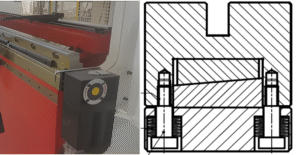
7. Consider CNC Crowning for Machines Longer Than 2,000 mm
As bending length increases, the elastic deflection of the ram and worktable becomes more noticeable.
For press brakes with a working length above approximately 2,000 mm, the crowning system should be discussed carefully, especially when the customer expects consistent angles along the complete part.
Some traditional or entry-level machines still use manual crowning. The operator adjusts the compensation based on experience and test bends.
On many current CNC press brakes manufactured in China, CNC-controlled mechanical crowning has become a common configuration. The CNC system calculates or recalls the compensation value and adjusts the crowning system automatically.
This can provide several practical benefits:
- Less dependence on manual adjustment
- Faster setup when changing materials or thicknesses
- Better consistency along long workpieces
- Easier reuse of saved programs
- Fewer trial bends
CNC mechanical crowning is sufficient for many general and precision applications.
Hydraulic crowning may also be considered for selected heavy-duty or variable-load applications, but it should not automatically be assumed to be more accurate.
The final decision should be based on:
- Working length
- Tonnage
- Material variation
- Required angular tolerance
- Type of workpiece
- Actual full-length bending results
For a short machine processing small parts, an expensive automatic crowning system may provide limited value. For a 2,500 mm, 3,200 mm or longer machine, omitting crowning can create a much more obvious production problem.
8. Choose Only the CNC Axes You Actually Need
More CNC axes provide greater flexibility, but every additional axis also increases the machine price and programming complexity.
Common press brake axes include:
- Y1/Y2: Independently control the left and right sides of the ram
- X: Controls the front-to-back movement of the backgauge
- R: Controls the vertical movement of the backgauge fingers
- Z1/Z2: Independently control the horizontal positions of the left and right fingers
- X1/X2: Provide independent depth positioning for tapered or asymmetrical parts
- Crowning axis: Allows the CNC system to adjust the crowning value automatically
For simple straight bends with consistent flange dimensions, Y1/Y2 and X-axis control may be sufficient.
Add an R axis when different bending steps require different backgauge heights.
Z1/Z2 axes are useful when:
- Workpiece widths change frequently
- Different sections of a part require different finger positions
- The operator would otherwise need to move the backgauge fingers manually
- Complex box parts are produced in small batches
X1/X2 and more advanced backgauge configurations may be required for tapered, angled or asymmetrical parts.
A six-axis machine is not automatically more accurate than a four-axis machine. Additional axes mainly improve positioning flexibility and reduce manual setup.
Before paying for more axes, identify which parts will use them and how often.
9. Match the CNC Controller to the Programming Work
The CNC controller should be selected according to part complexity and the operator’s workflow.
A more expensive controller does not directly improve the mechanical accuracy of the press brake. Its main value lies in programming, visualization, axis management and production efficiency.
For example:
- Simple parts and experienced operators may only require a basic graphical controller
- A controller such as the Delem DA-53TX is practical for multi-axis control and 2D graphical programming
- Complex box parts and frequent product changes may benefit from the 3D programming and collision simulation available on the DA-66T or DA-69T
- Customers who prepare programs in the office should confirm offline software, licence costs and file-transfer methods
MECA can provide different CNC options, but we do not recommend selecting a controller simply because it is the highest model in the catalogue.
The most suitable controller is the one your operators can use efficiently for the parts you actually produce.
10. Configure the Tooling Together With the Machine
Tooling affects tonnage, inside radius, minimum flange size and finished-part quality.
Before ordering, confirm:
- Required punch angle
- Punch-tip radius
- V-die openings
- Tool segmentation
- Tool load capacity
- Tool height
- Clamping type
- Whether special forming or hemming tools are required
For example, a four-V die provides flexibility for different material thicknesses, but it is larger and heavier than a single-V die. The die holder, daylight and operating method should therefore be considered together.
Quick clamping is valuable when tools are changed frequently. Hydraulic clamping may further reduce setup time, but it may not be necessary for a workshop that uses the same tooling most of the day.
A machine quotation should not be finalized before the supplier has reviewed the representative parts and proposed the appropriate tooling.
11. Confirm the Safety Configuration for the Destination Market
Safety configuration can create a significant price difference between two machines that otherwise appear similar.
If the destination market requires CE conformity, confirm which protective devices, electrical standards and technical documents are included in the quotation.
A CE label alone does not prove that the machine has a complete CE safety configuration.
The safety package should match the destination market’s requirements and the customer’s working conditions rather than being treated as a cosmetic option.
12. Compare Quotations Line by Line
Do not compare press brake quotations using only the model name and total price.
Two quotations for the same nominal machine may differ in:
- Torsion-bar or Y1/Y2 electro-hydraulic synchronization
- Standard or servo-driven main motor
- CNC brand and exact model
- Number of CNC axes
- Manual or CNC-controlled Z1/Z2 positioning
- Manual or CNC crowning
- Backgauge construction
- Component brands and models
- Standard or CE-oriented safety configuration
- Manual, mechanical or hydraulic tool clamping
- Tooling quantity and specifications
- Electrical standard
- Installation and commissioning
- Training
- Spare parts
- Warranty and technical support
The most reliable comparison method is to place all quotations into the same configuration table.
If one supplier’s price is substantially lower, identify which component, axis, safety function, tooling package or service has been removed before assuming that the machines are equivalent.
13. Ask for Evidence Before Placing the Order
A high-performance component list can make a quotation look impressive, but the finished part is the real test of machine performance.
Before ordering, ask the supplier to provide or demonstrate:
- A bending test using representative material
- Several consecutive parts for checking repeatability
- A long workpiece for checking angle consistency
- Backgauge positioning and repeated movement
- Tool installation and program setup
- Frame manufacturing and machining
- Assembly and electrical wiring
- Final machine inspection
- CNC and electrical backup files
- Remote troubleshooting procedures
- Spare-parts availability
At MECA, we recommend that customers send their material information and representative drawings before the machine configuration is finalized. This allows the tonnage, tooling, CNC axes and safety package to be reviewed as one complete solution.
Final Press Brake Selection Checklist
Before placing an order, confirm the following:
- Have all important parts been listed?
- Has tonnage been calculated separately for each main part?
- Have normal production parts been separated from occasional maximum parts?
- Has the V-die opening been confirmed?
- Is the selected machine type appropriate for both the budget and accuracy requirement?
- Have the frame, worktable, daylight, stroke and distance between frames been compared?
- Are the exact component brands and models identified?
- Is CNC crowning required for the working length and accuracy target?
- Will every purchased CNC axis be used by actual parts?
- Does the CNC controller match the operator’s programming needs?
- Has the tooling been selected together with the machine?
- Does the safety configuration meet the destination market’s requirements?
- Have competing quotations been compared line by line?
- Have the bending test and acceptance conditions been agreed?