Why Do Some Press Brakes Have the Same Configuration But Vastly Different Prices?
Table of Content
This post is also available in:
When comparing a press brake configuration, buyers often face a confusing situation: two machines appear to use almost the same components, yet their prices can differ by thousands of dollars. They may list the same CNC controller brand, similar hydraulic components, familiar electrical brands and even the same motor name — yet their prices can differ by thousands of dollars.
Why?
One important reason is that:
The same configuration description does not always mean the same component value.
A familiar brand name may represent different product series, manufacturing locations, technical standards or actual component combinations.
In some cases, simplified marketing descriptions can also make two different configurations appear more similar than they really are.
A common example in the press brake industry is the main motor.
Some quotations simply state:
Siemens Motor
or
Siemens BEIDE Motor
To an international buyer, these descriptions may sound almost interchangeable.
But they should not automatically be understood as the same product, the same manufacturing origin or the same procurement cost.
This does not mean that BEIDE is a poor motor.
BEIDE motors are widely used in industrial machinery and can be a reliable and cost-effective choice for hydraulic press brakes.
The real issue is transparency:
Buyers should know exactly which component is installed on the machine and what they are paying for.
A Configuration Sheet Is Only the Starting Point
A press brake quotation usually contains a list of major components.
That list is useful — but a brand name alone is often not enough to determine the real configuration.
| Quotation Says | What Buyers Should Verify |
|---|---|
| Siemens Motor | Exact brand, series, model and manufacturing origin |
| Rexroth Hydraulic System | Which pump, valves or hydraulic components are actually Rexroth |
| Schneider Electrical Components | Which specific electrical components use Schneider |
| Delem Controller | Controller model, axes and required modules |
| Servo System | Main drive servo system or only servo-driven back gauge |
| CE Configuration | Which safety systems and monitored functions are included |
| European Components | Exact brand, model and manufacturing origin |
This is one reason two quotations can look very similar while representing significantly different procurement costs.
Siemens and BEIDE: A Good Example
The historical relationship between Siemens and BEIDE explains why the two names are often seen together in Chinese machinery quotations.
Official Siemens Standard Motors Ltd. documentation stated that its Yizheng, Jiangsu operation produced Siemens-brand low-voltage motors according to IEC standards as well as BEIDE-brand low-voltage motors designed according to Chinese local standards.
This historical relationship helped make the term “Siemens BEIDE” common in the Chinese machinery industry.
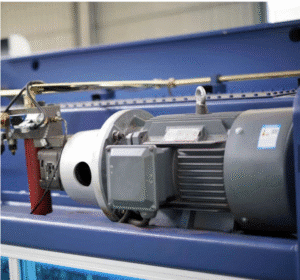
However, buyers should distinguish three separate concepts:
Brand Origin
Where the brand or technology originated.
Manufacturing Origin
Where the actual component supplied with the machine was manufactured.
Product Specification
The exact series, model, standard, efficiency level and certification of that component.
These are not interchangeable.
Brand Origin ≠ Manufacturing Origin ≠ Product Specification
For example, describing a component as a “German brand” does not automatically mean that the specific component installed on the machine was manufactured in Germany.
That distinction matters when customers are comparing both machine configuration and price.
What Is BEIDE Today?
The corporate background has also changed.
According to the current official BEIDE website, Innomotics Standard Motors Ltd., formerly Siemens Motor (China) Co., Ltd., officially changed its name in May 2024. The company continues to operate a major motor manufacturing base in Yizheng, Jiangsu, China.
Therefore, simply describing a current BEIDE motor as a “German Siemens motor” is not a sufficiently precise component description.
A professional quotation should identify the actual product being supplied.
Does This Mean BEIDE Is an Inferior Motor?
No.
That is not the point.
For a conventional hydraulic press brake, a properly selected BEIDE industrial motor can be a completely reasonable choice.
Motor suitability should be evaluated according to factors such as:
- Rated power
- Efficiency
- Voltage and frequency
- Operating duty
- Thermal performance
- Hydraulic pump compatibility
- Machine working conditions
- Required certification
A Chinese-manufactured motor is not automatically inferior because of where it is produced.
Likewise, installing a more expensive international component does not automatically make the whole press brake better.
The more useful question is:
Is the component properly selected, clearly identified and accurately represented in the quotation?
That is the difference between component quality and component marketing.
Why Can This Create a Price Difference?
Major components represent an important part of the manufacturing cost of a press brake.
Different product series, sourcing channels, manufacturing locations and technical standards can have different procurement prices.
Therefore, two suppliers might use similar wording in their quotations while purchasing different components at different costs.
The motor is only one example.
The same situation can occur with hydraulics, electrical components, CNC systems and safety systems.
“Rexroth Hydraulic System” — What Does It Actually Include?
Suppose a quotation states:
Rexroth Hydraulic System
A buyer should ask:
Does this mean the hydraulic pump is Rexroth?
The proportional valves?
The hydraulic control block?
Or the complete main hydraulic package?
If only one component is Rexroth while the remaining hydraulic system comes from other manufacturers, that is different from a machine using a more complete Rexroth component platform.
Yet both quotations may use similar wording.
So instead of asking only:
“Does this machine use Rexroth?”
ask:
“Which hydraulic components are Rexroth?”
That is a much more useful purchasing question.
What Does “Schneider Electrical Components” Mean?
The same applies to electrical systems.
A press brake electrical cabinet contains many components, including:
- Circuit breakers
- Contactors
- Relays
- Power supplies
- Protection devices
- Switches and control components
One machine may use Schneider for most major electrical components.
Another may use Schneider only for selected devices.
Both quotations may still state:
Schneider Electrical Components
Again, the logo alone does not describe the complete configuration.
Even the Same Delem Controller Can Mean Different Configurations
A quotation stating:
Delem DA-53TX
already provides useful information.
But it still does not describe the entire CNC system.
For example:
- Is the machine 4+1 axes or 6+1 axes?
- Which back gauge configuration is included?
- Are additional I/O or axis modules required?
- Which functions are included in the complete system?
Two machines can therefore use the same controller model while having different total CNC configurations and costs.
Same controller does not necessarily mean the same complete control system.
Be Careful With “CE” and “European Components”
These are two other descriptions worth checking carefully.
A quotation saying:
CE Press Brake
does not by itself explain the actual safety configuration.
Buyers should understand which systems are included, such as:
- Front safety protection
- Rear safety protection
- Safety controller
- Monitored hydraulic safety functions
- Emergency stop system
- Safety foot pedal
Likewise:
European Components
is too broad to evaluate without additional information.
Which components?
Which brands?
Which models?
Where are the actual products manufactured?
What certifications apply?
The more important a component is to performance or safety, the more clearly it should be identified.
How to Compare Two Press Brake Quotations Correctly
If two machines appear similar but the prices are very different, do not compare only:
Tonnage + bending length + controller brand + component logos + price
Compare what is actually behind those descriptions.
| Don’t Stop at This | Ask This Instead |
|---|---|
| Siemens motor | What exact brand, model and manufacturing origin? |
| Rexroth hydraulics | Which pump, valves and hydraulic components are Rexroth? |
| Schneider electrical | Which components actually use Schneider? |
| Delem controller | Which model, axes and modules are included? |
| Servo system | Is the main hydraulic drive servo-controlled? |
| CE | Which safety systems and monitored functions are included? |
| European components | Which components, models and manufacturing origins? |
This turns a simple price comparison into a technical comparison.
Only then can you understand whether the price difference comes from:
- Different component platforms
- Different axis configurations
- Additional safety systems
- Different manufacturing requirements
- Different sourcing costs
or simply different pricing strategies.
More Expensive Does Not Automatically Mean Better
There is an opposite mistake buyers should also avoid.
After discovering that some quotations use vague component descriptions, it would be equally misleading to assume:
Imported = good
Chinese = poor
A press brake is a complete engineered system.
Its performance depends on much more than the country printed on one component.
Important factors include:
frame rigidity, machining accuracy, hydraulic architecture, motor and pump sizing, CNC control, measuring feedback, tooling, electrical design, assembly quality and final calibration.
For some customers, a reliable Chinese component platform may provide the best balance between performance and cost.
For others, international components may be preferred because of corporate purchasing standards, local service availability or certification requirements.
Both approaches can be appropriate.
The important thing is that the difference is clear before the customer places the order.
MECA’s Approach: Transparent Press Brake Manufacturing
At MECA, we believe transparency should begin before production starts.
A customer should understand the major configuration of the machine they are ordering.
If a machine uses a BEIDE motor, it should be identified as BEIDE.
If an international hydraulic component is used, the actual manufacturer and component should be clearly stated.
If a controller has a specific axis configuration, the quotation should explain that configuration.
And if a CE-oriented machine requires additional safety components, those differences should be made clear.
The purpose is not to promote one country of manufacture over another.
It is to allow customers to make an informed decision based on:
- Their application
- Their budget
- Their certification requirements
- Their preferred component platform
- Their local service needs
Different projects may require different solutions.
But one principle should remain the same:
The customer should know what is actually installed on the machine.
We Don’t Sell Brand Names — We Specify What Is Actually Installed
It is easy to make a machinery brochure look impressive.
Add several international logos and terms such as:
German Technology
European Components
Premium Hydraulic System
International Standard
and the machine immediately appears more valuable.
But those words alone do not tell a professional buyer exactly what they are purchasing.
MECA prefers a different approach:
We don’t sell the perceived value of a brand name. We explain the actual configuration installed on the machine.
That allows customers to compare press brakes based on real component value, engineering suitability and manufacturing quality rather than marketing terminology.
And it also makes price differences much easier to understand.
Final Thoughts
BEIDE is a useful example of why press brake buyers should look beyond a familiar brand description.
Its historical relationship with Siemens is real. Historical Siemens Standard Motors documentation clearly distinguished Siemens-brand motors produced according to IEC standards from BEIDE-brand motors designed according to Chinese local standards.
Today, the former Siemens Motor (China) business operates as Innomotics Standard Motors Ltd.
But the lesson is not:
“Siemens is good and BEIDE is bad.”
The real lesson is much simpler:
Know What You Are Buying.
A reliable Chinese-made component may be the right choice.
An international component platform may also be the right choice.
A professional supplier should explain the difference clearly enough for the customer to make that decision.
That is what MECA means by Transparent Press Brake Manufacturing.
Not Sure How to Compare Two Press Brake Quotations?
If you already have quotations from different suppliers and the configurations look similar while the prices are significantly different, send us the configuration lists.
We can help you compare the major differences in:
motor, hydraulic system, CNC controller, axis configuration, electrical system and safety package.
Compare Your Press Brake Configuration
Send us your existing quotation or configuration list and understand what you are actually paying for.