CE vs Non-CE Press Brake: What’s the Difference?
Table of Content
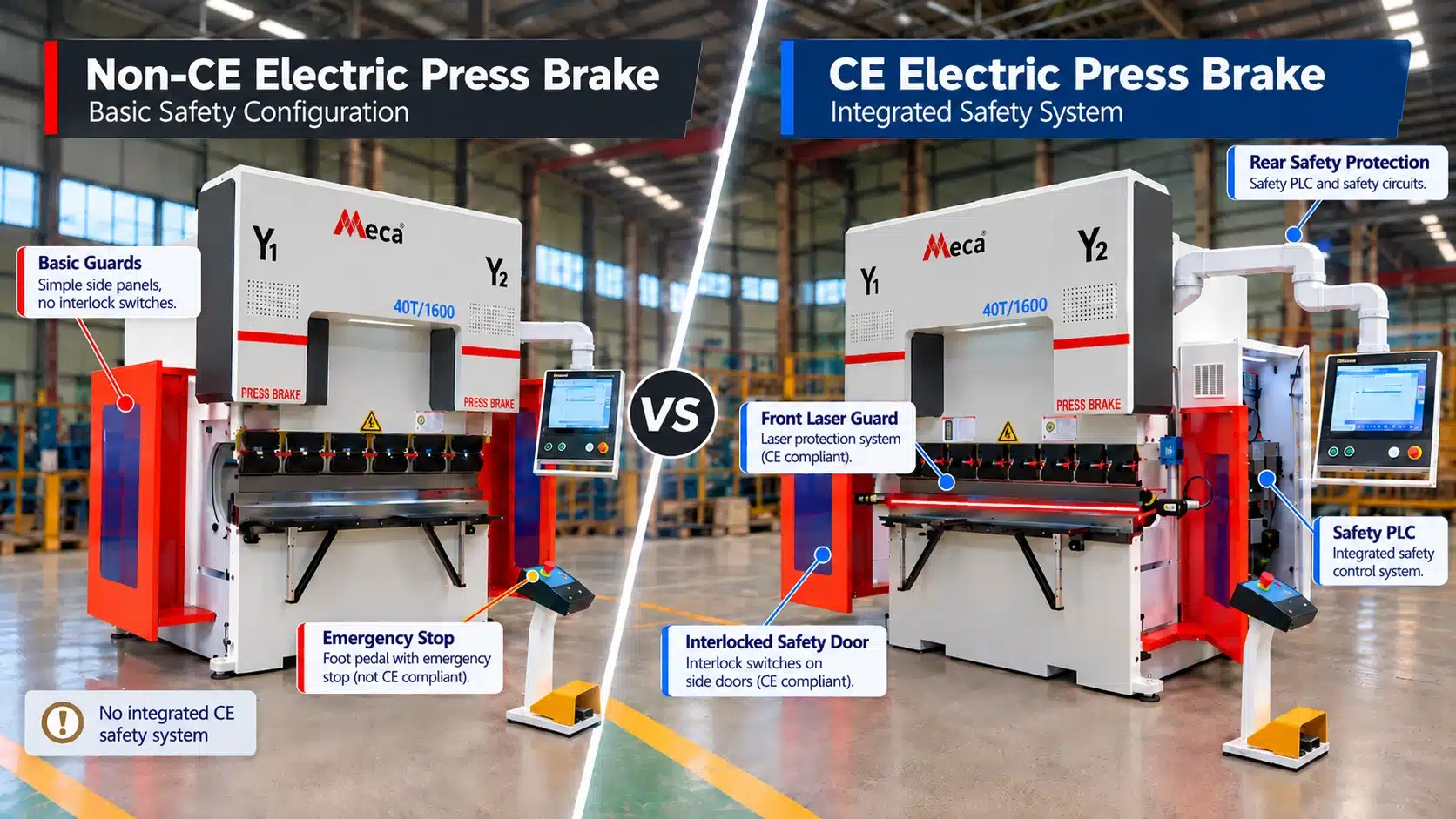
When comparing press brake quotations, buyers often find two machines that look very similar but are offered at noticeably different prices:
- CE version
- Non-CE version
The difference is not simply whether the machine carries a CE mark.
A press brake configured for CE compliance involves not only the machine itself, but also machine design, safeguarding systems, safety-related control circuits, electrical design, risk assessment, technical documentation, and conformity assessment of the complete machine.
For buyers outside Europe, some of these additional requirements may not be mandatory under local regulations. This is why manufacturers may also offer non-CE configurations.
So what are you actually paying for when you choose the CE version?
CE Press Brake vs Non-CE Press Brake: Quick Comparison
| Item | CE Press Brake | Non-CE Press Brake |
|---|---|---|
| Bending capacity | Essentially the same for the same machine model | Essentially the same for the same machine model |
| CNC controller | Can be the same | Can be the same |
| Y1/Y2 control | Can be the same | Can be the same |
| Front safety protection | Usually included as part of the safety solution | Depends on configuration |
| Rear / side guarding | Usually configured according to risk assessment | May be simplified |
| Guard interlocks | Usually integrated where required | May not be included |
| Safety PLC / safety relay system | Usually more comprehensive | May use a simpler safety circuit |
| Emergency stop architecture | Designed as part of the overall safety system | Depends on configuration |
| Safety function validation | Typically part of conformity work | Not necessarily performed to EU requirements |
| Risk assessment | Required | Depends on manufacturer and customer requirements |
| Technical documentation | CE conformity documentation required | Standard machine documentation |
| CE marking | Yes, after conformity assessment | No |
| Cost | Higher | Lower |
| Typical market | EU/EEA and customers requiring CE compliance | Markets where CE is not required |
Buyers should therefore confirm the actual machine configuration rather than relying only on the words “CE version.”
1. The Biggest Difference Is Usually the Safety System
From a mechanical perspective, a CE and non-CE version can use exactly the same:
- machine frame
- hydraulic system
- servo system
- CNC controller
- backgauge
- tooling
- motors
- linear encoders
The main difference is usually found in the safety system around the operator.
A press brake creates serious crushing and shearing hazards between the punch and die. The safeguarding system must therefore prevent access to hazardous movement while allowing the operator to work efficiently.
For a CNC press brake configured for CE compliance, this usually means an integrated safety system rather than a single additional safety device.
Front Laser Guarding
A press brake laser safety system is typically used to monitor the hazardous area directly below or around the upper tool.
If an unexpected object or part of the operator’s body enters the protected area during hazardous movement, the safety system can stop or control the ram movement.
This allows protection to remain close to the bending point while minimizing unnecessary impact on productivity.
Rear Safety Protection
The rear area of a press brake also needs to be considered as a hazardous zone.
Depending on machine design, rear protection may include:
- fixed rear guards
- safety doors
- light barriers
- interlocked guard panels
The purpose is to prevent access to the backgauge or ram movement area while hazardous movement is possible.
Guard Interlocking
When a protected access point is opened, the machine should not continue hazardous movement as if nothing has happened.
The guard therefore needs to interact with the safety-related control system rather than acting as a simple mechanical door.
Safety Control Circuit
Safety devices are not independent accessories.
Emergency stops, laser guards, safety doors, and other safety components need to work together through the machine’s safety-related control system.
This is why CE compliance should not be simplified to:
“CE press brake = standard press brake + light curtain.”
The real difference exists at the system level.
One important part of this system-level difference is hydraulic valve monitoring. For a closer look at how monitored valve feedback differs between CE and non-CE machines, see our guide to CE vs Non-CE press brake valve monitoring.
CE vs Non-CE Press Brake: What’s the Difference in Hydraulic Valve Monitoring?
2. CE Is Not Just a “Certificate”
Another common misunderstanding is:
“Does this machine have a CE certificate?”
CE marking is not simply a certificate that can be purchased separately and attached to any machine.
The CE mark can only be applied after the appropriate conformity assessment procedure has been completed.
For machinery, conformity assessment concerns the complete machine and the applicable safety requirements.
Depending on the machine and conformity route, this process may involve:
- risk assessment
- safety design
- electrical documentation
- technical drawings
- safety circuit documentation
- testing and validation
- operating instructions
- technical file
- declaration of conformity
- applicable conformity assessment procedures
Therefore, when a supplier simply says:
“CE is available.”
The better question is:
“What exactly is included in your CE configuration?”
3. Press Brakes Receive Special Attention Under EU Machinery Rules
Press brakes are not treated in the same way as ordinary low-risk workshop equipment.
Under the current Machinery Directive 2006/42/EC, Annex IV specifically identifies certain presses and press brakes used for cold working of metals with manual loading and/or unloading where the movable working parts exceed specified travel and speed limits.
The applicable conformity assessment procedure depends on factors such as machine design, intended use, and whether relevant harmonised standards fully cover the applicable essential health and safety requirements.
Therefore:
CE compliance should be considered during machine design, not added after the machine has already been manufactured.
4. Why Does a CE Press Brake Cost More?
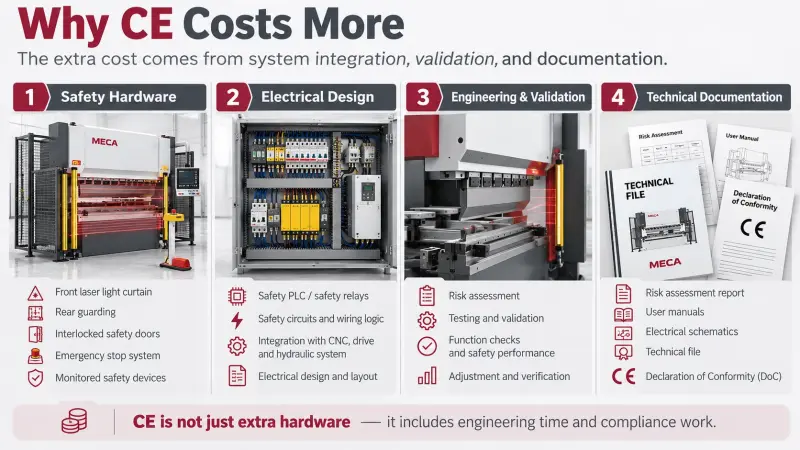
The price difference is usually not caused by one single component.
Additional cost can come from several areas.
Safety Hardware
Additional equipment may include:
- press brake laser guarding
- rear safety protection
- interlocked safety doors
- safety switches
- safety PLCs or safety relays
- more comprehensive emergency stop circuits
- monitored contactors
- safety-rated control components
Electrical Design
A CE-oriented machine may require additional engineering in areas such as:
- safety circuit architecture
- cable routing
- component selection
- grounding
- electrical protection
- labels and identification
Engineering and Validation
Safety functions are not complete simply because the components have been installed.
They need to be designed, checked, and validated as a system.
This creates additional engineering, testing, and documentation work that may not be visible when looking at the machine from the outside.
Technical Documentation
Preparing the required documentation also involves real engineering work.
This may include:
- risk assessment
- operating instructions
- electrical drawings
- technical documentation
- conformity-related records
Therefore, when one press brake costs several thousand dollars more than another apparently similar machine, it is worth checking whether the two machines actually have the same safety and compliance configuration before assuming the difference is simply supplier margin.
5. Does CE Improve Bending Accuracy?
Not directly.
This distinction is important.
A CE version does not automatically provide better:
- angle accuracy
- ram positioning accuracy
- backgauge accuracy
- bending repeatability
These performance factors depend much more on:
- frame rigidity
- machining accuracy
- Y1/Y2 control
- hydraulic or servo control
- linear encoder feedback
- tooling quality
- crowning system
- CNC control strategy
CE is primarily related to safety and compliance.
Therefore, if the CE and non-CE versions are built on the same mechanical platform, their bending performance can be essentially the same.
6. Does Non-CE Mean Unsafe?
Not necessarily.
“Non-CE” should not automatically be interpreted as “no safety protection.”
A manufacturer may supply a machine for a non-European market with:
- emergency stop buttons
- guards
- laser protection
- safety switches
- electrical protection
while not supplying the machine as a fully CE-conforming configuration.
Likewise, simply installing a laser safety system does not automatically make the complete machine CE compliant.
It is therefore more useful to compare the actual safety configuration than to compare only the CE or non-CE label.
7. When Should You Choose a CE Press Brake?
If the machine will be placed on the EU or EEA market and CE compliance is legally required, choosing the correct CE configuration is necessary.
Even outside Europe, a CE-level safety configuration may still make sense when:
- the company has strict internal safety standards
- the machine will be used by multiple operators
- the buyer is a large industrial company
- insurance or EHS requirements are strict
- the machine may later be transferred or resold into a market requiring CE compliance
In these situations, removing safety equipment simply to reduce the initial purchase price may create higher costs later.
8. When Can a Non-CE Version Make Sense?
In countries where CE marking is not required, some buyers may choose a non-CE version to reduce the initial investment.
This may make sense when:
- local regulations allow it
- the customer’s factory has its own safeguarding requirements
- additional perimeter protection will be installed locally
- CE technical documentation is not required
However:
Non-CE should never mean that machine safety can simply be ignored.
The buyer should still review local machinery safety regulations and workplace requirements.
9. Can You Buy a Non-CE Press Brake and Convert It to CE Later?
Sometimes it may be technically possible, but it is often not economical.
Retrofitting may require much more than simply adding a laser safety system.
Potential modifications can include:
- safety PLC
- electrical circuit redesign
- monitored valves or drives
- guard interlocks
- rear protection
- emergency stop architecture
- safety function validation
- updated electrical documentation
- updated risk assessment
If you already know that the machine may later be used in Europe, ordering the appropriate configuration from the beginning is usually the better approach.
2026–2027 EU Machinery Regulation Update
As of 2026, the Machinery Directive 2006/42/EC remains the main EU legal framework for machinery.
Regulation (EU) 2023/1230 will replace the Machinery Directive from 20 January 2027.
Under the new Regulation, certain presses and press brakes used for cold working of metals also remain within machinery categories requiring particular attention in conformity assessment.
For machines ordered close to this transition period, buyers and manufacturers should therefore confirm which legal framework will apply when the machine is placed on the EU market.