CE vs Non-CE Press Brake: How Hydraulic Valve Monitoring Differs
Table of Content
Before looking at the valve monitoring logic in detail, it is important to understand one key difference between CE and non-CE hydraulic press brakes.
In a CE-configured hydraulic press brake, the hydraulic valve group includes multiple monitored feedback points so that the safety control system can verify whether critical valves respond correctly and reach the expected safe state. In the configuration discussed in this article, this is implemented through a five-point monitoring arrangement.
A typical non-CE hydraulic press brake may use a simpler valve-control architecture with fewer independently monitored feedback points. The basic hydraulic bending process may be similar, but the level of safety-related valve monitoring is different.
This article focuses specifically on how the monitored hydraulic valve system works in a CE press brake. For a broader comparison of guarding, interlocks, emergency-stop systems, safety control, and compliance requirements, see our complete CE vs Non-CE press brake guide.
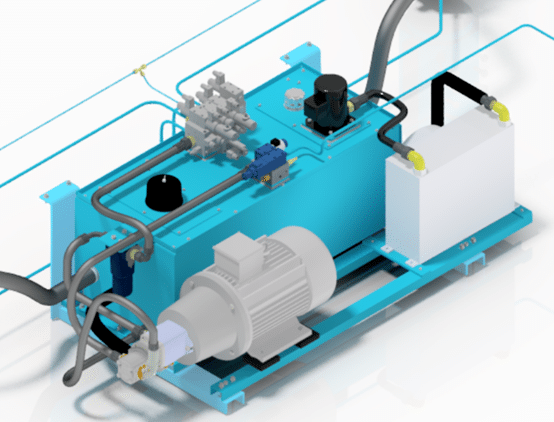
In a hydraulic press brake, the five-point valve group is the core hydraulic component that controls the movement of the ram. It consists of 2 proportional directional valves, 2 fast-down valves, and 1 slow-down valve. Through the MCS safety module, it is precisely regulated to ensure smooth, safe, and efficient machine operation.
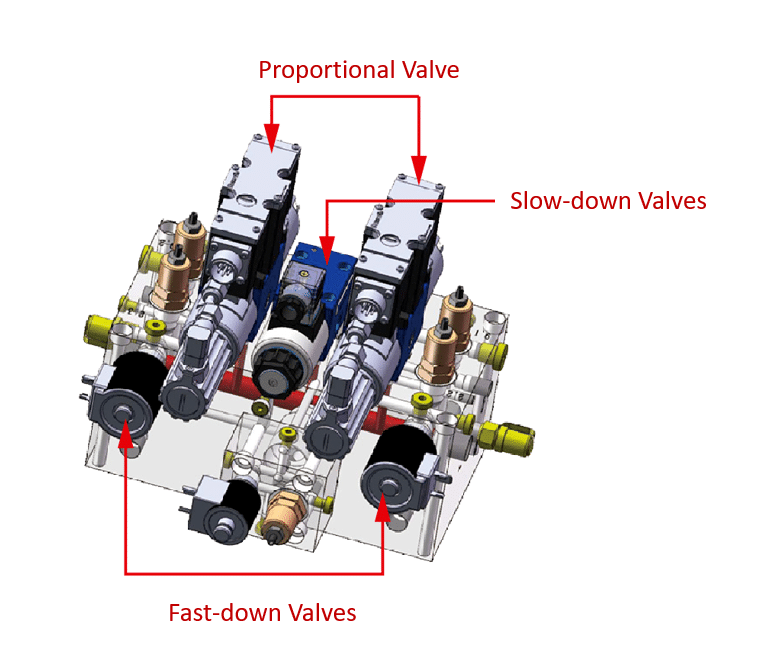
Proportional Directional Valve
Function:
It is used to control the flow and direction of hydraulic oil in the press brake, enabling efficient bending operations. It is controlled via OUTS1/OUTS2 output signals from the MCS module.
Features:
- Proportional control: Enables stepless adjustment of the spool position to regulate the flow direction and flow rate of hydraulic oil, thereby controlling the direction of motion.
- Closed-loop control: Works with valve feedback signals (such as INS7/INS8) to achieve real-time closed-loop regulation, ensuring precise adjustment.
Fast-down Valve
Function:
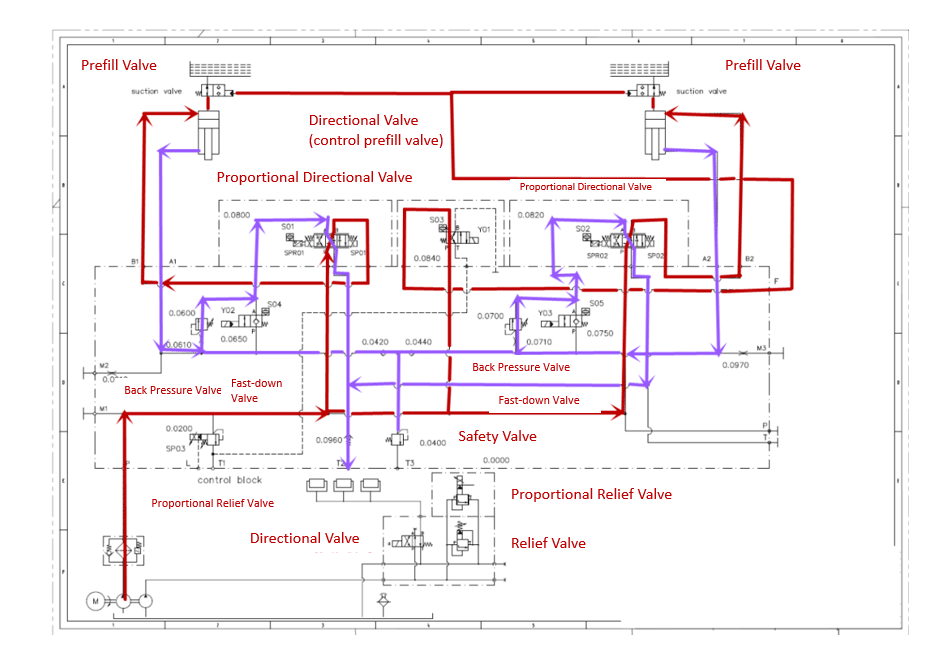
During the downward stroke of the ram, it provides a high-flow oil path to enable fast descent (rapid approach/idle stroke), improving production efficiency. It is controlled by OUTS3/OUTS4 of the MCS module, where high-flow hydraulic oil drives the ram to move at high speed.
Features:
- High-speed response: Reduces idle stroke time and improves cycle efficiency.
- Safety protection: If an abnormal condition is detected (e.g., abnormal signals from INS9/INS10), the MCS module immediately cuts off the valve control signal.
Slow-down Valve
Function:
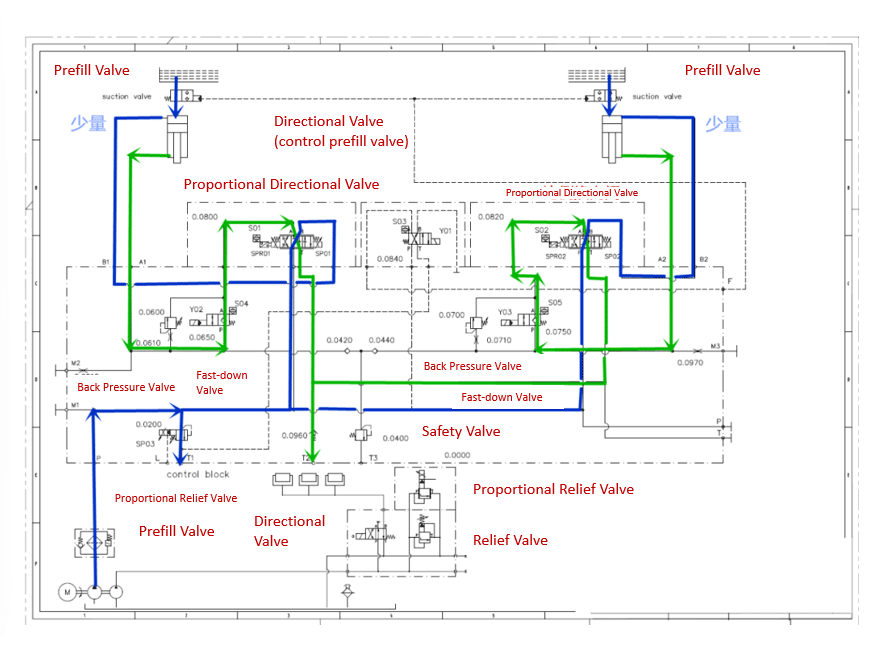
Controls the ram’s slow approach to the workpiece and the bending process, allowing the ram to descend steadily at low speed to ensure bending accuracy. It is independently managed by the OUTS5 signal of the MCS module for precise control.
Features:
- Smooth transition: Works together with the fast-down valve to achieve a smooth transition from “rapid approach → slow approach → pressing.”
- Safety protection: If INS14 detects an abnormal signal, the system automatically adjusts the signal control.
Rapid approach stage
Pressing stage
Valve Group Coordinated Working Process
Motion control stage:
The proportional valves regulate the movement direction through OUTS1/OUTS2 and participate throughout the entire bending process.
Fast-down stage:
The fast-down valves are activated, allowing the ram to descend rapidly, driven by OUTS3/OUTS4.
Slow-down stage:
When the press brake reaches the speed transition point, the slow-down valve engages under OUTS5 control, reducing the descending speed.
Safety closed-loop control:
Terminal 8 (INS7–INS14) continuously monitors the valve feedback signals in real time. If any abnormality is detected, the MCS safety protection mechanism is triggered immediately to cut off the valve control enable signal.
Technical Advantages
- Precise control:
The MCS safety output signals provide coordinated control of the proportional valves together with the fast/slow-down valves.
- High safety level:
The MCS module performs real-time monitoring and complies with CE-certified safety standards.
- Low maintenance cost:
Real-time monitoring of the valve group forms a closed-loop feedback system. When a valve abnormality is detected, the system can immediately issue an alarm and stop the machine, preventing equipment damage or personal injury caused by delayed detection of valve faults.
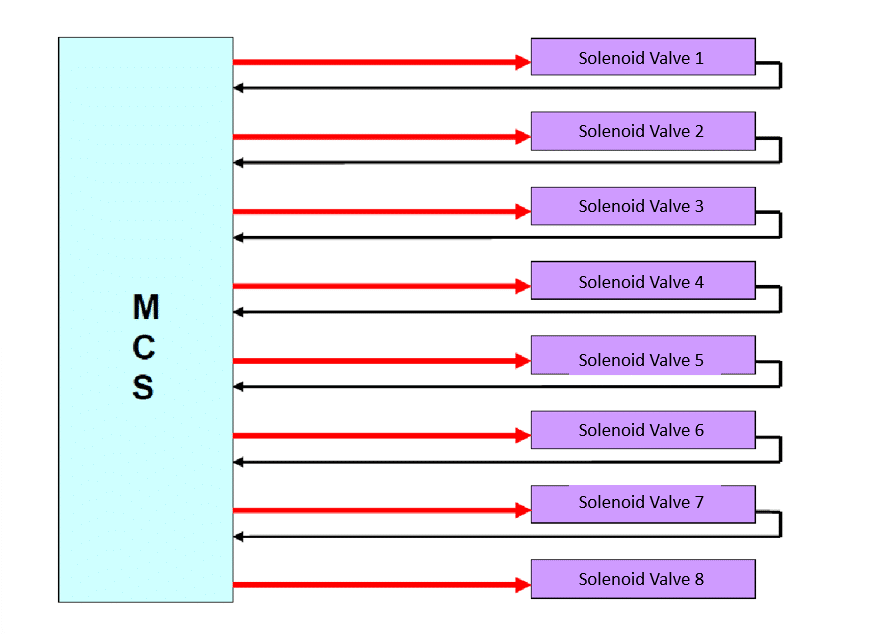
The MCS can control output signals for any type of safety valve and monitor valve feedback signals.
Through the intelligent management of the MCS safety module, the five-point valve group enables efficient, stable, and safe hydraulic control in the press brake, meeting the requirements of high-precision sheet metal processing.