Tandem Press Brake Guide: Synchronization, Setup & Selection
Table of Content
This post is also available in:
A tandem press brake uses two CNC press brakes that operate together to bend one extra-long workpiece or independently for standard-length parts.
It is mainly selected when the required bending length exceeds a practical single-machine configuration, or when a factory needs both long-part bending capability and flexible daily production.
Selecting a tandem press brake should not be based on combined tonnage alone. Material, thickness, bending length, load distribution, tooling, machine alignment, backgauge configuration, crowning and final commissioning must all be evaluated as one complete bending system.
What Is a Tandem Press Brake?
A tandem press brake is a bending system in which two CNC press brakes are installed side by side and configured to operate either synchronously or independently.
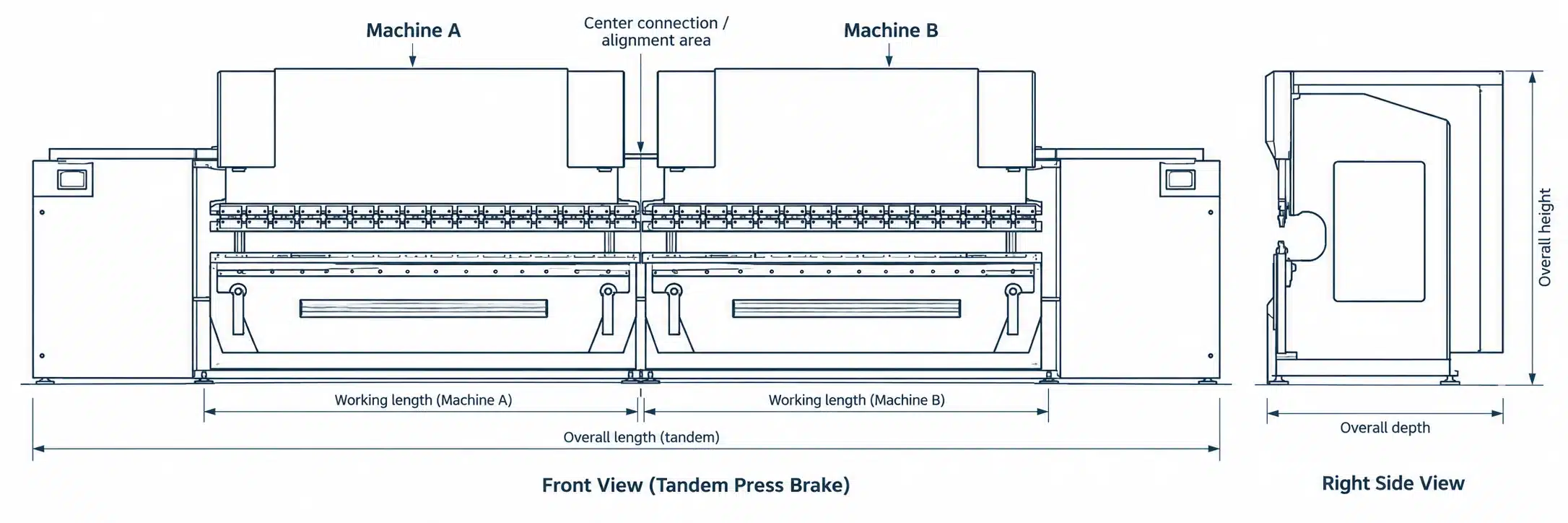
In tandem mode, the two machines work together on one long workpiece. Their ram movement, bending sequence and related control functions must remain coordinated throughout the bending cycle.
In independent mode, each press brake can produce shorter components separately. This gives tandem systems an important advantage for factories that do not produce extra-long parts all day.
For example, two 3100 mm press brakes can provide approximately 6 meters of combined nominal bending length while still allowing each machine to handle normal 3-meter production when tandem operation is not required.
The main purpose of a tandem system is therefore not simply to create a larger tonnage number. Its real value is combining:
- Extended bending length
- Synchronized long-part forming
- Independent machine operation
- Flexible production planning
- More practical transport for some oversized-machine projects
Tandem Press Brake at a Glance
| Item | Practical Meaning |
|---|---|
| Machine configuration | Two CNC press brakes forming one coordinated system |
| Operating modes | Tandem operation and independent operation |
| Main application | Extra-long sheet metal and structural components |
| Main control requirement | Synchronized ram positioning and bending cycle |
| Key mechanical requirement | Accurate machine, table and tooling alignment |
| Key bending requirement | Correct load distribution and crowning |
| Main production advantage | Long-part capability plus standard-length production |
| Typical alternative | One single long-bed press brake |
| Selection basis | Material, thickness, bending length, drawing and production mix |
How Does a Tandem Press Brake Work?
A tandem press brake works only when two separate machines behave as one coordinated forming system during the complete bending cycle.
The synchronization requirement extends beyond simply pressing the start button on both machines at the same time. Approach speed, transition to bending speed, ram position, pressure build-up, holding, decompression and return movement all need to remain coordinated.
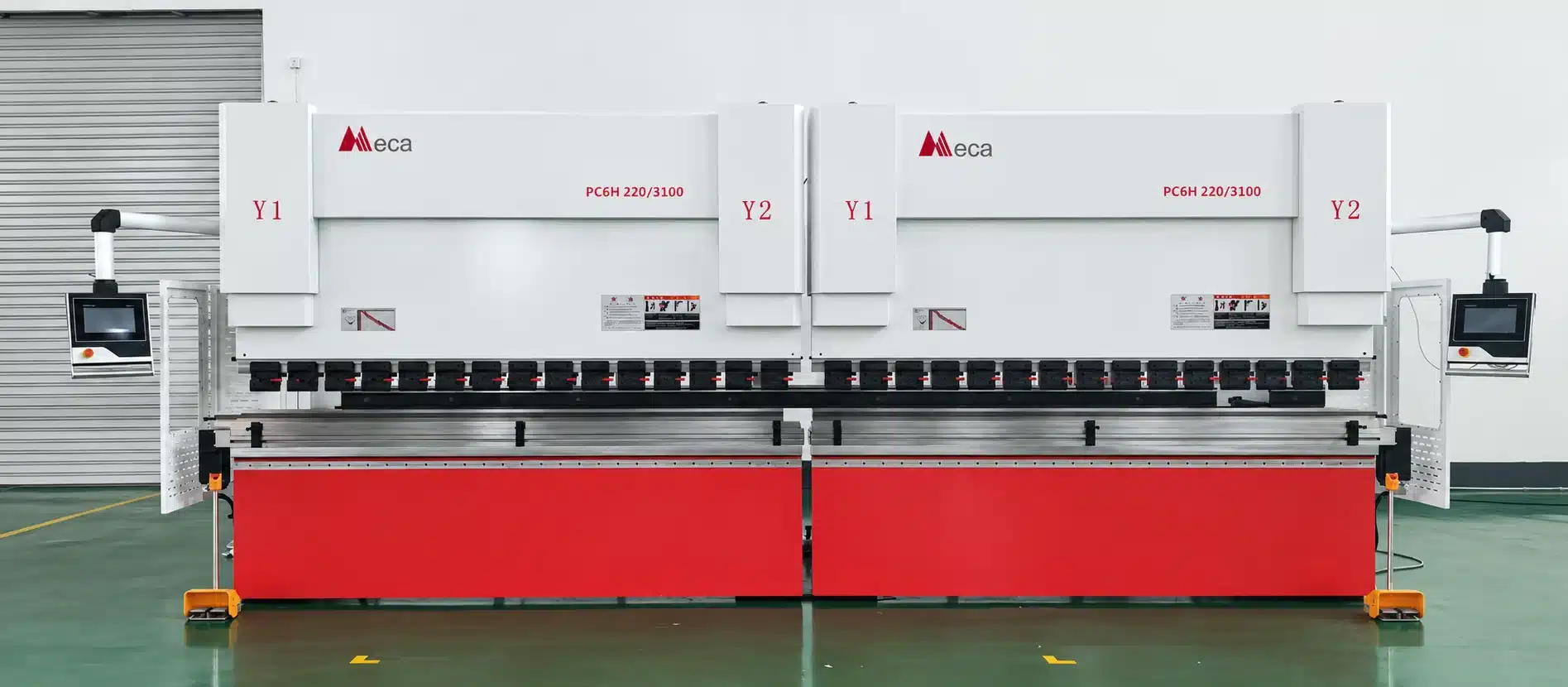
Real MECA project: 2 × 220T / 3100 mm tandem press brake configuration.
CNC Synchronization and Ram Position Control
Ram position feedback is one of the foundations of tandem press brake synchronization.
On a CNC hydraulic press brake, the ram is typically controlled through Y-axis position feedback. A tandem system therefore needs to coordinate the bending movement of both machines rather than treating each machine as an unrelated press brake.
The control system continuously receives position information and adjusts machine movement according to the programmed bending cycle.
This becomes increasingly important as workpiece length increases because a relatively small difference between two machine sections can produce visible angle variation, twisting or straightness problems across a long component.
Hydraulic Response Between Two Machines
Hydraulic response must also be considered as part of the complete tandem system.
Each hydraulic press brake has its own cylinders, proportional valves, hydraulic circuits and pressure behavior. During tandem operation, these two hydraulic systems must respond consistently enough for the CNC control system to keep ram movement coordinated.
Valve response, cylinder behavior, hydraulic pressure, oil condition and actual bending load can all affect movement.
This is why a tandem press brake should be engineered and commissioned as one complete bending system rather than simply placing two standard machines next to each other.
Crowning and Deflection Compensation
Crowning becomes more important when one long workpiece spans two press brakes.
Every press brake frame, ram and table experiences some elastic deflection under load. On a conventional single press brake, the crowning system compensates for deflection across one machine.
A tandem press brake adds another variable because the workpiece crosses two separate machine structures.
The crowning behavior of both machines therefore needs to be evaluated together. Incorrect compensation can create different bending angles at the center and ends of the workpiece or produce different results on each machine section.
For a deeper discussion of synchronization, structural consistency, crowning and commissioning, see our guide to the technical challenges of tandem press brake machines.
Does a Tandem Press Brake Simply Double the Tonnage?
A tandem press brake should not be treated as one press brake with a single ram whose capacity is simply the sum of two machine nameplates.
For example, two 320-ton machines may be described commercially as a 2 × 320T tandem configuration, but this does not mean that 640 tons can be applied at any arbitrary point along the complete bending length.
Each press brake still has its own rated load capacity, frame, ram, table and hydraulic system.
The actual bending load must therefore be distributed correctly between the two machines.
If most of the bending force is concentrated on one machine, that machine must remain within its permitted load conditions even if the theoretical combined capacity of the tandem system appears sufficient.
Workpiece geometry also affects load distribution. A continuous long component spanning both machines may distribute the load differently from a part whose bending area is concentrated near one side.
For this reason, tandem press brake tonnage calculations should consider:
- Material type
- Material thickness
- Total bending length
- Length of material actually loaded on each machine
- V-die opening
- Bending method
- Part geometry
- Position of the workpiece relative to both machines
The safest selection method is to evaluate the actual part drawing rather than selecting a tandem machine from total tonnage alone.
Which CNC Controller Is Required for a Tandem Press Brake?
A tandem press brake requires a CNC architecture that supports coordinated multi-machine operation.
The controller must do more than program bending angles and backgauge positions. It must also communicate with the machine control system in a way that allows both press brakes to participate in one coordinated bending sequence.
Depending on the machine architecture, tandem capability may be available through dedicated CNC functions, control modules and communication interfaces.
Delem, for example, provides TandemLink capability on selected press brake CNC systems. The final controller choice should nevertheless be confirmed together with the machine manufacturer because tandem operation depends on the complete CNC, electrical, hydraulic and feedback architecture rather than the controller screen alone.
A more advanced controller is also not automatically a better tandem solution.
Functions such as 2D or 3D graphical programming, offline programming and automatic bending sequence calculation improve programming efficiency, but they are different from the machine-level synchronization required for tandem operation.
When evaluating a controller, buyers should therefore ask two separate questions:
- Does the CNC provide the programming functions required by our operators?
- Does the complete machine control architecture support the required tandem operation?
Both questions matter.
Why Are Alignment and Tooling More Critical on a Tandem Press Brake?
Mechanical alignment is one of the most important conditions for producing a consistent bend across two press brakes.
The two machines must create one continuous bending reference for the workpiece.
During installation and commissioning, several relationships should therefore be checked carefully:
- Table height
- Machine centerline
- Front-to-back position
- Ram and table relationship
- Punch alignment
- Die alignment
- Distance between machine sections
- Workpiece support position
Tooling alignment is particularly important because a long workpiece may cross the transition between two machines.
If the punch or die height changes at the connection area, the workpiece will not experience a consistent bending condition across its full length.
Tooling should therefore be selected and installed as part of the tandem system rather than treated as two independent tooling sets.
A continuous reference between both machine sections is more important than simply using tooling with the same nominal dimensions.
How Should the Backgauge Be Configured on a Tandem Press Brake?
The correct tandem backgauge configuration depends on the actual part geometry and bending sequence.
Long workpieces are often more difficult to position than standard-length components, especially when flange depth, weight or workpiece flexibility makes manual handling difficult.
Backgauge configuration may therefore need to consider:
- X-axis positioning
- R-axis height
- Z1/Z2 finger position
- Independent or coordinated gauge movement
- Workpiece support
- Part orientation
- Operator access
- Bending sequence
A standard backgauge specification should not automatically be copied from a conventional press brake quotation.
The part drawing should be reviewed first to determine where the workpiece needs to be referenced during each bend.
For complex long components, front support systems or additional workpiece handling equipment may also be required.
What Are the Main Technical Requirements of a Tandem Press Brake?
A stable tandem press brake depends on mechanical, hydraulic, electrical and control systems working together.
| Requirement | Why It Matters |
|---|---|
| Ram synchronization | Keeps both machine sections coordinated during bending |
| Position feedback | Provides real-time ram position information |
| Hydraulic response | Helps maintain consistent movement under load |
| Machine alignment | Creates a common bending reference |
| Tool alignment | Reduces transition errors between machine sections |
| Crowning | Helps control angle consistency across the workpiece |
| Backgauge configuration | Positions long components correctly |
| Structural consistency | Reduces different deformation behavior between machines |
| Foundation and installation | Maintains machine geometry after delivery |
| Final commissioning | Integrates all systems under actual operating conditions |
No single specification guarantees good tandem performance.
A high-end CNC cannot compensate for poor mechanical alignment, and a rigid machine frame cannot compensate for incorrect tooling installation.
The complete system must therefore be evaluated together.
How Does a Tandem Press Brake Compare With a Single Long-Bed Press Brake?
Both tandem press brakes and single long-bed press brakes can produce extra-long components, but they suit different production conditions.
| Decision Factor | Tandem Press Brake | Single Long-Bed Press Brake |
|---|---|---|
| Long-part bending | Yes | Yes |
| Independent production | Two machines may operate separately | No |
| Standard-length production | Two machines can be available | Entire machine is occupied |
| Multi-machine synchronization | Required | Not required |
| Cross-machine tooling alignment | Required | Not applicable |
| Control complexity | Higher | Lower |
| Installation alignment | More demanding | Simpler control architecture |
| Oversized-frame transport | Often reduced | Can become more difficult as machine size increases |
| Production flexibility | Suitable for mixed long and standard parts | Suitable for dedicated long-part production |
| Commissioning | Requires multi-machine coordination | Single-machine commissioning |
A tandem press brake becomes particularly attractive when long workpieces represent only part of the production schedule.
The machines can work together when a 6-meter, 8-meter or longer component is required and return to independent production when shorter workpieces are scheduled.
A single long-bed press brake can be more appropriate when almost all production requires the same long working length.
In that situation, independent machine operation may provide little benefit and the simpler single-machine architecture can be attractive.
There is therefore no universal rule that tandem is better than one long press brake.
The correct choice depends on production mix, workpiece dimensions, transportation, workshop conditions and expected machine utilization.
When Should You Choose a Tandem Press Brake?
A tandem press brake is most useful when extra-long bending capacity and flexible machine utilization are both important.
You Need to Bend Extra-Long Workpieces
Very long components can exceed the practical working length of standard press brakes.
Typical examples include:
- Light poles
- Power transmission poles
- Long structural profiles
- Large panels
- Truck and trailer components
- Heavy equipment parts
- Long enclosures
- Infrastructure components
A tandem configuration can provide the required working length without depending on one extremely long frame.
You Also Produce Standard-Length Parts
Mixed production is one of the strongest reasons to consider tandem operation.
If a factory only occasionally produces 6-meter or 8-meter parts but regularly produces 3-meter components, dedicating one very long press brake to every job may reduce equipment utilization.
Two tandem machines can provide long-part capability when required while retaining independent production capacity for shorter workpieces.
Transporting One Oversized Machine Is Difficult
Transportation becomes an increasingly important consideration as machine length and weight increase.
One very large welded frame may create additional requirements for:
- Inland transportation
- Port handling
- Container or break-bulk shipment
- Factory entrance dimensions
- Crane capacity
- Machine unloading
Two smaller machines may sometimes simplify these logistics.
Transportation should still be evaluated project by project because total shipping cost depends on machine size, destination and available transport routes.
Workshop Conditions Favor Two Separate Machines
Factory conditions can influence machine selection as much as bending calculations.
Workshop entrance dimensions, crane capacity, foundation, floor space and material handling routes should all be reviewed before choosing between tandem and single-machine solutions.
The machine configuration should fit the factory instead of forcing the factory to adapt to an impractical machine layout.
When Is a Single Long Press Brake a Better Choice?
A single long-bed press brake can be the more practical solution when most production consists of long components with similar working-length requirements.
It may also be preferred when:
- Independent machine operation is unnecessary
- Transportation is manageable
- Workshop access is sufficient
- One machine can cover the required tonnage and length
- Simpler commissioning is preferred
- Production is highly standardized
A tandem system adds flexibility, but that flexibility also adds synchronization, installation and commissioning requirements.
The additional complexity only makes sense when the production requirement benefits from it.
What Can We Learn From a Real 6000 mm Press Brake Selection?
A real MECA customer project shows why bending length alone should not determine the machine configuration.
The customer needed to replace an existing press brake and prepare for future workpieces up to approximately 6 meters long.
Two configurations were evaluated:
Option 1: 320T × 6000 mm single press brake
Option 2: 2 × 320T × 3100 mm tandem press brake
Both configurations could address the customer’s maximum working-length requirement.
The important difference was daily production.
Much of the customer’s normal work still consisted of standard-length components rather than 6-meter parts.
With a 6000 mm single machine, the complete machine would remain occupied even when producing a short workpiece.
With the tandem configuration, the two 3100 mm machines could operate together for long components and separately for shorter production.
Production flexibility therefore became a major factor in the machine recommendation.
This example illustrates an important selection principle:
Do not ask only, “What is the longest part I need to bend?”
Also ask:
“What percentage of my daily production actually requires that maximum bending length?”
For the complete decision process, see our 6000 mm press brake vs tandem press brake selection case.
How Is a Tandem Press Brake Installed and Commissioned?
Final commissioning is more important on a tandem press brake than on a conventional single-machine installation.
Factory testing can verify the machine before shipment, but transportation and installation can change the final mechanical relationship between two machines.
Commissioning should therefore confirm the complete system after installation.
Typical checks include:
Machine Positioning
Both machines must be positioned so their working tables form the required common reference.
Leveling
Machine leveling should be checked according to the manufacturer’s installation procedure.
Table and Tooling Alignment
Punches and dies should create a consistent bending line across both machines.
Ram Synchronization
The control system should be tested through the complete bending cycle rather than only at one ram position.
Backgauge Position
Gauge references and movement should match the actual production requirement.
Crowning Adjustment
Deflection compensation should be verified under realistic bending conditions.
Trial Bending
Actual test pieces provide the most useful final confirmation because they combine machine movement, tooling, material behavior and load distribution.
The final bending result matters more than whether individual parameters appear correct when checked separately.
For tandem systems, commissioning should therefore be treated as a production validation process rather than simply an installation procedure.
What Real Tandem Press Brake Experience Does MECA Have?
Practical tandem experience is important because synchronization and commissioning cannot be evaluated from a specification sheet alone.
The MECA engineering team has worked with tandem press brake configurations across different tonnages and working lengths, including machines such as:
- 110T / 3100 mm
- 170T / 3100 mm
- 220T / 3100 mm
- 110T / 4100 mm
- 170T / 4100 mm
- 220T / 4100 mm
More than 10 end users have adopted tandem press brake solutions supported by the MECA engineering team.
These projects provide practical experience in areas such as:
- Multi-machine integration
- CNC synchronization
- Machine alignment
- Crowning adjustment
- Long-workpiece trial bending
- Installation and commissioning
Real Tandem Press Brake in Operation
Real operating footage is useful when evaluating a tandem press brake supplier because it shows whether the manufacturer has moved beyond conceptual machine specifications.
The MECA tandem press brake video demonstrates two CNC press brakes working together on one long workpiece.
When evaluating a supplier, buyers should ask to see actual machines, actual commissioning procedures and actual tandem applications rather than relying only on catalog descriptions.
What Information Should You Provide Before Requesting a Tandem Press Brake Quote?
A useful tandem press brake quotation should begin with the workpiece rather than the machine model.
Providing the following information allows the manufacturer to evaluate the bending requirement more accurately.
1. Material
Specify whether the workpiece is mild steel, stainless steel, aluminum, high-strength steel or another material.
Different materials require different bending forces.
2. Maximum Material Thickness
Maximum thickness directly affects required bending tonnage and tooling selection.
3. Maximum Bending Length
Provide the actual length of the bend rather than only the overall sheet dimensions.
4. Part Drawings
A drawing is one of the most valuable pieces of information for press brake selection.
It helps evaluate:
- Flange dimensions
- Bend angles
- Bending sequence
- Tool interference
- Backgauge access
- Workpiece handling
- Required tooling
5. Required Inside Radius
The required bend radius can influence the V-opening and tooling design, which then affects bending force.
6. Production Mix
Explain how often extra-long components are produced compared with standard-length parts.
This information is essential when comparing tandem and single long-bed machines.
7. Annual or Daily Production Volume
Production frequency helps determine whether flexibility, cycle time or dedicated long-part capacity should receive greater priority.
8. Workshop Conditions
Provide information about:
- Factory entrance size
- Available floor space
- Crane capacity
- Foundation
- Material handling direction
- Available power supply
These factors may affect the final machine layout.
9. Independent Operation Requirement
Confirm whether the two machines need to operate separately when tandem bending is not required.
This should be defined during machine design rather than assumed after installation.
How Should You Evaluate a Tandem Press Brake Manufacturer?
A tandem press brake supplier should be evaluated on integration and commissioning capability rather than machine specifications alone.
Before placing an order, consider asking:
- Have you delivered tandem press brakes before?
- Can you show a real tandem machine operating?
- What machine configurations have you already supplied?
- How are the two machines synchronized?
- How is tooling alignment checked?
- How is crowning coordinated?
- How is load distribution evaluated?
- What CNC architecture is used?
- Can the machines operate independently?
- What installation and commissioning support is provided?
- How is a long-workpiece bending test performed?
- What information do you need from my part drawing before confirming the machine?
A manufacturer that immediately recommends a machine only from tonnage and length is missing important information.
A proper tandem press brake proposal should begin with the workpiece, production requirement and installation conditions.
What Is the Most Important Principle When Selecting a Tandem Press Brake?
The most important principle is to select the complete bending system around the actual workpiece rather than selecting two machines first and trying to make the application fit afterward.
A successful tandem press brake project depends on the relationship between:
Workpiece → Tooling → Tonnage → Machine structure → CNC control → Synchronization → Installation → Commissioning
Each element affects the final bending result.
A tandem press brake can provide an effective solution for extra-long parts while preserving production flexibility, but only when the two machines are engineered and commissioned as one coordinated system.
If your project involves long structural parts, poles, panels or components beyond the practical working length of a standard press brake, send us the material, thickness, bending length and part drawing.
The MECA engineering team can compare a single long-bed press brake with a tandem press brake configuration based on your actual production requirements before recommending a machine.
Frequently Asked Questions
Can two press brakes work independently in a tandem system?
Yes, if the system is designed for independent operation. Each machine can produce shorter parts separately when tandem bending is not required.
Does a tandem press brake double the available tonnage?
Not at every point. Each machine retains its own rated capacity, so bending load must be distributed correctly across both machines.
Can two different press brakes be connected in tandem?
It is generally preferable to engineer the machines as a matched system. Different structures, hydraulics and controls make synchronization more difficult.
How are two tandem press brakes synchronized?
CNC control, ram position feedback and machine-level control logic coordinate the two machines throughout the bending cycle.
What CNC controller is suitable for tandem operation?
Use a controller and machine architecture that support multi-machine tandem control. The complete control system must be confirmed by the machine manufacturer.
Is a tandem press brake more accurate than one long press brake?
Not automatically. Final accuracy depends on machine design, alignment, tooling, synchronization, crowning, material and commissioning.
When should I choose tandem instead of a 6000 mm press brake?
Consider tandem when you need 6-meter bending capability but also regularly produce shorter parts that could use the two machines independently.
What information is required for a tandem press brake quotation?
Provide material, thickness, bend length, required radius, part drawings, production volume, production mix and workshop conditions.