Servo Motor vs Induction Motor: 5 Key Differences for Your Hydraulic Press Brake
Table of Content
This post is also available in:
When comparing a servo motor vs induction motor, the most important difference is not simply which motor is “more advanced.” The real question is how each motor is used and how it affects the complete machine.
This is especially important when buying a hydraulic press brake.
Two hydraulic press brakes may use the same CNC controller, similar hydraulic valves and the same Y1/Y2 closed-loop control system, but one may use a conventional three-phase induction motor as the main motor while the other uses a servo motor to drive the hydraulic pump.
So, what is the difference between a servo motor and an induction motor in a press brake, and is the servo system worth the additional cost?
Quick Answer: Servo Motor vs Induction Motor
A conventional three-phase induction motor is simple, reliable and economical. In a traditional hydraulic press brake power unit, it normally drives the hydraulic pump at a relatively constant speed during machine operation.
A servo motor, combined with a servo drive, can adjust motor speed according to the hydraulic flow and pressure required at different stages of the bending cycle.
For a hydraulic press brake, the main advantages of a servo main motor are therefore:
- More flexible hydraulic pump control
- Lower unnecessary energy consumption
- Reduced oil heating
- Lower standby noise
- Faster hydraulic response
However, one point is important:
A servo main motor does not by itself determine bending accuracy.
Bending accuracy depends on the complete CNC, Y1/Y2 feedback, hydraulic control, machine structure and crowning system.
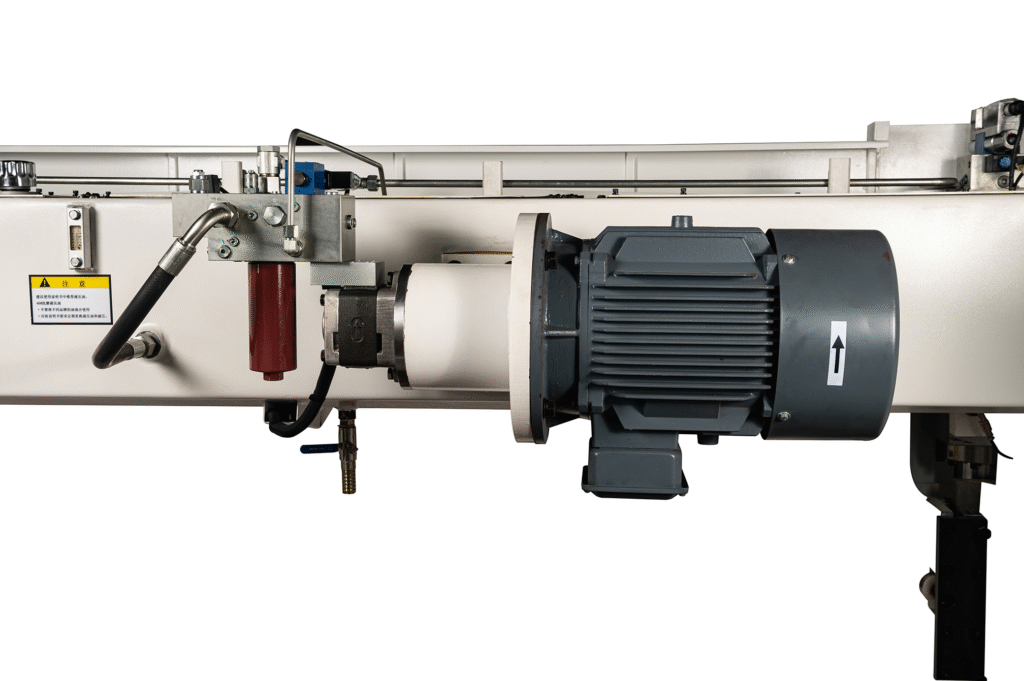
Three-Phase Induction Motor: Simple and Reliable
Three-phase induction motors have been widely used in industrial machinery for decades.
Their structure is relatively simple, they are durable, and their purchasing cost is usually lower than that of a complete servo motor and servo drive system.
In a conventional hydraulic press brake, the induction motor drives the hydraulic pump that supplies oil to the hydraulic system.
The motor itself is not necessarily a disadvantage.
For machines where initial cost is the main consideration, operating hours are limited, or energy efficiency is less important, a traditional induction-motor hydraulic system can still be a practical solution.
The main limitation is that a conventional system usually has less flexibility in matching pump output to the actual hydraulic demand of each machine movement.
During loading, workpiece repositioning or other low-demand periods, the motor and pump may still continue operating even though the machine does not require full hydraulic output.
This creates unnecessary energy consumption, heat and noise.
Servo Motor: Variable-Speed Hydraulic Power
A servo motor is normally used together with a servo drive and feedback system.
Instead of simply maintaining one operating speed, the motor speed can be adjusted according to the control command.
In a servo-hydraulic press brake, the servo motor does not directly move the ram.
The power path is:
Servo Motor → Hydraulic Pump → Hydraulic System → Cylinders → Ram
The CNC and hydraulic control system determine the machine’s operating requirements, while the servo system adjusts pump speed according to the required flow and pressure.
This allows the hydraulic power unit to respond more closely to what the machine actually needs at different stages of the bending cycle.
That distinction explains most of the practical differences between a servo motor and a conventional induction motor in a hydraulic press brake.
1. Hydraulic Pump Control
The first major difference is how the hydraulic pump is driven.
Conventional Induction Motor System
A traditional induction motor typically operates the pump at a relatively constant motor speed during machine operation.
The hydraulic valves then regulate the flow and pressure required for different machine movements.
Servo Main Motor System
A servo motor can vary pump speed according to the required hydraulic output.
For example, the hydraulic requirements are different during:
- Rapid approach
- Bending
- Pressure holding
- Ram return
- Waiting
- Workpiece repositioning
A servo-driven pump can respond more flexibly to these changing requirements.
This does not mean that every conventional induction-motor system is inefficient, or that an induction motor cannot be speed-controlled with additional drive technology.
The practical difference is that a modern servo-pump system is specifically designed around variable, demand-based hydraulic power control.
2. Energy Consumption
Energy efficiency is one of the main reasons servo motors are increasingly used as hydraulic press brake main motors.
However, the reason is often misunderstood.
If two machines bend the same steel plate under the same conditions, the physical work required to deform the material does not simply disappear because one machine uses a servo motor.
The main energy-saving opportunity comes from reducing losses outside the actual bending work.
With a conventional hydraulic system, the motor and pump may continue running during periods such as:
- Workpiece loading
- Repositioning
- Measuring
- Programming pauses
- Waiting between cycles
A servo-pump system can reduce motor speed when full hydraulic output is unnecessary.
As a result, total energy consumption can be lower, particularly in production environments with frequent pauses or changing hydraulic demand.
The actual energy saving depends on the machine, production cycle, workload and idle ratio.
For this reason, it is more accurate to evaluate servo energy efficiency according to the real application rather than assume that one fixed percentage applies to every press brake.
3. Oil Temperature and Noise
Unnecessary pump operation does more than consume electricity.
It also generates heat.
In a conventional hydraulic system, continuous oil circulation and hydraulic losses can increase oil temperature during long production periods.
A demand-based servo pump reduces unnecessary hydraulic circulation, which can help:
- Reduce heat generation
- Maintain more stable hydraulic oil temperature
- Reduce cooling requirements
- Improve the working environment of hydraulic components
The same principle applies to noise.
When the press brake is waiting or operating under low hydraulic demand, the servo motor can run at a lower speed.
This means the machine can be noticeably quieter during standby and low-demand stages.
For workshops where operators work next to multiple machines for long periods, lower standby noise can be a meaningful practical advantage.
4. Hydraulic Response and Cycle Performance
The fourth difference is hydraulic response.
A servo system can change pump speed quickly according to the required flow.
This makes it possible to optimize hydraulic output during different stages of the machine cycle.
The benefit may appear in areas such as:
- Faster transition between operating stages
- More responsive pump output
- Better control of unnecessary flow
- Potential reduction of non-bending cycle time
However, this advantage should not be confused with bending accuracy.
The servo motor mainly improves the hydraulic power supply and response.
It does not replace the machine’s Y1/Y2 position control system.
Does a Servo Motor Make a Press Brake More Accurate?
Not by itself.
This is an important distinction when comparing press brake specifications.
The bending accuracy of a modern CNC hydraulic press brake is primarily determined by the complete closed-loop control system, including:
- Y1/Y2 independent ram control
- Linear scale or magnetic scale feedback
- Proportional hydraulic valves
- CNC control
- Frame rigidity
- Machine geometry
- Crowning system
- Tooling and material consistency
The servo main motor provides hydraulic power more efficiently and responsively.
Better thermal stability and hydraulic response can indirectly contribute to stable long-term operation, but the main motor should not be presented as the sole reason for high bending accuracy.
Therefore:
Servo main motor = hydraulic power efficiency and response
while:
Y1/Y2 closed-loop control = ram positioning accuracy
Keeping these functions separate makes it much easier to evaluate a press brake correctly.
5. Initial Cost vs Long-Term Value
A servo main motor system normally costs more initially because the machine requires both a servo motor and an appropriate servo drive and control architecture.
The difference can be summarized as follows:
| Three-Phase Induction Motor | Servo Main Motor | |
|---|---|---|
| Initial cost | Lower | Higher |
| Pump operation | Usually relatively constant-speed | Variable / demand-based |
| Idle energy loss | Higher | Lower |
| Oil heating | Generally higher | Generally lower |
| Standby noise | Higher | Lower |
| Hydraulic response | Conventional | More flexible |
| Drive system | Simpler | Servo motor + servo drive |
| Best suited for | Cost-sensitive / lighter use | Modern CNC production / frequent operation |
Whether the additional investment is worthwhile depends on how the machine will be used.
For occasional operation and highly price-sensitive projects, a conventional induction motor may still be sufficient.
For customers operating CNC press brakes regularly, especially in environments with frequent loading, repositioning and production pauses, the advantages of a servo main motor become more meaningful over the machine’s operating life.
Don’t Confuse the Main Servo Motor With Back-Gauge Servo Motors
This is another important point when comparing press brake quotations.
Most modern CNC press brakes already use servo motors for one or more back-gauge axes, such as:
X, R, Z1 or Z2.
But this does not mean the hydraulic power unit itself uses a servo main motor.
For example, a machine may have:
- Servo X-axis
- Servo R-axis
while still using:
- A conventional three-phase induction motor for the hydraulic pump
Therefore, if a quotation simply says:
“Servo Motor”
the description is not complete enough.
A better question is:
Is the main hydraulic pump driven by a servo motor or by a conventional three-phase induction motor?
This is one of the component details buyers should verify when comparing press brake configurations.
Why Does MECA Use a Servo Main Motor as Standard?
At MECA, the servo main motor is not positioned simply as a premium option added to make the specification sheet look more advanced.
It is part of the standard hydraulic power architecture of our servo-hydraulic press brakes.
MECA hydraulic press brakes use a servo motor as the main motor to drive the hydraulic pump rather than using a conventional three-phase induction motor as the standard main drive.
We accept the higher component cost of the servo motor and servo drive because the system provides practical benefits in:
- Hydraulic pump control
- Energy management
- Oil temperature
- Standby noise
- Machine response
The purpose is not to claim that a servo motor alone makes a press brake more accurate.
Instead, it provides a more controllable and efficient hydraulic power source, while bending accuracy is handled by the machine’s CNC, Y1/Y2 feedback and hydraulic closed-loop control system.
This reflects a broader principle in MECA machine configuration:
A component should be selected because of what it contributes to the complete machine — not simply because its name sounds more advanced on a quotation.
Servo Motors in Electric vs Servo-Hydraulic Press Brakes
MECA also uses servo technology in our all-electric press brakes, but the role of the servo motor is different.
All-Electric Press Brake
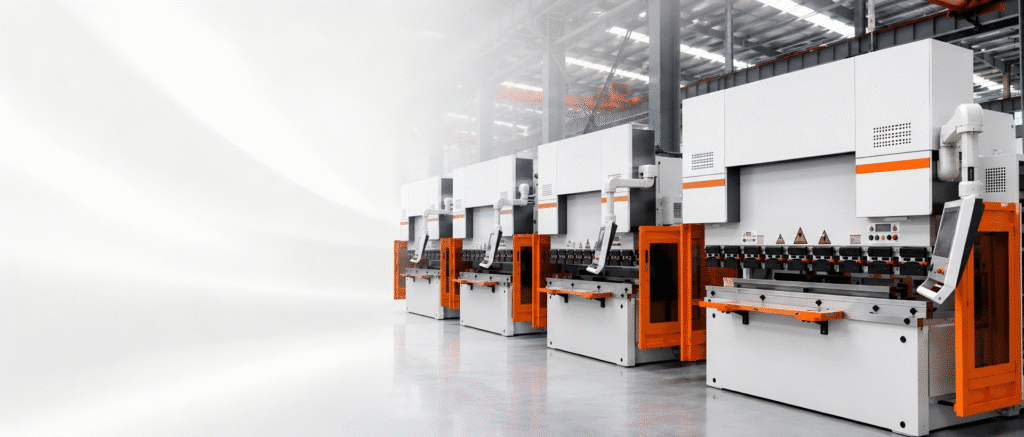
Servo Motor → Mechanical Drive → Ram Movement
The servo motor directly powers the mechanical bending drive without a hydraulic power unit.
Servo-Hydraulic Press Brake
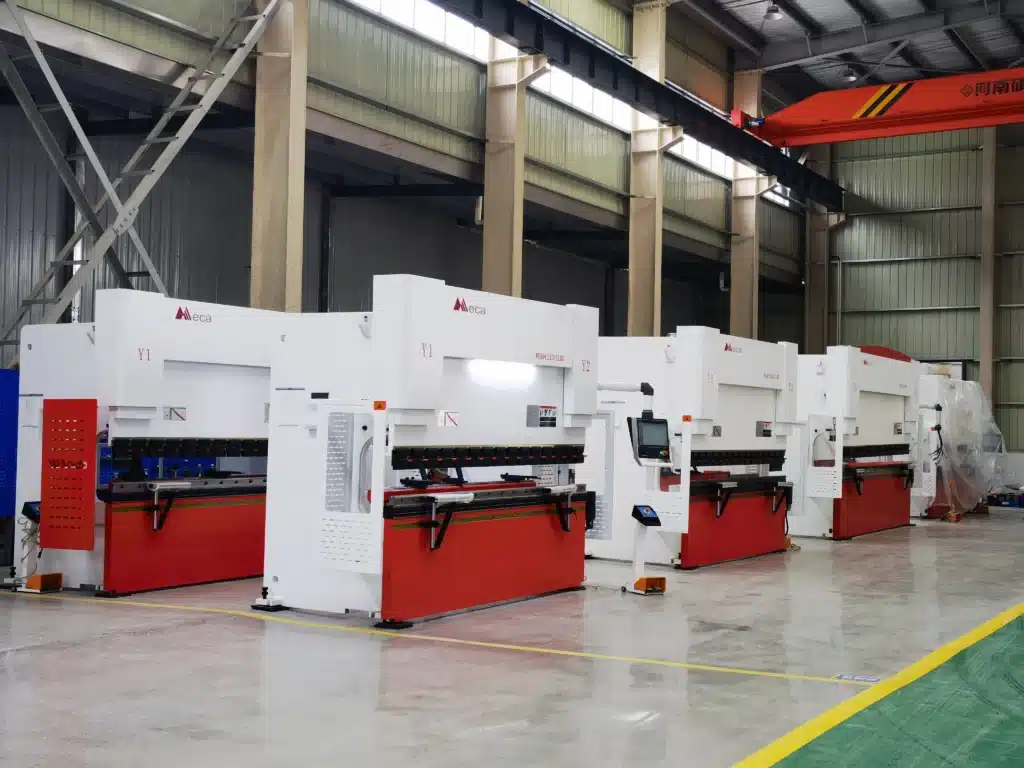
Servo Motor → Hydraulic Pump → Cylinders → Ram Movement
The machine still uses a hydraulic bending system, but the hydraulic pump is powered by a servo main motor.
This distinction is important.
Both machines use servo technology, but they are fundamentally different drive architectures.
For lower-tonnage precision sheet-metal applications, an all-electric press brake may be the better solution.
For applications requiring a wider tonnage and bending-length range, servo-hydraulic press brakes remain highly flexible.
Servo Motor vs Induction Motor: Which Is Better for a Hydraulic Press Brake?
There is no single motor technology that is automatically right for every application.
A conventional three-phase induction motor remains:
- Reliable
- Simple
- Economical
- Easy to understand and maintain
A servo main motor generally offers:
- Demand-based pump control
- Lower idle losses
- Lower standby noise
- Reduced unnecessary oil heating
- More flexible hydraulic response
For MECA’s standard servo-hydraulic press brakes, we choose the servo main motor because we believe these advantages provide a better overall hydraulic architecture for modern CNC bending production.
But the important point when comparing machines is not simply whether the quotation contains the word “servo.”
The buyer should understand:
Which servo motor?
Where is it used?
What does it control?
And what practical benefit does it provide?
That is how two press brake configurations should be compared.
FAQ
What is the difference between a servo motor and an induction motor?
A three-phase induction motor is generally simpler and less expensive, while a servo motor works with a servo drive and feedback control to provide more flexible control of speed and torque. In a hydraulic press brake, a servo main motor can vary hydraulic pump speed according to system demand, reducing unnecessary energy consumption, heat and standby noise.
Is a servo motor better than an induction motor for a press brake?
For a modern servo-hydraulic press brake operating regularly, a servo main motor generally provides advantages in pump control, energy efficiency, heat management and response. However, a conventional induction motor can still be suitable for simpler or cost-sensitive applications.
Does a servo motor improve press brake bending accuracy?
Not directly. Bending accuracy mainly depends on Y1/Y2 closed-loop control, linear scale feedback, proportional valves, CNC control, machine rigidity and crowning. The servo main motor primarily improves hydraulic power control and efficiency.
Are all CNC press brakes servo-driven?
Not necessarily. Many CNC press brakes use servo motors for the back gauge while still using a conventional induction motor for the hydraulic pump. Buyers should verify whether the main hydraulic motor itself is servo-driven.
Which Press Brake Drive System Is Right for Your Application?
MECA offers two servo-based bending solutions for different applications:
All-Electric Press Brake
Best suited for lower-tonnage, high-efficiency precision sheet-metal applications.
Explore Electric Press Brakes
Servo-Hydraulic Press Brake
Suitable for a wider range of tonnage, bending lengths and medium-to-heavy fabrication applications.
Explore Servo-Hydraulic Press Brakes
If you are comparing different press brake configurations, we can also help you understand whether the motor, hydraulic system, CNC configuration and safety package offered by different suppliers are truly equivalent.