Press Brake Frame Thickness: How to Compare Machine Rigidity
Table of Content
This post is also available in:
Press brake frame thickness matters because the side frames, ram and worktable must resist deformation under bending load. However, a thicker frame does not automatically mean a more accurate or better press brake.
Frame geometry, reinforcement, working length, tonnage, throat depth, welding, stress relief and machining all influence structural rigidity.
For buyers comparing two press brakes, plate thickness should therefore be treated as one measurable part of the complete frame design, rather than a standalone indicator of machine quality.
Which Parts of a Press Brake Frame Carry the Bending Load?
The main load-bearing structure of a press brake includes the side frames, ram, worktable and the structural members connecting them.
During bending, force is transmitted through the ram and tooling into the workpiece, worktable and machine frame.
The main structural areas include:
- Side frames or uprights
- Ram / slider
- Worktable
- Upper and lower cross-members
- Reinforcement plates and ribs
- Cylinder mounting areas
- Throat area
Each component contributes differently to overall machine stiffness.
This is why comparing only one dimension—such as side-frame plate thickness—does not provide a complete picture of press brake rigidity.
Why Does Frame Rigidity Affect Bending Accuracy?
A press brake frame experiences elastic deformation whenever bending force is applied.
Some deformation is unavoidable. The engineering objective is to keep it controlled and predictable so that the ram, tooling and worktable maintain the required relationship under load.
If structural deflection becomes excessive, operators may experience:
- Different bend angles between the center and ends of a part
- Greater dependence on crowning compensation
- More adjustment between production batches
- Uneven tooling loads
- Lower repeatability on long or high-load bends
Frame rigidity therefore affects how well the machine maintains its geometry during bending.
However, rigidity cannot be determined from plate thickness alone because a press brake works as a complete load-bearing structure.
Is a Thicker Press Brake Frame Always Better?
No. A thicker steel plate can increase stiffness, but simply adding steel is not the same as designing a better frame.
In structural engineering, flexural rigidity is related to:
E × I
where:
- E = elastic modulus of the material
- I = second moment of area of the structural section
For press brakes manufactured from similar structural steel, the geometry of the frame can therefore be just as important as the raw plate thickness.
Two machines may use the same side-frame thickness but behave differently if one has:
- Better rib placement
- A taller or deeper structural section
- More effective cross-members
- Different throat geometry
- Better load distribution
- A stronger ram and worktable structure
For this reason, the better question is not:
“Which press brake uses the thickest steel?”
It is:
“How is the complete frame designed to control deformation under rated bending load?”
What Else Determines Press Brake Frame Rigidity?
Several factors need to be evaluated together with plate thickness.
Working Length
Longer machines are more difficult to keep rigid because the span of the ram and worktable increases.
For example, a 100-ton × 1600 mm press brake and a 100-ton × 3200 mm press brake should not be compared by tonnage alone.
The longer machine requires a different structural solution to control deformation across the larger span.
Rated Tonnage
Higher bending force creates greater structural loads.
The side frames, ram, worktable and reinforcement must therefore be designed according to both the rated force and how that force travels through the machine.
Throat Depth
A deeper throat changes the side-frame geometry and increases the distance between the applied load and structural support.
This can influence deformation and must be considered during frame design.
Ram and Worktable Structure
The ram and worktable behave like structural beams during bending.
Their height, thickness and reinforcement influence how much they deflect across the working length.
Reinforcement Design
Ribs and reinforcement plates can increase stiffness without simply increasing every plate thickness.
Their position is important because reinforcement should support the actual load path.
Welding, Stress Relief and Machining
A welded press brake frame is also affected by the manufacturing process.
Welding introduces heat and residual stress. Welding sequence, fixture control and stress-relief treatment can influence the final geometry.
Critical reference surfaces should then be accurately machined after the frame structure has been stabilized.
This affects the alignment of components such as the cylinders, ram guides and worktable.
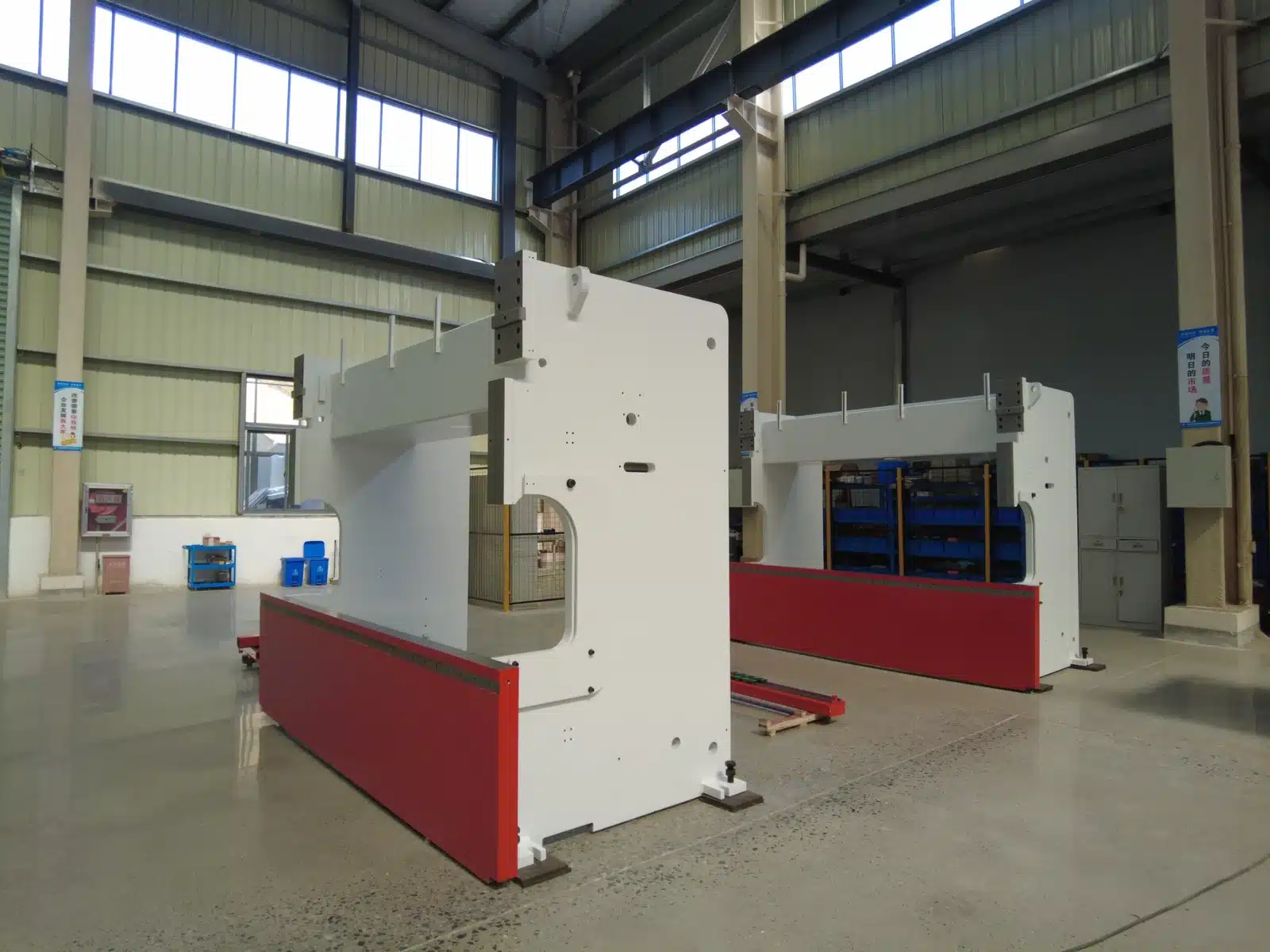
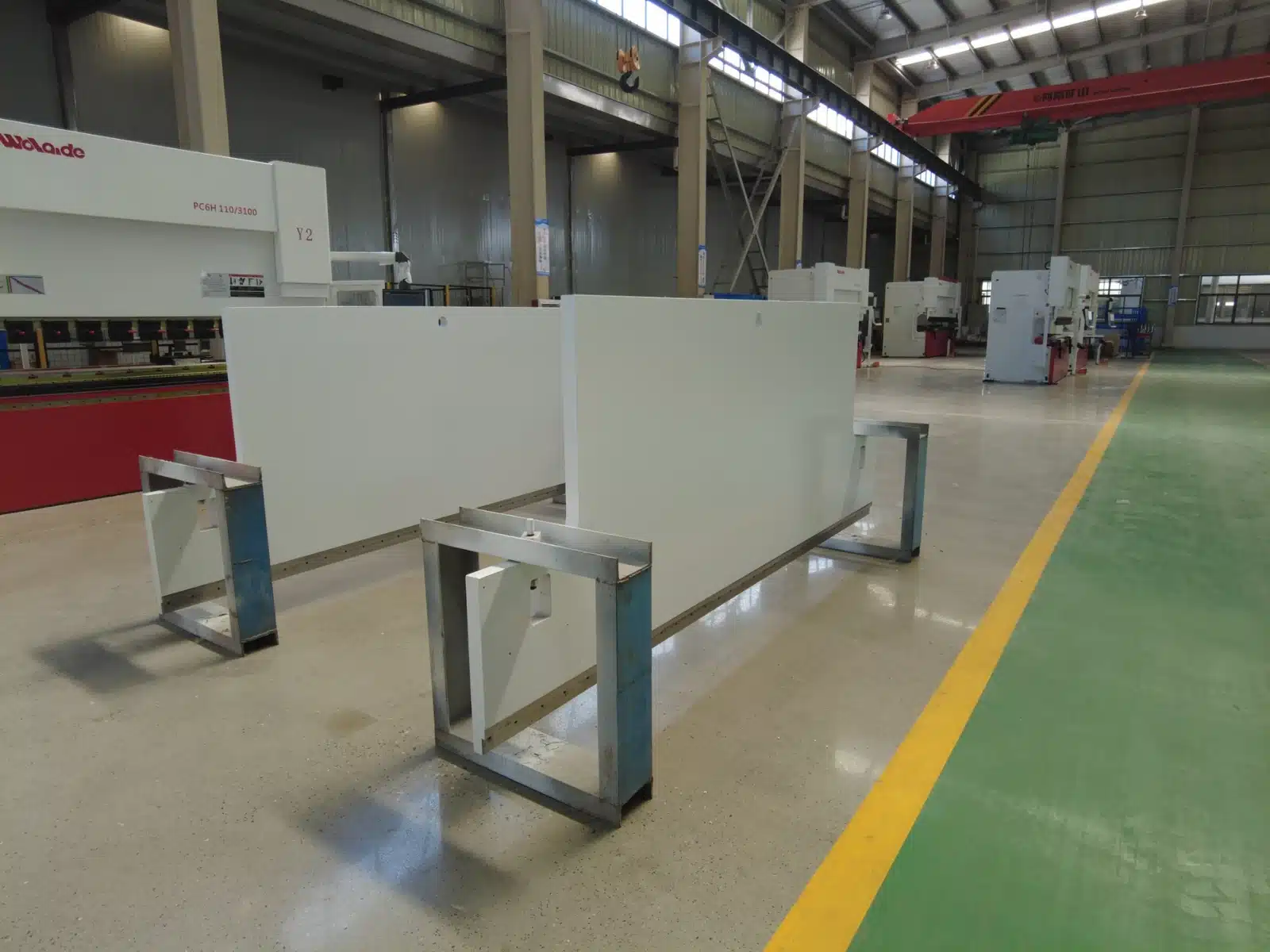
Real Example: MECA 225T × 4100 mm Press Brake Frame
A real machine provides a more useful reference than a universal “recommended frame thickness” chart because frame dimensions vary by machine design.
For one MECA 225T × 4100 mm hydraulic press brake configuration, the main structural plate dimensions are:
| Structural Component | Thickness |
|---|---|
| Side Plate | 70 mm |
| Ram / Slider | 90 mm |
| Worktable | 120 mm |
These dimensions apply to this specific 225-ton × 4100 mm machine configuration.
They should not be interpreted as universal industry standards for every 225-ton press brake.
The purpose of publishing these measurements is to give buyers a concrete reference from an actual machine.
|
|
|
|

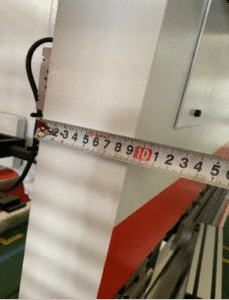
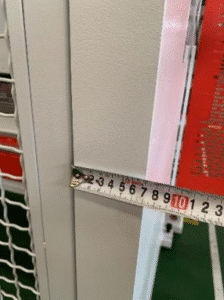
If a buyer is comparing another 225T × 4100 mm press brake, equivalent structural dimensions can be requested from the other manufacturer.
The complete frame can then be compared instead of relying only on advertised tonnage.
How Should Buyers Compare Two Press Brake Frames?
A meaningful comparison should start with machines of approximately the same specification.
Ideally, compare similar:
- Rated tonnage
- Working length
- Throat depth
- Stroke
- Daylight
- Machine configuration
Then compare the frame structure.
| Item to Compare | Machine A | Machine B |
|---|---|---|
| Rated tonnage | ||
| Working length | ||
| Throat depth | ||
| Side-frame thickness | ||
| Ram structure / thickness | ||
| Worktable structure / thickness | ||
| Reinforcement design | ||
| Stress-relief process | ||
| Final machining method | ||
| Crowning system | ||
| Machine weight |
Machine weight can provide additional context, but it should not be used alone.
A heavier machine contains more material, but total weight does not show where that material is located or how effectively it supports the bending load.
What Should You Ask a Press Brake Manufacturer?
Buyers do not need to perform their own structural calculations. A few practical questions can already make machine comparisons much more transparent.
First, ask for the actual dimensions of the side frames, ram and worktable for the specific machine you are purchasing.
Next, ask how the frame is reinforced. Look at rib placement, cross-members and how the side frames connect to the worktable and upper structure.
For welded frames, ask what process is used after welding and before final precision machining.
You can also ask how important reference surfaces are machined, especially:
- Cylinder mounting positions
- Ram guide areas
- Worktable surfaces
- Tooling reference surfaces
For new or customized structures, ask whether structural analysis such as FEA is used during design.
FEA can help engineers examine stress concentration and deformation, but an FEA screenshot alone does not prove machine quality. The model, load conditions and manufactured structure must correspond with each other.
Real production photos, drawings and factory inspection can provide additional confirmation that the delivered structure matches the specification.
Does Crowning Replace the Need for a Rigid Frame?
No. Crowning and frame rigidity solve related but different problems.
A rigid frame helps control unwanted structural deformation.
A crowning system compensates for predictable deflection across the working length so that bending angles remain more consistent from the center to the ends of the workpiece.
Long hydraulic press brakes may therefore use mechanical or hydraulic crowning even when the frame is properly designed.
Crowning should not be considered a substitute for adequate structural rigidity.
Why Should Buyers Avoid Universal Frame Thickness Standards?
There is no single side-frame thickness that defines whether every press brake is correctly designed.
For example, a statement such as:
“A 200-ton press brake must use an 80 mm side frame.”
ignores important differences in:
- Working length
- Throat depth
- Ram geometry
- Worktable geometry
- Reinforcement
- Material distribution
- Overall load path
Frame thickness tables can be useful as manufacturer-specific references, but they should not be treated as universal engineering standards.
The more reliable approach is to evaluate the complete frame structure for a specific tonnage and working length.
Frequently Asked Questions
Does thicker steel always make a press brake more accurate?
No. Thickness contributes to stiffness, but frame geometry, reinforcement, machining and load distribution also affect bending performance.
What press brake frame thickness should I look for?
There is no universal value. Frame thickness should be evaluated together with tonnage, working length, throat depth and structural design.
What is the most important frame dimension to compare?
There is no single most important dimension. Compare the side frames, ram and worktable together.
Can I compare press brakes only by machine weight?
No. Machine weight does not show where the material is located or how the bending load is distributed through the frame.
Why do two 100-ton press brakes have different frame thicknesses?
They may use different working lengths, throat depths, reinforcement layouts or structural geometries.
Does a longer press brake need a different frame structure?
Usually yes. Longer ram and worktable spans make deformation control more difficult and must be considered during design.
Does crowning compensate for a weak press brake frame?
No. Crowning compensates for predictable deflection but should not replace adequate structural rigidity.
Is FEA proof that a press brake frame is strong?
Not by itself. FEA is a design tool, and its value depends on whether the model, load conditions and manufactured structure correspond.
Conclusion
Press brake frame thickness is important, but it should never be evaluated alone.
The side frames, ram and worktable work together as one structural system. Working length, rated tonnage, throat depth, reinforcement, welding, stress relief and machining all influence how the press brake behaves under bending load.
For buyers, the most useful approach is to compare equivalent machines using actual structural dimensions and manufacturing details, rather than assuming that the machine with the thickest plate or highest weight is automatically better.