Why This Customer Upgraded from a 30T to a 40T Electric Press Brake
Table of Content
📋 The Challenge
A customer had been using a traditional 30-ton press brake to produce thin stainless steel parts with bending lengths of up to approximately 1.5 meters.
The machine could still bend the parts, but several limitations were beginning to affect daily production. The customer wanted more capacity for future workpieces, faster tool changes for different jobs, and better safety protection for operators.
The question was not simply whether the customer needed a larger press brake.
The real question was: which upgrades would actually improve production, and which expensive features were unnecessary?
After reviewing the customer’s workpieces and production requirements, we recommended a 40T/1600mm electric press brake with a configuration focused on the functions the customer would actually use.
What Was Limiting the Existing 30T Press Brake?
The existing 30T machine had served the customer’s production needs for many years, but three areas needed improvement.
Capacity and Working Length
The customer mainly processed thin stainless steel, with some workpieces approaching 1.5 meters in bending length.
Rather than continuing to operate close to the practical limits of the existing machine, the customer wanted additional capacity for future production.
A 40-ton machine provided more flexibility for different workpieces, while the 1600mm working length covered the customer’s current bending requirements without moving directly to a significantly larger machine.
Slow Tool Changes
The existing press brake used a traditional manual bolted clamping system.
For a workshop producing different types of parts, frequent tool changes can consume valuable production time. The customer therefore wanted a faster and more convenient way to change tooling.
In this case, improving the tool clamping system could have a greater impact on daily production efficiency than simply adding more CNC axes.
Operator Safety
The existing machine also lacked modern safeguarding around the bending area.
For the replacement machine, operator safety became an important consideration. An appropriate safety protection system could help reduce risks during daily bending operations without unnecessarily complicating the machine.
Did the Customer Need a More Complex Press Brake?
When upgrading an older press brake, it can be tempting to add more CNC axes and automation features.
However, more axes do not automatically mean a better machine for every application.
After reviewing the customer’s actual workpieces, we found that the parts were relatively straightforward and did not require complex multi-axis backgauge positioning.
For this application, adding Z1/Z2 axes would increase the machine cost without providing significant benefits in daily production.
Instead, we focused the machine configuration on the functions that directly addressed the customer’s actual requirements.
The goal was not to build the highest-specification machine possible, but to select the right specifications for the work being produced.
Why We Recommended a 40T/1600mm Electric Press Brake
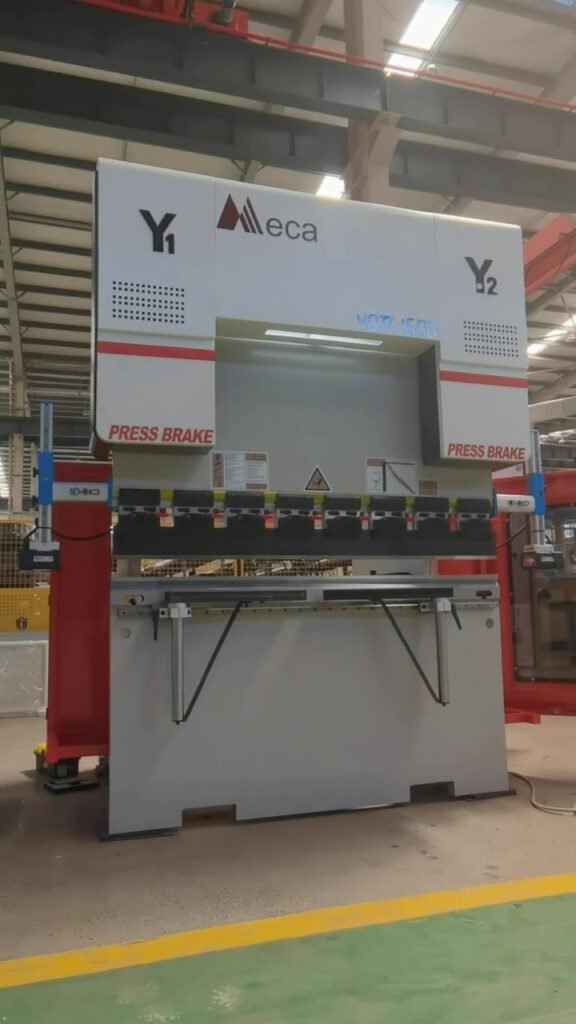
Based on the customer’s workpieces, production process and upgrade requirements, we recommended a 40T/1600mm electric press brake.
There were several reasons behind this recommendation.
More Capacity for Future Production
Moving from 30 tons to 40 tons provided additional bending capacity for future workpieces.
The customer did not necessarily need a much larger machine. The 40-ton capacity provided a practical upgrade while avoiding unnecessary investment in oversized equipment.
A Suitable 1600mm Working Length
With workpieces approaching 1.5 meters, a 1600mm working length provided sufficient space for the customer’s current production.
This allowed the customer to meet existing requirements while maintaining some additional working margin.
Electric Drive for Thin-Sheet Production
The customer mainly produced thin stainless steel components.
An electric press brake provides precise ram control and repeatable positioning, making it well suited to applications involving frequent bending of small and medium-sized sheet metal parts.
The electric drive system also offers clean operation without hydraulic oil and can reduce energy consumption during intermittent production.
Faster Tool Changes
Because the customer frequently changed between different jobs, improving the tooling system was an important part of the upgrade.
A quick clamping system makes tool changes faster and more convenient compared with the traditional bolted clamping system on the customer’s existing machine.
For this workshop, faster tool changes could provide more practical daily value than adding unnecessary backgauge axes.
What We Did Not Recommend
An important part of selecting a new press brake is deciding not only what to add, but also what is unnecessary.
For this customer, we did not recommend:
- An oversized press brake with significantly more tonnage than required
- Z1/Z2 backgauge axes that the actual workpieces did not require
- An unnecessarily complex machine configuration
Instead, the investment was focused on the features that directly improved production: appropriate capacity, sufficient working length, electric drive technology, faster tool clamping and operator safety.
The goal was not to recommend the most expensive press brake. It was to solve the limitations of the customer’s existing machine.
What Can Other Buyers Learn from This Upgrade?
When replacing an older press brake, simply moving to the next larger tonnage is not always the right approach.
Before selecting a new machine, it is worth asking:
Is the existing tonnage actually insufficient?
Is the working length limiting production?
Are slow tool changes reducing efficiency?
Do the workpieces really require additional backgauge axes?
Is the existing safety system adequate?
Which machine functions will actually be used every day?
For this customer, the right upgrade was a 40T/1600mm electric press brake with faster tool clamping, appropriate safety protection and a backgauge configuration matched to the actual workpieces.
The result was not simply a larger press brake, but a machine better suited to the customer’s daily production.
If you are considering upgrading an older press brake, send us your material, thickness, bending length and workpiece information. We can help evaluate which machine specifications and configurations are actually necessary for your production.