How to Choose a Press Brake Manufacturer: 10 Things to Check Before Buying
Table of Content
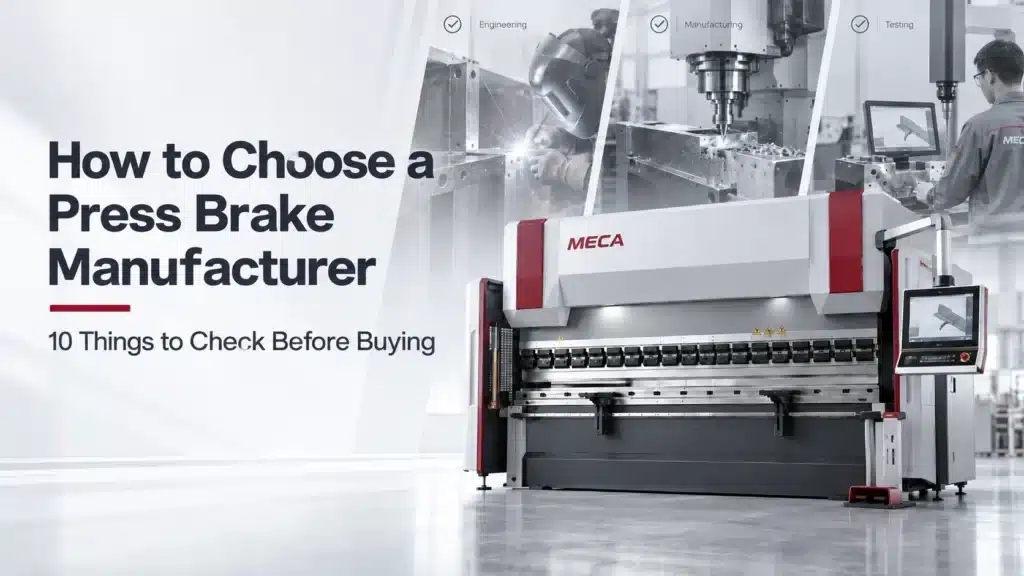
Choosing a press brake manufacturer should involve much more than comparing tonnage, working length and price.
Two suppliers may both offer a 110-ton × 3200 mm CNC press brake, but the machines can be very different in terms of frame design, CNC control, backgauge configuration, hydraulic or electric drive system, crowning, tooling, safety equipment, testing standards and after-sales support.
A reliable press brake manufacturer should be able to do three things:
- Recommend the right machine for the parts you actually produce.
- Clearly explain what is included in the machine you are buying.
- Provide evidence of manufacturing, testing and after-sales capability.
Before comparing quotations, use the following 10 points to evaluate each supplier.
1. Can the Manufacturer Select the Press Brake Based on Your Actual Parts?
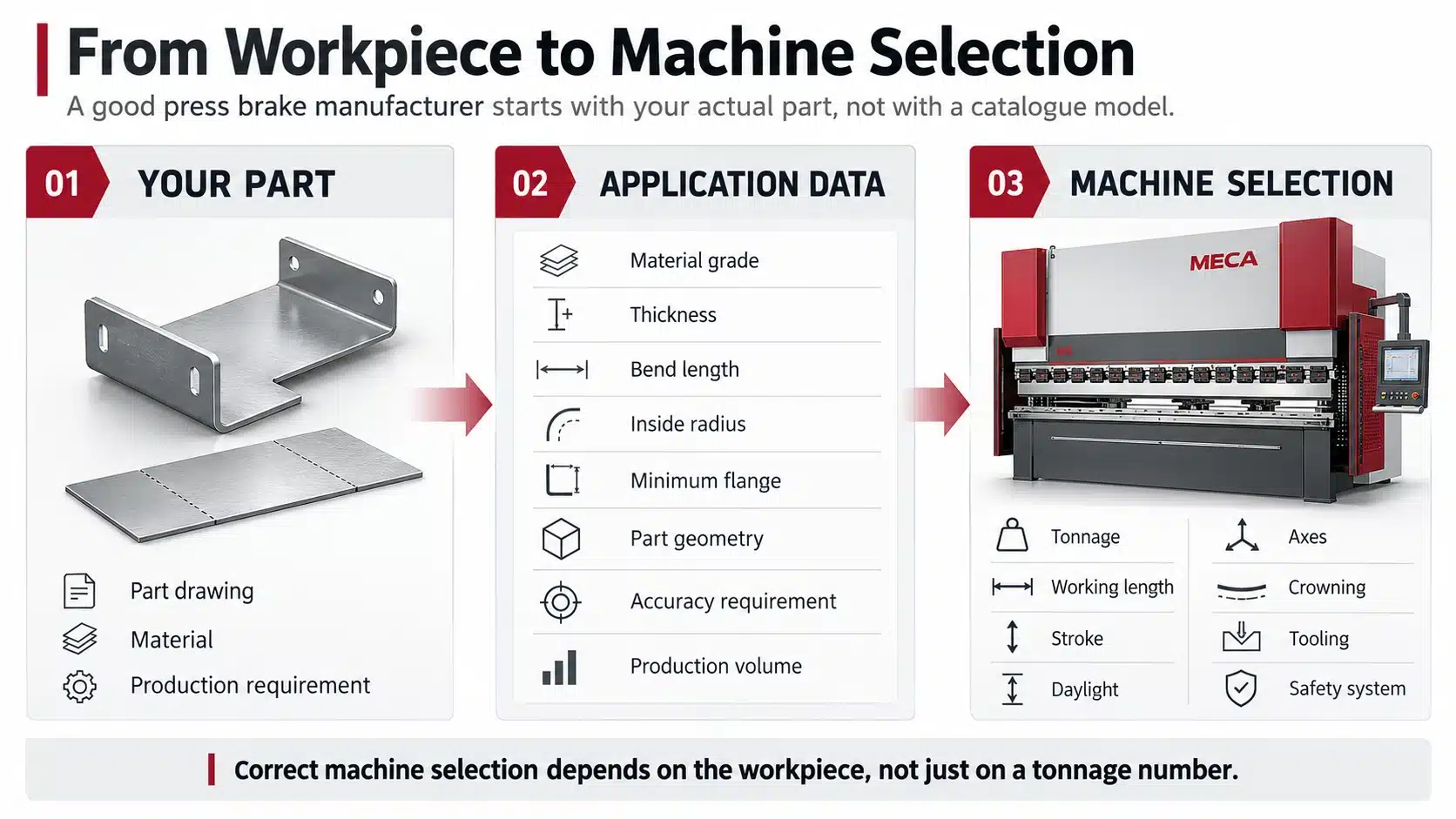
This should be the first question.
A press brake should not be selected only by saying:
“I need a 100-ton press brake.”
The required machine depends on what you actually need to bend.
A competent manufacturer should ask about:
- Material type and grade
- Maximum material thickness
- Maximum bending length
- Minimum flange size
- Inside bending radius
- Part geometry
- Production volume
- Required accuracy
- Tooling requirements
- Special bending applications
For example, bending a 3 mm mild-steel sheet over 1000 mm requires a very different machine capacity from bending the same material over 3000 mm.
The V-die opening also directly affects the required bending force.
What you should expect from the supplier
The manufacturer should be able to determine:
- Required tonnage
- Working length
- Stroke
- Daylight
- Throat depth
- Backgauge configuration
- Number of CNC axes
- Crowning requirement
- Tooling configuration
- Hydraulic or electric drive type
If the supplier recommends a machine before understanding your parts, ask for the engineering basis behind the recommendation.
→ Not sure how much bending force you need? Use our Press Brake Tonnage Calculator.
2. Is the Machine Configuration Clearly Defined?
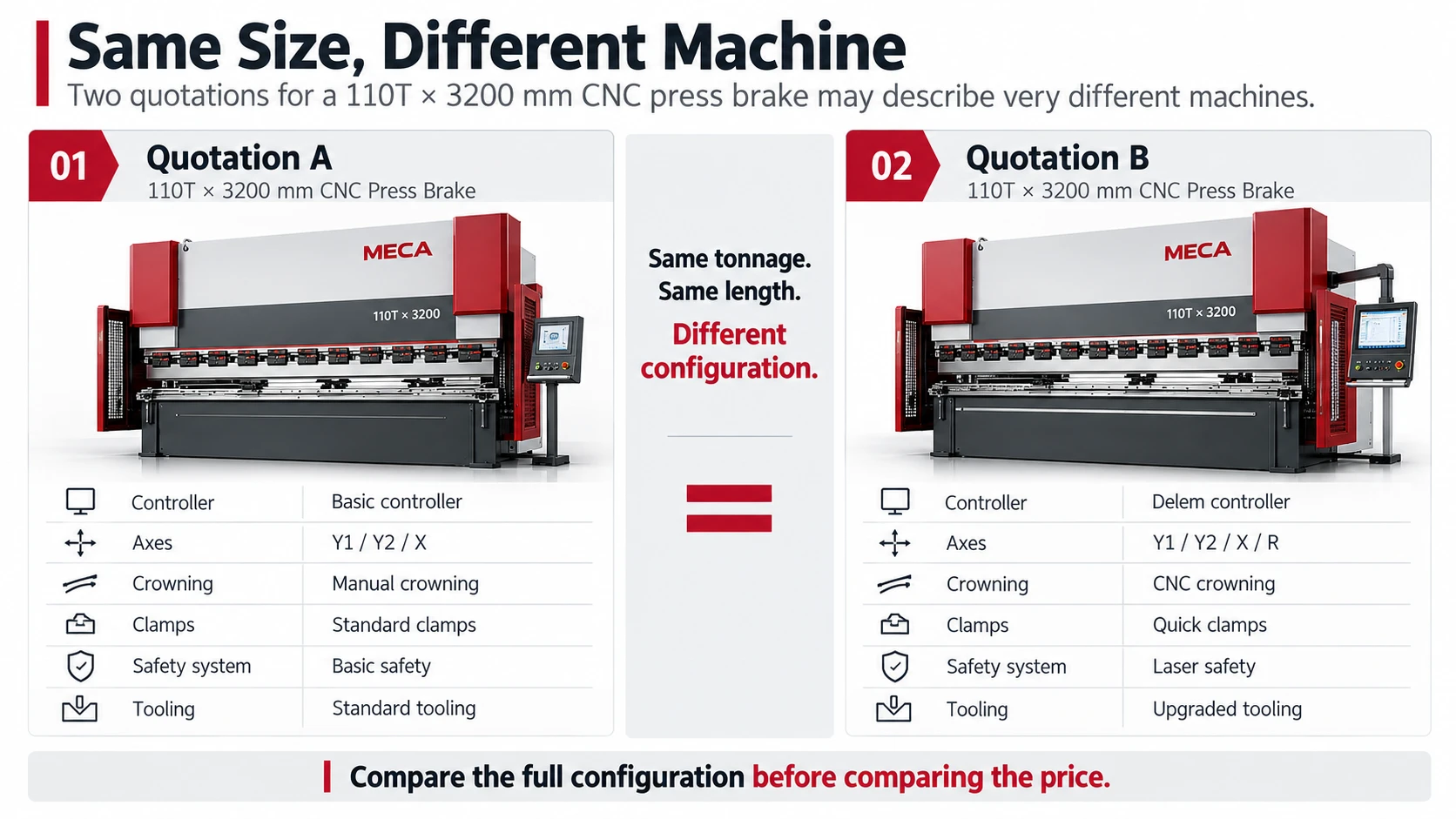
One of the biggest mistakes when comparing press brake quotations is comparing only:
Tonnage + working length + price.
For example:
110T × 3200 mm CNC Press Brake
does not tell you enough about the machine.
You should also compare:
| Item | What to Check |
|---|---|
| CNC controller | Brand and exact model |
| Controlled axes | Y1/Y2/X/R/Z1/Z2, etc. |
| Backgauge | Structure, travel and positioning method |
| Drive system | Hydraulic, hybrid or electric |
| Hydraulic components | Pump, valves and main hydraulic components |
| Linear scales | Brand and configuration |
| Crowning | Manual or CNC |
| Tool clamping | Standard or quick clamping |
| Tooling | Punch and die type |
| Safety | Guards, light curtain or laser protection |
| Electrical system | Main component brands |
| Machine dimensions | Overall size and weight |
This is especially important when comparing machines from different manufacturers.
A lower quotation may simply include a different configuration.
Good quotation vs unclear quotation
An unclear quotation might say:
CNC press brake, 4 axes, European components.
A better quotation should identify exactly what those components and axes are.
The more clearly the configuration is defined before the order, the easier it is to verify the machine before shipment.
3. Can You Verify the Manufacturer’s Actual Production Capability?
Before choosing a press brake manufacturer, understand how the machine is actually produced.
Typical press brake manufacturing stages include:
Material preparation → Cutting → Welding → Machining → Assembly → Electrical integration → Commissioning → Testing → Packing
Photos and videos of real production stages are more useful than generic claims such as:
“We have advanced manufacturing technology.”
You do not necessarily need every component to be manufactured in-house.
What matters is whether the manufacturer understands and controls the processes that affect machine geometry, accuracy and reliability.
→ See MECA Press Brake Manufacturing Capability.
4. Does the Manufacturer Explain Why Each Configuration Is Recommended?
More expensive does not automatically mean better.
For example, not every buyer needs:
- 6-axis backgauge
- DA-69S
- Automatic tool clamping
- CNC Z1/Z2
- Laser angle measurement
- Premium tooling
At the same time, choosing the cheapest configuration can create unnecessary limitations later.
A good manufacturer should explain:
Why do you need this option?
For example:
A simple part with repetitive bends may only require a relatively basic backgauge.
A complex part with different bend positions may benefit from independent Z1/Z2 positioning.
High-mix production may justify a more advanced CNC controller, while a simple repetitive application may not.
The key question
Do not ask only:
“What is your best configuration?”
Ask:
“Why is this configuration suitable for my parts?”
This is one of the easiest ways to distinguish application engineering from simple equipment selling.
5. What Quality Checks Are Performed Before Shipment?
Almost every manufacturer says:
“Every machine is tested before shipment.”
That statement alone tells you very little.
Ask what is actually tested.
Depending on the machine configuration, inspection may include:
- Machine geometry
- Ram movement
- Y1/Y2 positioning
- Backgauge positioning
- CNC axis movement
- Crowning operation
- Electrical functions
- Safety functions
- Hydraulic system operation
- Tool alignment
- Bending test
- Repeated positioning
- Final configuration verification
For a CNC press brake, a visual inspection alone is not enough.
The machine should be commissioned as a complete system.
Ask for evidence
Before shipment, you can request:
- Test photos
- Bending videos
- Controller operation videos
- Machine serial information
- Final configuration confirmation
- Packing photos
The exact documentation will vary between manufacturers, but the supplier should be able to explain the inspection process clearly.
→ See How MECA Performs Press Brake Quality Control.
6. Can You Track What Happens During Production?
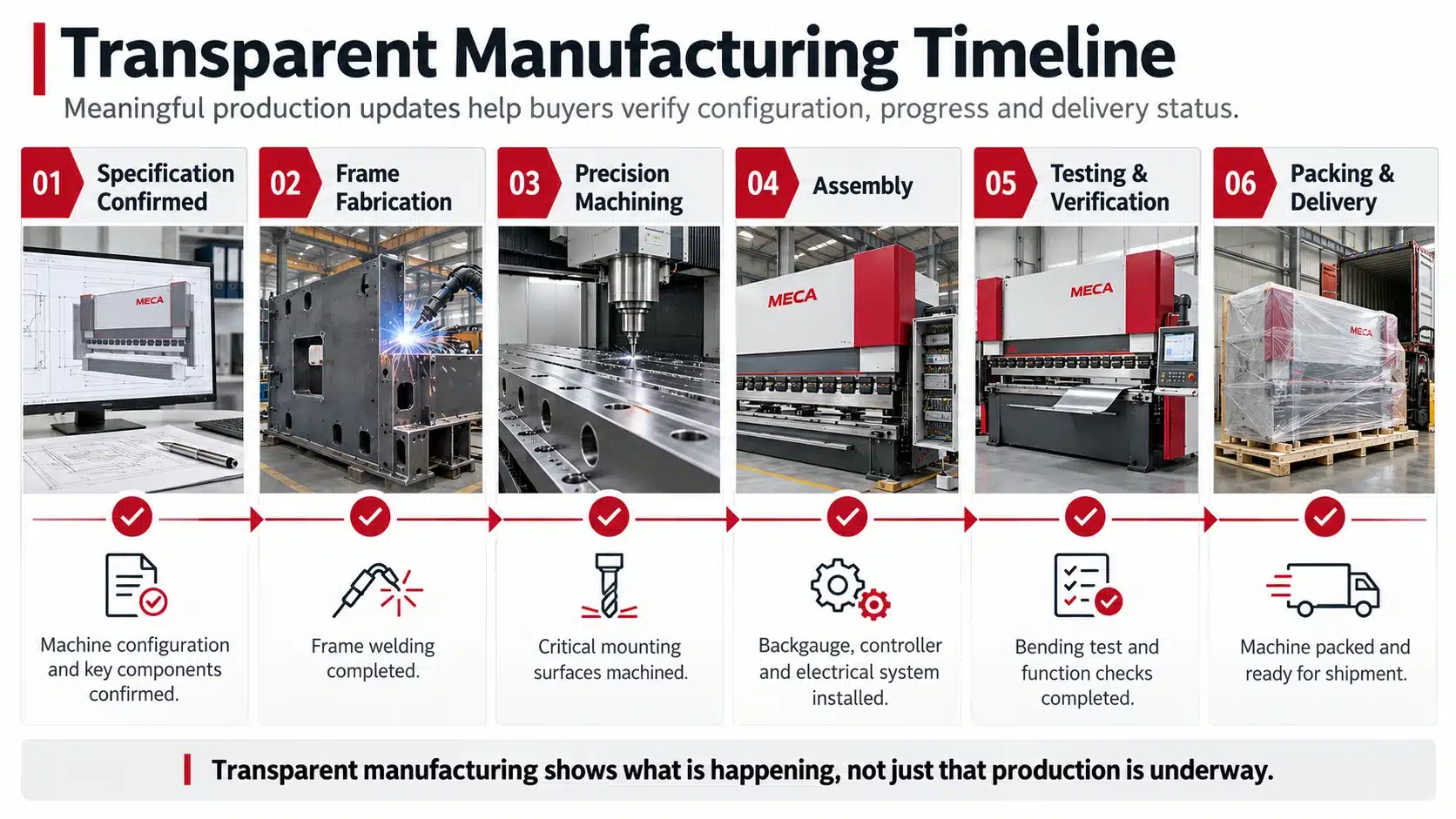
This is especially important when purchasing a customized machine internationally.
A statement such as:
“Your machine is under production.”
does not provide much useful information.
More meaningful production updates are:
Frame welding completed. Machining is scheduled next.
or:
CNC controller, backgauge and electrical cabinet have been installed. Functional commissioning is underway.
or:
Final configuration has been checked and bending tests are complete. The machine is being prepared for packing.
Production visibility helps reduce misunderstandings about:
- Machine configuration
- Optional equipment
- Production status
- Testing progress
- Delivery schedule
It also gives the buyer an opportunity to identify discrepancies before the machine reaches the destination.
This is why production transparency is useful not only for project management, but also for risk control.
→ Learn More About MECA Transparent Manufacturing.
7. What Happens After the Machine Arrives?
Press brake purchasing does not end when the machine is loaded into a container.
Before choosing a supplier, understand what happens after delivery.
Ask about:
- Installation guidance
- Remote commissioning
- CNC controller setup
- Operator training
- Bending support
- Troubleshooting
- Electrical support
- Spare parts
- Warranty
- On-site service availability
For international buyers, remote service capability is particularly important.
A supplier should have a clear process for diagnosing problems.
For example:
Problem reported → information collected → technical diagnosis → corrective action → parts supplied if required
Instead of simply saying:
“We provide lifetime technical support.”
Ask exactly what that support includes.
8. Can the Manufacturer Support Spare Parts and Consumables?
Press brakes are long-term production equipment.
Some components may need replacement during the machine’s service life.
Examples include:
- Seals
- Sensors
- Electrical components
- Backgauge components
- Safety devices
- Tooling
- Clamping components
- Hydraulic parts
Before buying, ask whether the manufacturer keeps records of the configuration supplied with your machine.
This becomes very important several years later.
If a replacement component is required, the supplier should be able to identify the correct specification from the machine record rather than asking the customer to rediscover everything.
9. Are You Comparing the Same Scope of Supply?
A common purchasing mistake is assuming the cheapest quotation represents the lowest total cost.
Consider two offers:
Supplier A
USD 24,000
Supplier B
USD 27,000
Supplier A initially looks cheaper.
But Supplier B may include:
- Better CNC controller
- Additional axes
- CNC crowning
- Safety system
- Tooling
- Quick clamping
- Training
- Larger spare-parts package
Once the specifications are normalized, the price difference may become much smaller.
Before making a decision, build a comparison table.
Press Brake Supplier Comparison Checklist
| Item | Supplier A | Supplier B | Supplier C |
|---|---|---|---|
| Tonnage | |||
| Working length | |||
| CNC controller | |||
| CNC axes | |||
| Crowning | |||
| Hydraulic/drive system | |||
| Backgauge | |||
| Tool clamping | |||
| Tooling included | |||
| Safety system | |||
| Bending test | |||
| Warranty | |||
| Training | |||
| Spare-parts support | |||
| Shipping scope |
Only compare price after the technical scope is aligned.
10. Is the Manufacturer Suitable for Your Type of Project?
There is no single press brake manufacturer that is ideal for every buyer.
Different suppliers may be better suited to different applications.
For example:
Standard production machine
Priorities may include:
- Price
- Reliability
- Standard configuration
- Delivery time
High-mix sheet metal production
Priorities may include:
- CNC capability
- Multiple backgauge axes
- Fast setup
- Tooling flexibility
High-accuracy production
Priorities may include:
- Frame and ram accuracy
- Linear scales
- Crowning
- Controller capability
- Stable repeatability
Distributor / OEM project
Additional priorities may include:
- Branding customization
- Component customization
- Documentation
- Long-term configuration consistency
- Dealer support
The best manufacturer is therefore not simply the largest factory or the lowest-priced supplier.
It is the manufacturer whose engineering, machine configuration, manufacturing capability and service model fit your actual production requirements.
Manufacturer vs Trading Company: Does It Matter?
Buyers often ask whether they should purchase directly from a factory.
Direct manufacturing capability can be valuable, especially for:
- Customized specifications
- Technical changes
- OEM projects
- Configuration verification
- Long-term spare-parts support
However, being a factory alone does not guarantee a better machine.
Likewise, a distributor with strong application engineering and local service may provide significant value.
Instead of asking only:
“Are you a factory?”
Ask:
Who is responsible for machine selection, engineering, production, testing and after-sales support?
The answer is more useful.
What should I look for in a press brake manufacturer?
Look for application engineering capability, clearly defined machine specifications, verifiable manufacturing capability, documented testing procedures, after-sales support and a transparent quotation.
How do I compare two press brake manufacturers?
First make sure both suppliers are quoting the same tonnage, working length, CNC controller, axes, crowning, tooling, safety system and service scope. Compare price only after the technical specifications are aligned.
Should I buy a press brake directly from a manufacturer?
Buying directly from a manufacturer can be useful for customized machines, OEM projects and technical configuration control. However, engineering capability and after-sales support are more important than factory status alone.
How do I know what size press brake I need?
The required press brake depends mainly on material type, thickness, bending length, tooling and part geometry. Calculate the required bending force first, then determine working length and machine configuration.
Is a more expensive press brake always better?
No. A higher specification only adds value if your application requires it. The right machine should balance production requirements, accuracy, automation, reliability and cost.
What information should I send when requesting a press brake quotation?
Ideally send the material grade, maximum thickness, maximum bending length, part drawings, required radius, production volume and any special accuracy or automation requirements.