Full Electric vs Hydraulic Press Brake Maintenance
Table of Content
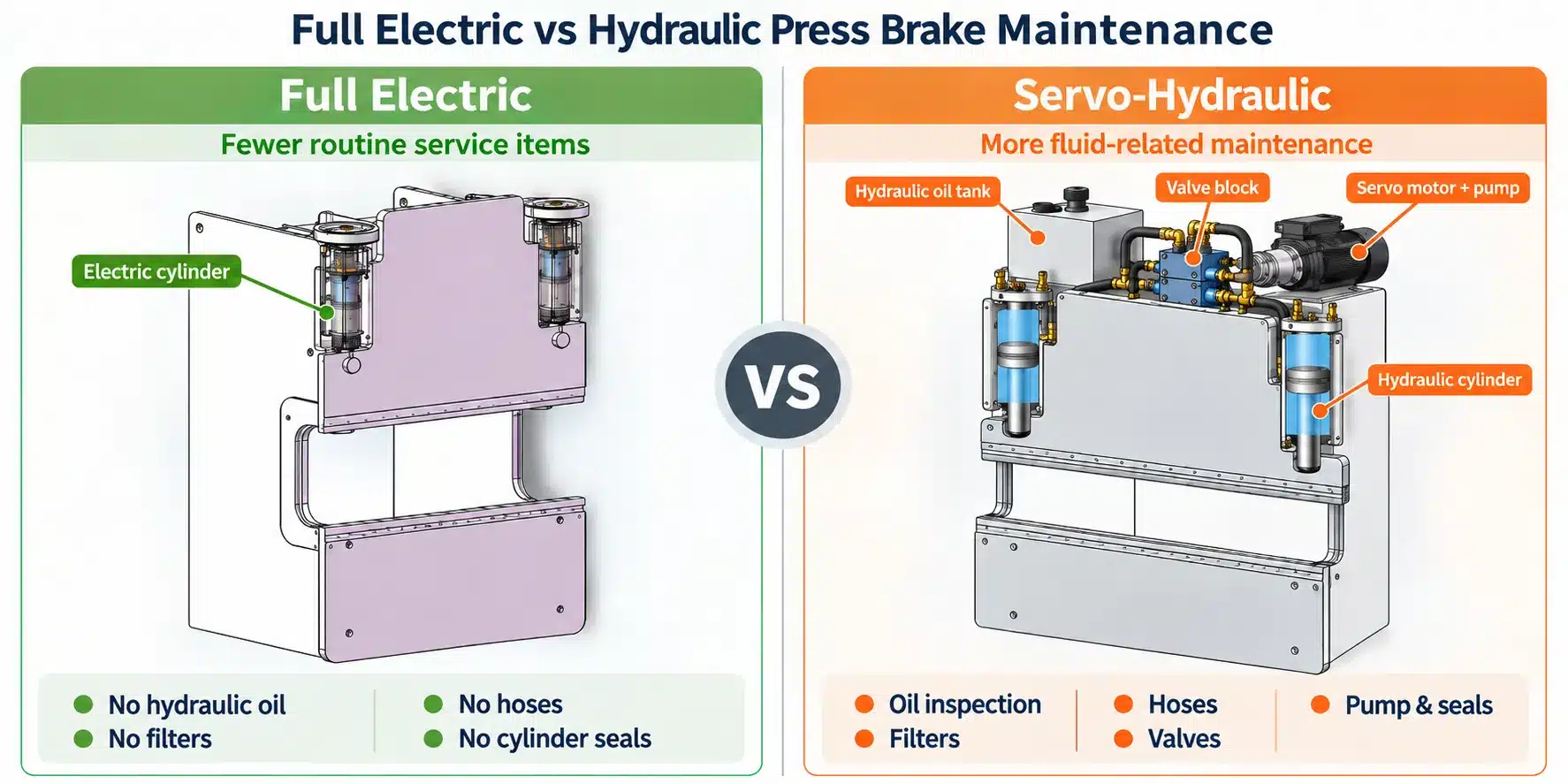
Maintenance is one of the clearest long-term differences between a full electric press brake and a servo-hydraulic press brake. A full electric machine removes the hydraulic circuit and therefore eliminates hydraulic oil, filters, hoses, valves, pumps and cylinder seals from its routine service list. A hydraulic machine requires more fluid-related inspection, but it remains a proven solution for higher tonnage, longer bending lengths and demanding heavy-duty work.
The practical conclusion is not that one machine is maintenance-free or that one technology is always better. Full electric press brakes generally have fewer routine service items and a cleaner maintenance environment, while hydraulic press brakes offer broader capacity and a large existing service base. Buyers should compare the type of maintenance, the availability of technicians and spare parts, and the cost of production downtime.
The Drive System Creates the Main Difference
A full electric press brake uses servo motors and a mechanical transmission to move and control the ram. Depending on the design, the transmission may include ball screws, roller screws, belts, pulleys, gearboxes or electric cylinders. Position feedback from linear encoders or motor encoders closes the control loop.
A servo-hydraulic press brake uses an electric motor to drive a hydraulic pump. Oil flow and pressure are controlled through valves and cylinders to move the ram. Modern hydraulic machines also use linear encoders and CNC control, but the force is still generated and transmitted through the hydraulic circuit.
This structural difference determines what the maintenance team must inspect. Electric machines concentrate service work on mechanical transmission, lubrication, servo systems and electrical cooling. Hydraulic machines add oil condition, filtration, leakage, pressure, valve, pump, hose and seal maintenance.
| Maintenance area | Full electric press brake | Servo-hydraulic press brake |
| Hydraulic oil | Not used | Check level, temperature and condition; replace according to condition and the manufacturer schedule |
| Filters | No hydraulic filter | Inspect clogging indicators and replace return or pressure filters as specified |
| Leaks | No hydraulic leakage risk | Inspect cylinders, manifolds, fittings, hoses and connections |
| Seals and hoses | Not part of the drive system | Wear items that may harden, crack or leak over time |
| Drive transmission | Inspect screws, belts, pulleys, bearings, gearboxes or electric cylinders according to design | Inspect pump, coupling, valves and cylinders in addition to mechanical guides |
| Lubrication | Lubricate guides, screws or transmission points as specified | Lubricate guides, backgauge and other mechanical points; hydraulic oil does not replace machine lubrication |
| Diagnostics | Servo alarms, encoder feedback, transmission wear and electrical temperature | Oil temperature, pressure stability, contamination, valve response, pump noise and cylinder synchronization |
| Typical spare parts | Belts, bearings, lubrication parts, sensors, servo-drive or transmission components | Filters, seals, hoses, fittings, valves, pump components and sensors |
What a Full Electric Press Brake Still Requires
The phrase low maintenance should not be confused with no maintenance. Removing hydraulics reduces the number of consumables and leak-related failures, but the electric drive remains a precision mechanical system.
- Clean the machine, tooling area and backgauge, and prevent metal dust from accumulating around moving components.
- Check safety devices, emergency stops, guards and light curtains before production.
- Lubricate guideways, ball screws, roller screws or other specified points with the correct lubricant and interval.
- Inspect belts, pulleys, couplings, bearings and fasteners where they are used, and monitor unusual noise or vibration.
- Keep electrical-cabinet filters, cooling fans and ventilation paths clean so servo drives operate within their temperature range.
- Review servo alarms, encoder feedback and positioning trends instead of clearing recurring alarms without diagnosis.
The exact transmission layout differs among manufacturers. A maintenance plan should therefore be based on the machine manual, working hours, load spectrum and shop environment rather than a generic calendar alone.
What a Hydraulic Press Brake Requires
Hydraulic maintenance focuses on keeping the oil clean, cool and contained. Contaminated or overheated oil can affect valves, pumps, seals and positioning stability. Hydraulic maintenance focuses on keeping the oil clean, cool and contained. Contaminated or overheated oil can affect valves, pumps, seals and positioning stability. Small leaks may also become larger failures if they are ignored. For a detailed diagnosis of common leak locations and root causes, see our hydraulic press brake oil leakage troubleshooting guide.
- Check oil level, oil temperature, visible leakage and abnormal pump noise during routine inspections.
- Inspect hoses, fittings, manifolds, cylinder areas and seals for seepage, abrasion, cracking or loosening.
- Monitor filter indicators and replace filters according to the machine manual and actual oil condition.
- Sample or inspect hydraulic oil when contamination, oxidation, water ingress or overheating is suspected.
- Verify pressure stability, ram synchronization and valve response when bend consistency changes.
- Keep the oil cooler, heat exchanger and ventilation paths clean where fitted.
A fixed oil-change interval should not be copied from another machine without checking the manufacturer instructions. Oil type, operating temperature, working hours, contamination control and local climate all affect service life.
Daily Weekly and Periodic Maintenance
| Interval | Tasks common to both | Technology-specific focus |
| Before each shift | Clean the work area; inspect tooling, guards, emergency stops and safety devices | Electric: listen for transmission noise. Hydraulic: check leaks, oil level and pump noise |
| Weekly | Clean backgauge and accessible guide areas; inspect cables and fasteners | Electric: inspect visible belts and lubrication points. Hydraulic: inspect hoses, fittings and filter indicators |
| Monthly or by hours | Check positioning consistency, tooling condition and machine alignment indicators | Electric: review servo alarms and cooling. Hydraulic: review temperature, pressure and oil condition |
| Periodic service | Follow the manufacturer checklist and document findings | Electric: service transmission and servo cooling. Hydraulic: service oil, filters, seals, valves and cooling as required |
Downtime and Service Skills
Full electric machines usually reduce downtime associated with oil leaks, clogged filters, damaged hoses and hydraulic contamination. Routine maintenance can also be cleaner and easier to schedule. However, a servo drive, encoder or precision transmission problem may require accurate remote diagnostics and trained electrical or mechanical support.
Hydraulic technicians and standard hydraulic components are widely available in many industrial markets. This can make some repairs easier to source locally. On the other hand, intermittent pressure loss, contamination or valve behavior can require systematic troubleshooting, and opening the circuit without proper cleanliness can introduce new problems.
For either technology, buyers should ask the supplier what can be diagnosed remotely, which spare parts are recommended for local stock, how electrical drawings and parameter backups are provided, and how quickly replacement parts can be dispatched.
Which Machine Has the Lower Maintenance Cost
For small and medium precision sheet-metal work, a full electric press brake will often have the lower routine maintenance burden because it eliminates hydraulic oil, filters, seals, hoses and leak management. It can be especially attractive for clean workshops, frequent start-stop production and users that want predictable daily upkeep.
Hydraulic press brakes normally involve more preventive maintenance, but purchase decisions should not be based on maintenance alone. When an application requires high tonnage, a long bending length, large parts or sustained heavy loading, hydraulic technology may provide the more appropriate capacity and overall value.
The correct comparison is total cost over the expected workload: scheduled maintenance, consumables, technician availability, spare-part lead time, energy use, production volume and the financial impact of unplanned downtime.
Conclusion
A full electric press brake simplifies maintenance by removing the hydraulic system, but it still requires correct lubrication, cleaning, inspection and servo-system care. A hydraulic press brake has more fluid-related service items, yet it remains the practical choice for many high-capacity applications.
The best machine is the one whose capacity, maintenance requirements and local support plan match the actual work. Share your material, thickness, bending length, part drawings and production volume with MECA. We can help compare the suitable electric and hydraulic configurations before quotation.