Electric Press Brake vs Hydraulic Press Brake: Which Should You Choose?
Table of Content
This post is also available in:
Choosing between an electric press brake and a hydraulic press brake is not simply a question of which technology is better.
At MECA, the two machine types are designed for different production needs.
Our electric press brakes focus on smaller parts, thin-sheet bending, repeatability, efficiency and automation, with standard models from 30 to 80 tons. Smaller machines can also be customized for specialized applications, such as a 12T/600 mm compact electric press brake.
Our servo-hydraulic press brakes cover a much wider capacity range, from 60 to 600 tons, making them suitable for general sheet metal fabrication, larger workpieces and higher-tonnage bending.
For bending requirements above 80 tons, MECA normally recommends a hydraulic press brake. In these applications, the hydraulic platform provides the higher pressing force and broader machine configuration range that most factories need.
The right choice therefore depends on three questions:
- What parts do you bend?
- How much force do you need?
- How do you organize production?
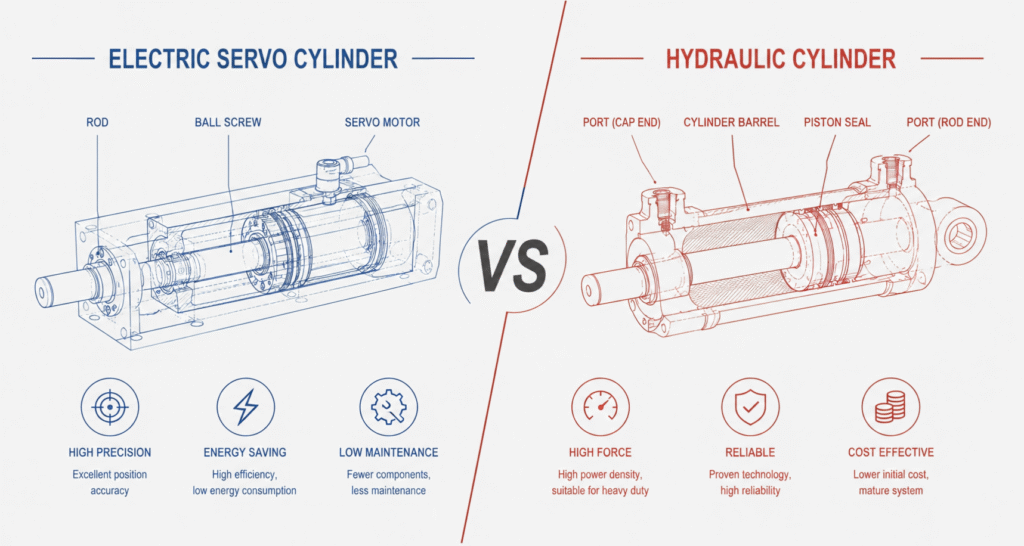
Electric vs Hydraulic Press Brake: Quick Comparison
| MECA Electric Press Brake | MECA Servo-Hydraulic Press Brake | |
 |
 |
|
| Tonnage Range | 30–80T | 60–600T |
| Smaller Custom Models | Available, e.g. 12T/600 mm | Available by project |
| Best For | Small parts, thin sheet, repetitive production | General and heavy-duty fabrication |
| Automation | Particularly suitable for robotic bending cells | Automation also available |
| Hydraulic Oil | No | Yes |
| Configuration Flexibility | More standardized | Highly configurable |
| Higher Tonnage | Not normally recommended above 80T | Major advantage |
| Typical Production | Repetitive and high-efficiency | Flexible and varied |
The key difference is not simply electric versus hydraulic.
It is the type of production each machine is designed to support.
How Does an Electric Press Brake Work?
A MECA electric press brake uses servo motors to drive the ram movement directly through a mechanical transmission system.
The rotational movement of the servo motors is converted into controlled linear movement, allowing the ram position and bending stroke to be precisely controlled.
Because the drive system is fully electric, the machine does not require:
- A hydraulic pump
- Hydraulic valve groups
- Hydraulic cylinders as the main drive system
- Hydraulic oil
This relatively direct drive architecture is well suited to repetitive production where speed, repeatability and stable cycling are important.
How Does a Servo-Hydraulic Press Brake Work?
A MECA servo-hydraulic press brake also uses a servo motor, but the servo motor drives a hydraulic system.
The machine generates bending force through components such as:
- Hydraulic pump
- Hydraulic valve group
- Cylinders
- Hydraulic oil circuit
The hydraulic cylinders move the ram and provide the bending force.
The major advantage of this architecture is flexibility.
The hydraulic pump, valve group and other internal components can be selected according to:
- Machine tonnage
- Performance requirements
- Production conditions
- Budget
This allows MECA to configure hydraulic press brakes for a much wider range of applications.
When Should You Choose a MECA Electric Press Brake?
The strongest advantage of an electric press brake is not maximum tonnage.
It is efficient and repeatable production of smaller sheet metal parts.
MECA electric press brakes are particularly suitable for applications such as:
- Electrical cabinets
- Control enclosures
- Small stainless steel boxes
- HVAC components
- Lighting products
- Electronic equipment housings
- Small chassis
- Brackets
- Precision sheet metal parts
These applications often involve relatively thin material and repeated production of similar components.
For customers producing larger batches, an electric press brake can also be integrated with an industrial robot to create an automated bending cell.
This can provide two major benefits.
Lower Dependence on Manual Bending Labor
The robot can perform repetitive loading, positioning and unloading tasks, reducing the amount of manual handling required.
More Stable High-Volume Production
When hundreds or thousands of similar parts are produced, automated material handling and repeatable machine motion can help maintain more consistent results over long production runs.
Robotic bending cells are already widely used in the sheet metal industry for repetitive automated production.
In simple terms, a MECA electric press brake is usually the better choice when your production looks like this:
small parts + thin sheet + repeated jobs + high efficiency requirements + consistent output
When Should You Choose a MECA Servo-Hydraulic Press Brake?
A hydraulic press brake is usually the more practical choice when production requirements are broader.
MECA servo-hydraulic press brakes cover approximately 60T to 600T, allowing them to serve a much wider range of workpieces.
Typical applications include:
- General sheet metal fabrication
- Structural steel components
- Agricultural machinery
- Construction equipment
- Truck and trailer components
- Heavy machinery parts
- Long profiles
- Thick plate
- Large fabricated components
For a general fabrication factory or job shop, production requirements can change frequently.
A machine may process thin stainless steel parts today and thicker carbon steel components tomorrow.
In this situation, a wider tonnage range and greater configuration flexibility may be more valuable than optimizing the machine for repetitive production of smaller parts.
Hydraulic Press Brakes Offer More Configuration Flexibility
This is one of the clearest differences between MECA’s two product lines.
The electric press brake platform is more standardized around its servo-electric drive system.
The hydraulic press brake gives customers more flexibility to select components according to their production needs and investment budget.
Depending on the project, options may include:
- Hydraulic pump
- Valve group
- CNC controller
- Backgauge configuration
- Safety system
- Tooling
- Clamping system
- Front support system
This flexibility is useful for factories, but it is also valuable for machine distributors.
Because the MECA hydraulic range covers approximately 60T to 600T, distributors can serve customers from smaller general fabrication workshops to companies producing large industrial components.
This gives the hydraulic product line a much broader market coverage.
Why MECA Does Not Normally Recommend Electric Press Brakes Above 80 Tons
MECA currently focuses its standard electric press brake range on 30T to 80T.
Smaller machines can be customized where required. For example, a compact 12T/600 mm electric press brake can be produced for specialized small-part applications.
However, when the required bending force exceeds approximately 80 tons, MECA normally recommends moving to a hydraulic press brake.
Customers requiring higher tonnage are usually more likely to process:
- Thicker material
- Larger workpieces
- Longer bending lengths
- Heavier components
For these applications, the hydraulic platform provides a more practical combination of bending force, machine dimensions and configuration flexibility.
MECA’s approach is therefore not to replace every hydraulic press brake with an electric machine.
Instead:
Electric technology is used where efficiency, repeatability and automation provide the greatest value, while hydraulic technology is used where higher force and broader processing flexibility are more important.
Maintenance and Daily Operation
Instead of looking at each machine separately, the practical differences can be compared directly.
| MECA Electric Press Brake | MECA Servo-Hydraulic Press Brake | |
|---|---|---|
| Hydraulic Oil | Not required | Required |
| Hydraulic Oil Replacement | Not required | Required according to condition and maintenance schedule |
| Hydraulic Pump Maintenance | None | Required |
| Hydraulic Valve Group | None | Requires inspection and maintenance |
| Oil Leakage Risk | None from hydraulic drive system | Possible at seals, hoses and fittings |
| Main Maintenance Focus | Mechanical transmission, servo system, lubrication, backgauge and safety components | Hydraulic system, oil condition, pump, valves, seals, backgauge and safety components |
| Production Environment | Cleaner, with no hydraulic oil | Requires hydraulic oil management |
The electric press brake eliminates the hydraulic circuit entirely.
This reduces the number of hydraulic-related maintenance tasks and can be an advantage for customers who prioritize a cleaner production environment.
The hydraulic press brake contains more fluid-power components, but this additional system is also what allows the machine to provide higher forces and a broader range of configurations.
Automation and Production Comparison
| MECA Electric Press Brake | MECA Servo-Hydraulic Press Brake | |
|---|---|---|
| Small-Part Production | Strong advantage | Suitable |
| Thin-Sheet Production | Strong advantage | Suitable |
| High-Volume Repetitive Jobs | Strong advantage | Suitable |
| Robotic Bending Cell | Particularly suitable | Possible |
| Continuous Automated Production | Strong application | Possible |
| High-Mix, Low-Volume Production | Suitable | Strong advantage |
| Frequently Changing Workpieces | Suitable | Strong advantage |
| Thick or Heavy Parts | Limited by available tonnage | Strong advantage |
For repetitive small-part production, the electric press brake has a particularly clear automation use case.
When combined with a robot, it can form a bending cell that reduces repetitive manual handling and allows longer continuous production.
For factories where workpiece type, material thickness and batch size change frequently, the hydraulic press brake often provides greater production flexibility.
Typical Industry Applications
| Industry / Application | Electric Press Brake | Hydraulic Press Brake |
|---|---|---|
| Electrical Cabinets & Enclosures | Excellent | Good |
| Electronic Equipment Housings | Excellent | Good |
| Lighting Products | Excellent | Good |
| HVAC Components | Excellent | Good |
| Precision Sheet Metal Parts | Excellent | Good |
| Small Stainless Steel Products | Excellent | Good |
| General Sheet Metal Fabrication | Good | Excellent |
| Job Shops | Good | Excellent |
| Agricultural Machinery | Limited | Excellent |
| Construction Equipment | Limited | Excellent |
| Truck & Trailer Components | Limited | Excellent |
| Structural Components | Limited | Excellent |
| Thick Plate Bending | Not normally recommended | Excellent |
| Large or Heavy Workpieces | Not normally recommended | Excellent |
Which MECA Press Brake Should You Choose?
| Your Production Requirement | Recommended Machine |
|---|---|
| Small parts and thin sheet | Electric |
| Repetitive production | Electric |
| Large production batches | Electric |
| Robotic bending cell | Electric |
| Consistency is a priority | Electric |
| No hydraulic oil preferred | Electric |
| More than 80T required | Hydraulic |
| Thick or heavy material | Hydraulic |
| Large or long workpieces | Hydraulic |
| High-mix production | Hydraulic |
| Wide tonnage range required | Hydraulic |
| Flexible component configuration | Hydraulic |
| Different budget configurations required | Hydraulic |
Final Recommendation
There is no universal winner in the electric press brake vs hydraulic press brake comparison.
Within the MECA product range, the two machines serve different production requirements.
MECA electric press brakes are primarily designed for smaller parts, thinner sheet, repetitive production and applications where efficiency, consistency and automation are priorities.
MECA servo-hydraulic press brakes are designed for customers who require higher tonnage, a broader processing range and greater flexibility in machine configuration.
Therefore, the first question should not simply be:
Which technology is better?
Instead, ask:
What parts do I need to bend, how much bending force do I need, and how many parts do I need to produce?
You can start by calculating the required bending force with the MECA Press Brake Tonnage Calculator, then consider the workpiece size, material, production volume and automation requirements before selecting the machine type.