4 Axis vs 6 Axis Press Brake: Which Configuration Do You Need?
Table of Content
This post is also available in:
When comparing CNC press brakes, buyers often ask a simple question:
Should I choose a 4 axis press brake or a 6 axis press brake?
The answer depends less on the number of axes and more on how your parts need to be positioned during bending.
In this guide, we mainly compare two common MECA configurations:
4+1 axis: Y1 + Y2 + X + R + V
6+1 axis: Y1 + Y2 + X + R + Z1 + Z2 + V
The main difference is the addition of Z1 and Z2, which allow the two backgauge fingers to move laterally under CNC control.
A 6 axis press brake does not automatically bend more accurately or apply more force than a 4 axis machine.
Its main advantage is greater backgauge automation and reduced manual setup when producing different-width, asymmetrical or high-mix parts.
Note: Press brake axis-counting conventions can vary between manufacturers. When comparing machines, always check the actual controlled axes rather than relying only on labels such as “4 axis” or “6 axis.”
Quick Answer: 4 Axis or 6 Axis Press Brake?
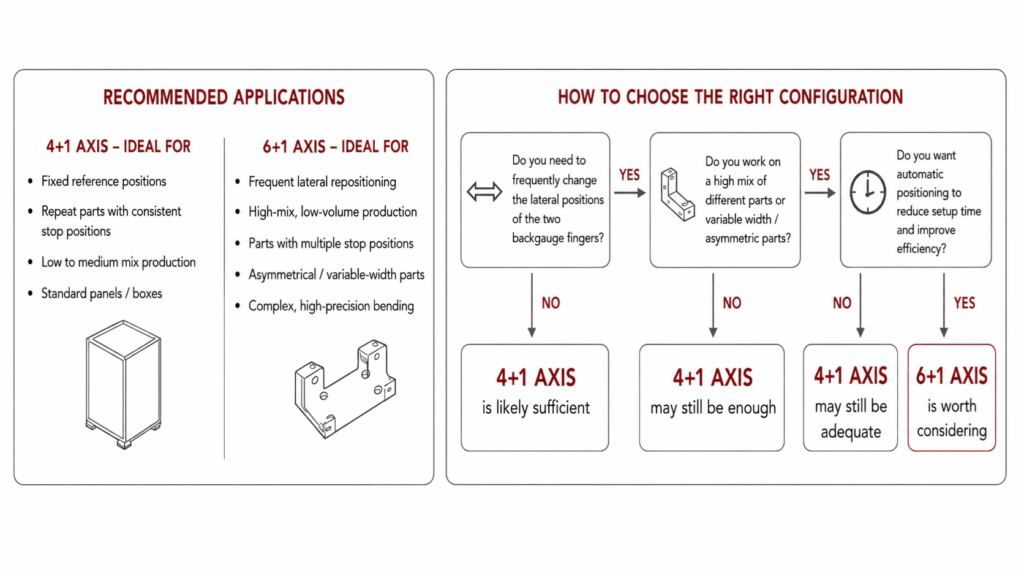
Choose a 4 axis press brake if:
- Your parts are mainly regular panels, boxes, trays or brackets
- Backgauge finger positions rarely need to change laterally
- Production is repetitive
- Part widths are relatively consistent
- You want a practical general-purpose configuration with lower complexity
Choose a 6 axis press brake if:
- You frequently bend different-width parts
- Parts are asymmetrical
- Backgauge reference positions change often
- Operators repeatedly move the two backgauge fingers left and right
- You run high-mix or short-batch production
- Automatic finger positioning can reduce setup time
The key question is not:
“Is a 6 axis press brake more advanced?”
The better question is:
“Will Z1/Z2 actually reduce manual setup in my production?”
4 Axis vs 6 Axis Press Brake at a Glance
| Configuration | 4 Axis / 4+1 | 6 Axis / 6+1 |
|---|---|---|
| Y1 / Y2 | Yes | Yes |
| X | Yes | Yes |
| R | Yes | Yes |
| Z1 / Z2 | No | Yes |
| V Crowning | Yes | Yes |
| Backgauge depth positioning | CNC | CNC |
| Backgauge height positioning | CNC | CNC |
| Lateral finger positioning | Manual | CNC-controlled |
| Best suited for | Standard and repetitive parts | High-mix, asymmetrical and changing-width parts |
| Machine complexity | Lower | Higher |
| Initial cost | Lower | Higher |
| Main advantage | Simplicity and value | Reduced manual finger repositioning |
Both configurations already provide CNC-controlled ram positioning, backgauge depth, backgauge height and crowning.
The practical difference is mainly Z1/Z2.
What Is the Real Difference Between a 4 Axis and 6 Axis Press Brake?
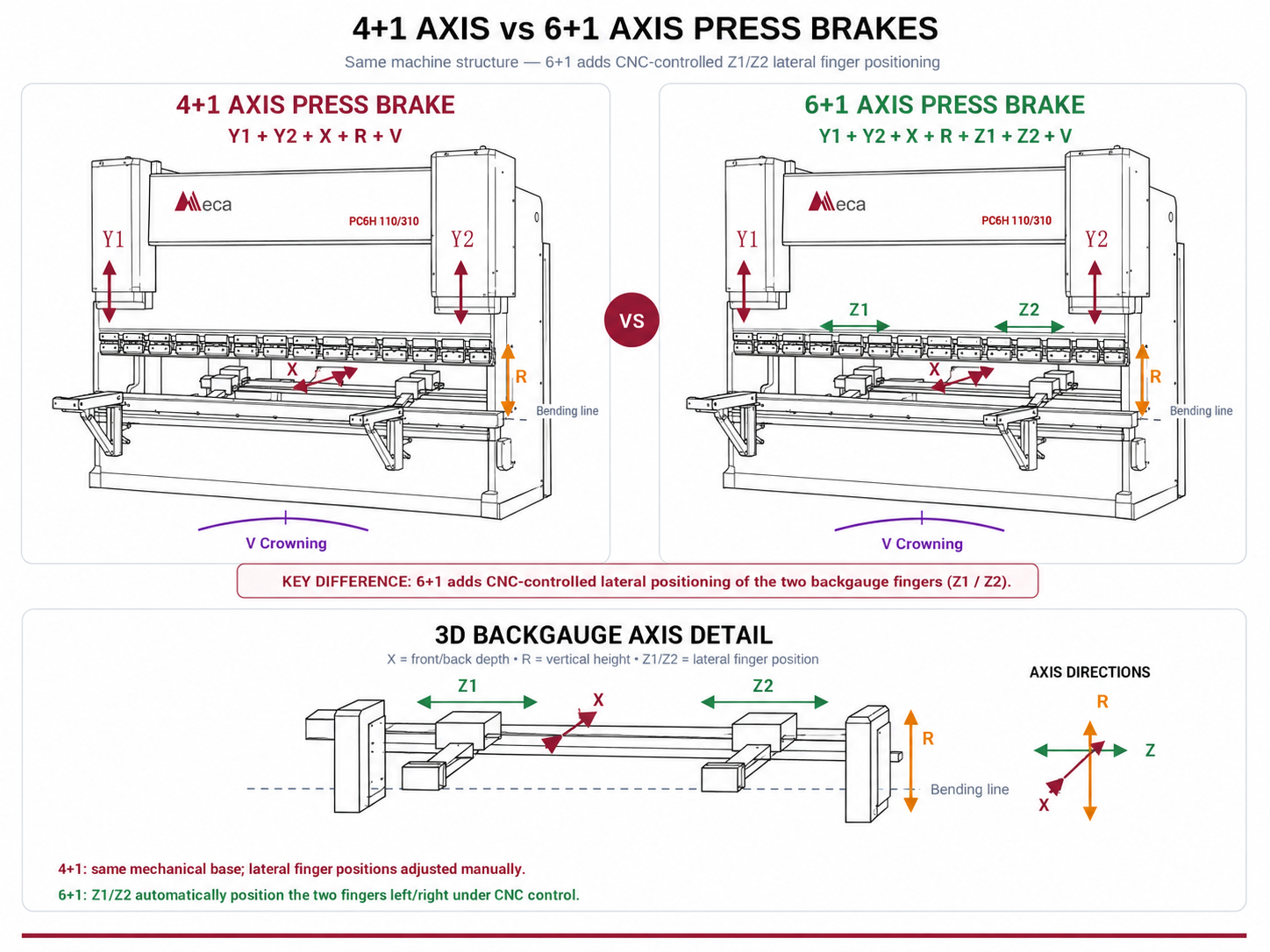
For the configurations discussed in this guide, the difference is straightforward.
4+1 Axis Configuration
Y1 + Y2 + X + R + V
This provides:
- Independent left/right ram control
- CNC backgauge depth positioning
- CNC backgauge height positioning
- CNC crowning compensation
For many general sheet-metal applications, this already provides all of the positioning capability required.
6+1 Axis Configuration
Y1 + Y2 + X + R + Z1 + Z2 + V
The 6+1 configuration adds:
Z1 + Z2 — automatic lateral positioning of the two backgauge fingers
This means the CNC program can automatically change the left/right positions of both fingers instead of requiring the operator to reposition them manually.
That is the real reason to upgrade from 4 axis to 6 axis.
If you are not familiar with Y1/Y2, X, R, Z1/Z2 and V, see our CNC Press Brake Axes Explained guide for a complete explanation of press brake axis functions.
When Is a 4 Axis Press Brake Enough?
A 4 axis press brake is suitable for a large proportion of standard sheet-metal fabrication.
Typical applications include:
- Electrical cabinet panels
- Enclosures
- Boxes
- Trays
- Standard brackets
- Rectangular parts
- Repetitive production
- Parts with consistent reference positions
The important factor is not whether the part is technically “simple.”
The more useful question is:
Do the two backgauge fingers need to move laterally very often?
If the answer is no, Z1/Z2 may provide little practical benefit.
For example, a manufacturer may produce several thousand identical electrical cabinet panels every day.
Production volume is high, but once the two backgauge fingers are positioned, their lateral positions may remain unchanged for the entire production run.
In this situation, a 4+1 configuration can already provide:
- Accurate Y1/Y2 ram positioning
- Automatic X-axis depth control
- Automatic R-axis height adjustment
- CNC crowning
- Repeatable production
A 6 axis configuration would not necessarily make the bending operation faster simply because it has two additional axes.
When Is a 6 Axis Press Brake Worth the Upgrade?
A 6 axis press brake becomes more valuable when operators frequently need to move the two backgauge fingers laterally.
Typical applications include:
- High-mix fabrication
- Small-batch production
- Frequent job changeovers
- Different-width workpieces
- Asymmetrical parts
- Changing reference positions
- Custom sheet-metal fabrication
- Jobs where finger spacing changes repeatedly
Suppose a fabrication shop processes 20 different part designs during one shift.
Each job requires a different finger spacing or different lateral reference position.
With a 4+1 machine, the operator may need to manually reposition the backgauge fingers during every changeover.
With a 6+1 machine, those Z1/Z2 positions can be stored in the bending program and automatically recalled.
The benefit is therefore not necessarily:
faster ram movement
but rather:
less manual setup between jobs.
Real Production Examples
Example 1 — Electrical Cabinet Panels
A manufacturer produces large batches of rectangular electrical cabinet panels.
The parts have consistent widths, and the backgauge fingers remain in almost the same lateral positions.
Recommended:
4 Axis / 4+1
Why?
Because Z1/Z2 would rarely be used.
The standard configuration already provides CNC control of bending depth, flange length, backgauge height and crowning.
Example 2 — Custom Sheet-Metal Brackets
A job shop produces many different custom brackets in small quantities.
Widths, shapes and reference positions change continuously.
Operators frequently move the two backgauge fingers laterally between jobs.
Recommended:
6 Axis / 6+1
Why?
Z1/Z2 allow automatic lateral repositioning of the two fingers, reducing repeated manual adjustment.
Example 3 — High-Volume Repetitive Production
A factory bends 3,000 identical components per day.
Once the job is set up, the backgauge finger positions remain unchanged.
Recommended:
4 Axis may still be sufficient
High production volume alone does not justify a 6 axis press brake.
If Z1/Z2 do not move during the production run, the extra axes provide limited productivity benefit.
Example 4 — High-Mix, Low-Volume Fabrication
A fabrication company produces 30–50 different parts every day.
Batch quantities are small, but the width and reference position of almost every part is different.
Recommended:
6 Axis
In this case, reducing setup and changeover time may be more valuable than increasing the speed of any single bending cycle.
Does a 6 Axis Press Brake Bend More Accurately Than a 4 Axis?
Not inherently.
This is one of the most important points when comparing a 4 axis press brake vs 6 axis press brake.
Adding Z1/Z2 does not fundamentally change the Y1/Y2 ram control system.
Bending accuracy depends on the complete machine, including:
- Frame rigidity
- Y1/Y2 synchronization
- Position feedback
- Hydraulic control
- Crowning compensation
- Tooling accuracy
- Material thickness
- Material consistency
- CNC parameters
Z1/Z2 mainly improve backgauge positioning flexibility and automation.
If two otherwise identical machines bend the same conventional part, the 6 axis machine does not automatically produce a more accurate bending angle simply because it has two additional backgauge axes.
Is a 6 Axis Press Brake Faster?
Sometimes — but not necessarily during the bending stroke itself.
For a repetitive job where the backgauge finger positions remain unchanged:
4 axis and 6 axis machines may have very similar production efficiency.
For high-mix production where finger positions constantly change:
6 axis can reduce total production time.
The time saving comes mainly from:
- Faster job changeovers
- Reduced manual finger adjustment
- Automatic recall of finger positions
- Less operator intervention
Therefore, the productivity advantage of Z1/Z2 is mainly associated with setup efficiency, not ram speed.
Does a 6 Axis Press Brake Cost More?
Yes.
On otherwise comparable machines, a 6+1 configuration normally costs more because Z1 and Z2 require:
- Additional servo-controlled movement
- Additional mechanical components
- Additional electrical control
- CNC axis support
- More complex backgauge construction
However, the actual price difference depends on:
- Machine tonnage
- Bending length
- Backgauge design
- CNC controller
- Servo components
- Overall machine configuration
Instead of asking only:
“How much more does a 6 axis press brake cost?”
A better purchasing question is:
“How often will my operators need to move the backgauge fingers manually?”
If the answer is only occasionally, 4 axis may provide better value.
If the answer is many times every shift, Z1/Z2 may justify the additional investment.
Do You Actually Need Z1/Z2?
You can make the decision with three practical questions.
Step 1 — Do the backgauge fingers need frequent lateral repositioning?
No → A 4 axis configuration is probably sufficient.
Yes → Continue to Step 2.
Step 2 — Do you frequently produce different-width or asymmetrical parts?
No → 4 axis may still be sufficient.
Yes → Continue to Step 3.
Step 3 — Would automatic finger positioning reduce setup time?
Yes → Consider a 6 axis configuration.
This decision process is usually more useful than simply selecting the machine with the highest number of axes.
MECA Engineering Recommendation
Do not choose a 6 axis press brake simply because it has more axes.
For most standard sheet-metal parts, a 4+1 axis configuration already provides the CNC positioning required for productive and accurate bending.
MECA normally recommends upgrading to a 6+1 configuration when Z1/Z2 solve a real production requirement.
Typical reasons include:
- Frequent lateral finger adjustment
- Different-width parts
- Asymmetrical workpieces
- Constant product changeovers
- High-mix fabrication
If the lateral positions of the backgauge fingers rarely change, the additional Z1/Z2 axes may provide limited practical benefit.
The best way to choose between a 4 axis and 6 axis press brake is therefore to evaluate:
part geometry + bending sequence + backgauge positioning requirements
rather than simply comparing the number of axes.
Frequently Asked Questions
What is the difference between a 4 axis and 6 axis press brake?
For the MECA configurations discussed in this guide, a 4+1 axis press brake uses Y1, Y2, X and R plus V-axis crowning. A 6+1 configuration adds Z1 and Z2 for automatic lateral positioning of the backgauge fingers.
Is a 6 axis press brake better than a 4 axis press brake?
Not always. A 6 axis machine provides more backgauge automation, but if your finger positions rarely change, a 4 axis configuration may provide the same practical bending capability at lower cost.
Does a 6 axis press brake provide better bending accuracy?
Not inherently. Z1/Z2 mainly automate lateral finger positioning. Bending accuracy depends more directly on the ram control system, frame, feedback system, crowning, tooling and material conditions.
Is a 6 axis press brake faster?
It can be faster in high-mix production because Z1/Z2 reduce manual setup. For repetitive jobs where finger positions remain unchanged, the productivity difference may be small.
What does the “+1” mean in 4+1 and 6+1?
In MECA press brake configurations, the “+1” refers to the CNC-controlled V-axis crowning system.
Can a 4 axis press brake handle asymmetrical parts?
Yes, depending on the geometry and gauging requirements. However, if the backgauge fingers need frequent lateral repositioning, Z1/Z2 on a 6 axis configuration can reduce manual adjustment.
Can I upgrade from 4 axis to 6 axis later?
It may be technically possible on some machine designs, but it is normally not a simple software upgrade.
The backgauge structure, servo motors, electrical wiring and CNC axis support all need to be considered.
If Z1/Z2 are likely to be required, it is generally better to specify them when ordering the machine.
4 Axis or 6 Axis? Start With Your Part Drawing
There is no universal answer to whether a 4 axis or 6 axis press brake is better.
For standard and repetitive sheet-metal production:
4+1 axes often provide the best balance of capability, simplicity and cost.
For high-mix fabrication, changing-width parts, asymmetrical workpieces and jobs requiring frequent lateral finger repositioning:
6+1 axes can reduce manual setup and improve production flexibility.
Not sure which configuration your parts require?
Send MECA your part drawing and bending requirements.
Our engineers can review the bending sequence and backgauge positioning requirements and determine whether Z1/Z2 will provide a practical benefit for your production.