Why We Recommended a 40 Ton Electric Press Brake for 12 Gauge Stainless Steel
Table of Content
When customers ask us to recommend a press brake, we usually ask several questions before suggesting a machine:
What material do you bend? How thick is it? What is the maximum bending length? What types of workpieces do you produce?
Sometimes, customers may wonder why we need so much information before providing a machine recommendation.
The reason is simple: even a small misunderstanding about the workpiece can lead to a completely different press brake selection.
One of our customer inquiries is a good example.
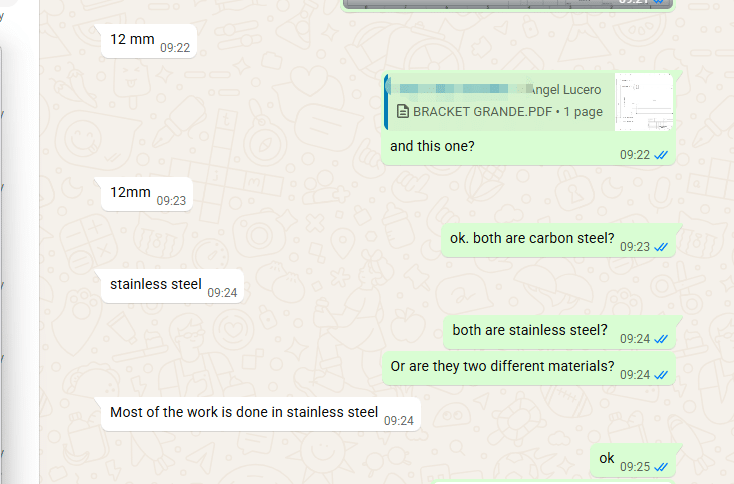
The customer initially told us that they needed to bend 12 mm stainless steel. Based on this information, the application would require a relatively high-tonnage press brake.
However, after reviewing videos of the customer’s actual products, we noticed something unusual. The parts were relatively small stainless steel components and did not appear to be made from 12 mm thick material.
We confirmed the specification again with the customer and discovered the problem:
The material was 12 Gauge stainless steel—approximately 2.7 mm thick—not 12 mm stainless steel.
This single difference completely changed the machine recommendation.
Why Accurate Material Information Matters
Material type and thickness are two of the most important factors when calculating the required press brake tonnage.
Carbon steel, stainless steel and aluminum have different mechanical properties. Even when the material thickness and bending length are the same, the required bending force can be different.
Thickness has an even greater impact.
In this case, the difference between 12 mm stainless steel and 12 Gauge stainless steel was significant.
The customer’s initial information suggested:
Stainless steel: 12 mm
After confirmation, the actual requirement was:
Stainless steel: 12 Gauge ≈ 2.7 mm
If we had recommended a press brake based only on the initial 12 mm information, the machine would have been significantly oversized for the customer’s actual production requirements.
This is why we often ask customers to confirm the actual material thickness in millimeters, especially when Gauge measurements are used.
Bending Length Is Just as Important as Thickness
Knowing the material thickness alone is not enough to determine the required press brake capacity.
We also need to know the actual bending length.
For example, bending a 2.7 mm stainless steel part with a 500 mm bend length requires much less force than bending the same material across a 3000 mm length.
This is why we ask customers for the maximum length of each bend—not simply the overall dimensions of the sheet.
Material, thickness and bending length must be considered together when determining the appropriate press brake tonnage.
Why We Ask to See Your Workpieces
Whenever possible, we also ask customers to provide photos, drawings or videos of the parts they produce.
In this case, seeing the customer’s actual products helped us identify the inconsistency between the stated 12 mm thickness and the workpieces being manufactured.
Workpiece information can also help determine other machine specifications beyond tonnage.
For example, the shape and complexity of the parts may influence whether the customer needs additional backgauge axes, different tooling configurations or a more advanced CNC control system.
This is why understanding the actual workpiece is often more useful than simply asking, “What tonnage press brake do you want?”
Why We Recommended a 40T/1600mm Electric Press Brake
After confirming that the customer was actually processing approximately 2.7 mm stainless steel rather than 12 mm stainless steel, we reassessed the application based on the correct material thickness, bending length and actual workpieces.
Based on these requirements, we recommended a 40T/1600mm electric press brake.
The machine provides sufficient bending capacity for the customer’s actual workpieces while offering the precision and repeatability required for producing small-to-medium stainless steel components.
Compared with selecting a much larger machine based on the incorrect 12 mm thickness, the 40T/1600mm electric press brake was a more appropriate match for the customer’s real production needs.
The goal of machine selection is not to recommend the largest press brake possible. It is to find a machine that matches the workpieces the customer actually produces.

What Information Should You Provide Before Asking for a Press Brake Recommendation?
To help us recommend a suitable press brake, we normally need the following information:
Material
Carbon steel, stainless steel, aluminum or other materials.
Maximum Thickness
Preferably provided in millimeters. If you use Gauge, please also tell us the material type.
Maximum Bending Length
The actual length of the bend that will be formed in one operation.
Workpiece Information
Photos, drawings or videos can help us better understand the shape and complexity of your parts.
Production Requirements
Approximate production volume and the variety of parts you need to manufacture.
With accurate information, we can better evaluate the required tonnage, bending length, machine type, axes and tooling configuration.
The Questions We Ask Are Part of the Machine Selection Process
When a press brake supplier asks several questions before providing a quotation, these questions should not simply be a sales formality.
They are part of selecting the right machine.
In this case, clarifying one detail—12 Gauge instead of 12 mm—changed the entire machine recommendation and ultimately led us to recommend a 40T/1600mm electric press brake that better matched the customer’s actual production.
If you are not sure what size press brake you need, send us your material, thickness, bending length and workpiece information. Our engineering team can help evaluate the requirements and recommend a suitable machine configuration.