Tandem Press Brake Machine | Technical Guide for Long & Heavy Sheet Metal Bending
Table of Content
This post is also available in:
Español (Spanish) العربية (Arabic) Русский (Russian)
Tandem Press Brake Machine | Technical Guide for Long & Heavy Sheet Metal Bending
1. What Is a Tandem Press Brake Machine?
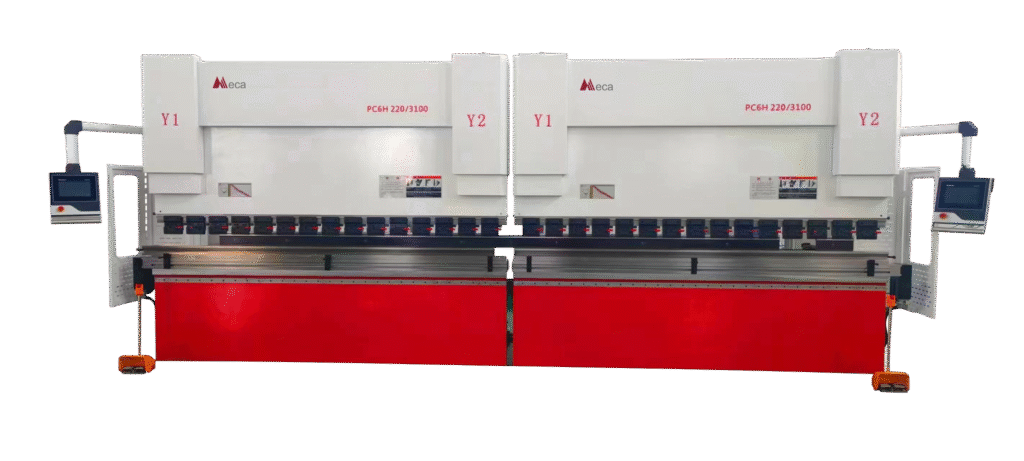
A tandem press brake machine consists of two identical press brakes electronically and hydraulically synchronized to operate as a single bending system.
The machines can function in two modes:
-
Tandem mode: Both machines operate synchronously to bend extra-long or high-tonnage workpieces.
-
Independent mode: Each press brake operates separately for standard production tasks.
This dual capability allows manufacturers to combine extreme capacity with daily production flexibility—a key advantage over single ultra-large machines.
2. Core Technical Architecture
2.1 High-Precision Synchronization Control
At the heart of any tandem press brake machine is a high-precision synchronization system:
-
CNC master–slave control architecture
-
Full closed-loop feedback using linear encoders
-
Real-time position, speed, and acceleration matching
Typical synchronization accuracy reaches ±0.01–0.02 mm, ensuring uniform bend angles across the entire working length—even under full load.
Guaranteed consistency for long parts eliminates rework, scrap, and customer complaints.
2.2 Unified Structural Rigidity and Deflection Control
Unlike simple side-by-side installations, true tandem systems are engineered for structural compatibility:
-
Identical frame design and plate thickness
-
Matched ram and table deflection behavior
-
Integrated mechanical or hydraulic crowning systems
This ensures the tandem press brake behaves as one extended machine, not two independent units.
Superior angle uniformity across 8–12 meters or more, even on thick or high-strength materials.
2.3 Coordinated Hydraulic System Performance
In tandem operation, hydraulic systems must deliver:
-
Stable pressure under asymmetric loads
-
Predictable flow response during bending and holding
-
Thermal stability during continuous high-duty cycles
Well-designed tandem press brake machines maintain pressure balance and minimize pulsation, directly improving bending stability and machine longevity.
Lower maintenance costs, longer seal life, and higher uptime.
2.4 CNC Integration and Operator Usability
Advanced CNC systems allow:
-
Seamless switching between tandem and single-machine modes
-
Unified bending programs for extra-long parts
-
Consistent backgauge positioning across both machines
From the operator’s perspective, the tandem system behaves like a single extended press brake, reducing training time and programming complexity.
Higher productivity without increasing operator skill requirements.
3. Key Performance Advantages
3.1 Breaking Length and Tonnage Limits
A tandem press brake machine enables:
-
One-piece bending of ultra-long workpieces (8 m, 10 m, 12 m+)
-
Combined bending force for thick plate and structural components
Typical applications:
-
Electrical enclosures and cabinets
-
Rail transportation components
-
Wind power and heavy structural parts
3.2 Productivity Gains: True “1 + 1 > 2”
In real production environments:
-
Tandem mode handles large parts
-
Independent mode allows parallel production on two machines
When combined with automation, overall throughput often reaches 2.5–3× that of a single manually operated press brake.
Higher output without doubling labor or floor space.
3.3 Superior Accuracy and Batch Consistency
Compared with segmented bending on a single machine, tandem bending offers:
-
Single-pass forming
-
No cumulative positioning errors
-
Stable angle consistency across the entire length
Critical for customers supplying high-end industries with strict quality standards.
3.4 Exceptional Flexibility and Asset Utilization
Unlike oversized single machines, a tandem press brake machine:
-
Adapts to both large and small jobs
-
Maintains high utilization during normal production
-
Avoids idle capacity during low-demand periods
Better ROI and lower financial risk.
4. Tandem Press Brake Machines in Automated Production
Tandem press brake machines are ideally suited for automation:
-
Robot-assisted loading and unloading
-
Integration with laser cutting and welding lines
-
Compatibility with MES and digital production systems
They function not only as machines, but as core execution units in smart manufacturing environments.
Future-proof investment aligned with Industry 4.0 and lights-out manufacturing.
5. Commercial Considerations and Total Cost of Ownership
While initial investment is higher than a single standard press brake, tandem systems deliver long-term economic benefits:
-
Reduced labor dependence
-
Lower scrap and rework rates
-
Extended machine service life
-
Higher resale value
Over a 5–10 year lifecycle, the total cost of ownership (TCO) is often significantly lower than alternative solutions.
6. Who Should Choose a Tandem Press Brake Machine?
A tandem press brake machine is ideal for manufacturers who:
-
Process extra-long or heavy sheet metal parts
-
Require high repeatability and batch consistency
-
Plan for automation or smart factory upgrades
-
Seek scalable capacity without sacrificing flexibility
Conclusion
A tandem press brake machine is not merely a larger press brake—it is a strategic production system that combines extreme capability, precision, and operational flexibility.
For manufacturers focused on scale, quality, and long-term competitiveness, tandem press brake technology represents a decisive upgrade path in modern sheet metal fabrication.