5 Technical Challenges in Tandem Press Brake Synchronization
Table of Content
This post is also available in:
A tandem press brake can combine two CNC press brakes into one long-part bending system, but making two machines move at the same time is only part of the engineering challenge.
Stable tandem press brake synchronization also depends on hydraulic response, machine alignment, structural behavior, crowning and final commissioning.
A small difference that may be insignificant on an individual press brake can become much more noticeable when one long workpiece spans two machines.
The real objective is therefore not simply to synchronize CNC commands. It is to make two press brakes behave as one coordinated bending system under load.
This article focuses on five technical challenges that directly affect tandem bending performance.
If you are new to tandem systems and want to understand how they work or when to choose one, first read our Tandem Press Brake Technical & Selection Guide.
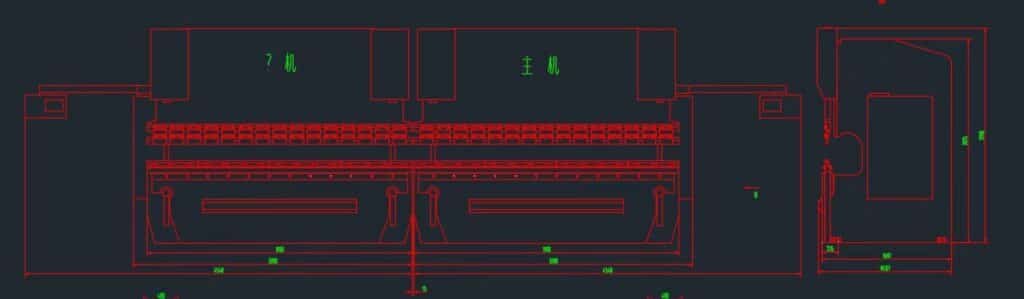
1. Coordinating Ram Movement Across Two Press Brakes
Each CNC hydraulic press brake controls ram position through closed-loop Y-axis feedback.
In a tandem configuration, both machines must remain coordinated throughout the entire bending cycle, including:
- Approach
- Speed transition
- Bending
- Pressure holding
- Decompression
- Return
The challenge is not simply making the two machines start at the same time.
Position, speed and transition points must remain coordinated while the bending load changes.
Position feedback continuously measures ram movement and allows the control system to make corrections during the cycle.
If one machine responds differently from the other, the long workpiece may show:
- Angle variation
- Twisting
- Uneven forming
- Different deformation on each side of the combined bending length
This becomes especially important as workpiece length increases.
A tandem control strategy therefore needs to coordinate the two machines continuously rather than treating them as two independent press brakes receiving the same command.
2. Managing Differences in Hydraulic Response
The two press brakes normally retain their own hydraulic systems.
Even when the CNC system commands coordinated movement, the hydraulic response of each machine may be affected by factors such as:
- Proportional valve response
- Hydraulic pressure
- Oil temperature
- Cylinder condition
- Load distribution
The control system can use position feedback to correct differences, but stable hydraulic behavior is still essential for smooth synchronization.
This is particularly important during speed transitions and bending under uneven load.
For example, if a long workpiece places more resistance on one machine than the other, the hydraulic system and control loop must still maintain coordinated ram movement.
This is why tandem synchronization cannot be evaluated only from the CNC controller specification.
The hydraulic and mechanical systems must also respond predictably under actual bending conditions.
3. Maintaining Mechanical Alignment and Structural Consistency
Even perfect ram-position control does not automatically guarantee identical bending results across two machines.
The reason is simple:
synchronized position does not always mean synchronized deformation.
Each press brake frame, ram and worktable deflect slightly under load.
If the two machines have different structural behavior, the same programmed ram position may still produce different bending results.
Important factors include:
- Frame geometry
- Worktable reference surfaces
- Ram alignment
- Machine stiffness
- Installation level
- Tooling reference height
When one long workpiece spans both machines, these differences become part of the same bend.
This is why accurate structural machining and installation alignment provide the mechanical foundation for tandem synchronization.
Important: CNC synchronization controls machine movement, but long-part bending accuracy also depends on how both machine structures behave under load.
How Manufacturing Capability Supports Structural Consistency
Tandem performance begins before CNC synchronization is activated.
Critical frame, ram and worktable reference surfaces must first be manufactured accurately enough for the two machines to be aligned as one bending system.
For large press brakes, this requires suitable machining capability for heavy welded structures and long reference surfaces.
MECA uses large-frame machining equipment, including gantry machining and floor-type boring capability, to process critical press brake structures before assembly.
These manufacturing processes support:
- Frame geometry
- Worktable accuracy
- Mounting reference accuracy
- Consistency between machines
Accurate machining does not replace synchronization and commissioning, but it creates the mechanical foundation required for them to work correctly.
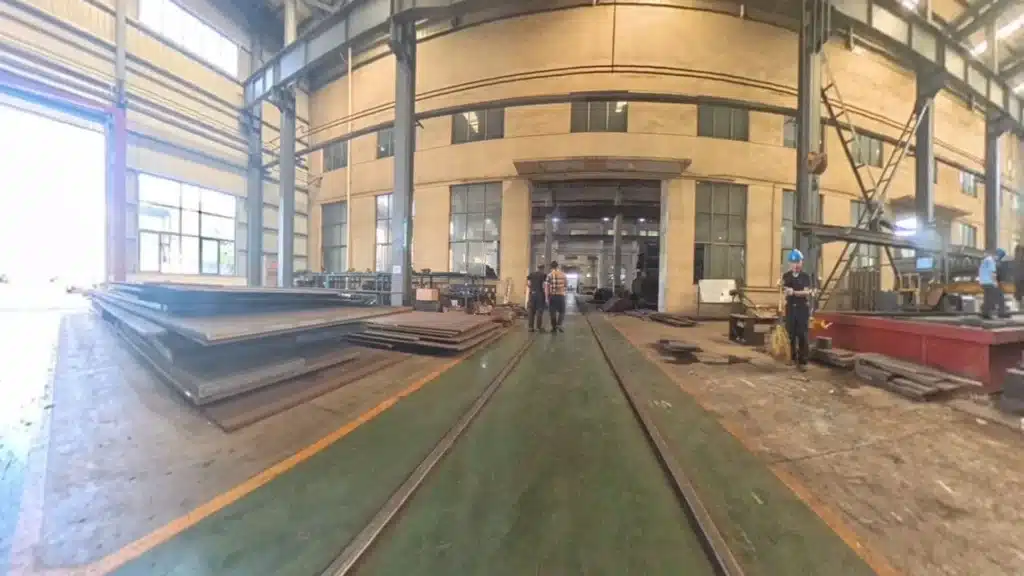
See our press brake manufacturing and machining capability for more information about the production equipment and processes behind MECA press brakes.
4. Coordinating Crowning Across the Combined Bending Length
Every press brake deflects under load.
A crowning system compensates for this deformation so the bending angle remains more consistent along the workpiece.
In a tandem system, the challenge is greater because one long workpiece spans two separate machine structures.
Each machine experiences its own load and structural deformation.
The goal is therefore not necessarily to apply identical crowning values to both machines.
The real objective is to achieve a continuous and consistent bend across the complete workpiece.
Poorly calibrated compensation may result in:
- Correct angle on one machine but not the other
- Angle variation near the transition between machines
- Over-compensation in one section
- Under-compensation in another section
- Poor straightness across the complete bend
Crowning therefore needs to be evaluated as part of the complete tandem system rather than adjusted independently without considering the final workpiece.
Trial bending remains an important part of final calibration.
5. Final Alignment and Tandem Commissioning
A tandem press brake is not finished when two machines leave the factory.
Final installation and commissioning have a major influence on actual long-part bending performance.
Typical commissioning includes:
Mechanical leveling
↓
Machine alignment
↓
Tooling alignment
↓
Synchronization calibration
↓
Crowning adjustment
↓
Dry run
↓
Long-part trial bending
↓
Angle verification
Mechanical Leveling and Alignment
The two machines must share a consistent bending reference.
Installation therefore needs to check:
- Table height
- Machine centerline
- Front-to-back alignment
- Tooling reference height
- Foundation condition
Synchronization Calibration
The control system must then be calibrated so both machines remain coordinated throughout the complete bending cycle.
Trial Bending
The final proof is not a controller screen.
It is the workpiece.
Long-part trial bending is used to verify bending angle, straightness and consistency across the complete combined length.
Adjustments to alignment, crowning or machine parameters may be required before final acceptance.
Real Tandem Press Brake Synchronization
What Should You Verify When Choosing a Tandem Press Brake Supplier?
A useful way to evaluate a tandem press brake supplier is not to ask only about tonnage, controller brand or machine price.
Ask how the complete system is built and commissioned.
1. Has the supplier built real tandem systems before?
Tandem capability should be supported by actual machines, commissioning experience or operating footage.
2. How are the two machines aligned during installation?
Ask how table height, tooling reference and machine centerline are checked.
3. How is synchronization verified under load?
Moving two unloaded machines together is different from coordinating them while bending a long workpiece.
4. How is crowning calibrated across both machines?
The objective should be consistent bending across the complete workpiece rather than simply using the same compensation settings.
5. Who performs final commissioning and trial bending?
A tandem system requires final calibration after installation.
The supplier should have a clear commissioning procedure.
Frequently Asked Questions
How Is Synchronization Maintained Between Two Tandem Press Brakes?
The CNC system coordinates the bending program while closed-loop position feedback monitors ram movement on both machines.
Hydraulic response, machine alignment and commissioning also affect final performance.
Why Does Machine Alignment Affect Tandem Bending Accuracy?
Because one workpiece spans both machines.
Even if ram positions are synchronized, differences in table height, tooling reference or structural deformation can produce different bending results.
Do Both Machines Need the Same Crowning Value?
Not necessarily.
The objective is consistent bending across the complete workpiece. Compensation should be calibrated according to actual machine deformation and bending conditions rather than assuming both machines always require identical values.
What Is the Most Important Test During Tandem Commissioning?
Long-part trial bending.
Final workpiece angle and straightness provide the most practical confirmation that mechanical alignment, synchronization and compensation are working together correctly.
Synchronization Is a Complete-System Engineering Problem
A tandem press brake is more than two CNC machines connected together.
Reliable long-part bending depends on the interaction between:
CNC control + hydraulic response + structural consistency + crowning + installation + commissioning
A problem in any one of these areas can influence the complete bend.
This is why tandem press brake synchronization should be evaluated as a system-level engineering task rather than as one additional CNC function.
For a broader explanation of tandem press brake applications, single-machine vs tandem selection, and a real 6000 mm customer case, read our Tandem Press Brake Technical & Selection Guide.