Press Brake Crowning & Deflection Compensation: Hydraulic vs Mechanical Systems
Table of Content
This post is also available in:
A press brake can be correctly programmed, properly tooled and accurately positioned—and still produce a long bend that is correct at both ends but too open in the center.
In many cases, the problem is not the CNC controller or the operator. It is elastic deflection of the press brake under load.
Press brake crowning is designed to compensate for this predictable deformation and maintain a more consistent punch-to-die relationship across the bending length.
But crowning should not be treated as a universal correction for every angle problem. Material variation, springback, tooling wear, Y1/Y2 synchronization and incorrect bend depth can produce similar symptoms.
This guide explains:
- What press brake crowning actually compensates for
- How to identify a true deflection problem
- The difference between crowning and springback correction
- Hydraulic vs mechanical crowning systems
- When CNC crowning becomes valuable
- How to choose the right compensation system for your production
What Is Press Brake Crowning?
When a press brake applies bending force, the machine structure does not remain perfectly rigid.
Under load:
- the ram can deflect,
- the lower bed can deflect,
- the tooling support system can deform slightly.
The largest difference often appears toward the center of a long bend.
If the punch penetrates the die slightly less in the center than at the ends, the result may look like this:
| Position | Example Bend Angle |
|---|---|
| Left | 90.1° |
| Center | 91.5° |
| Right | 90.2° |
The center of the part is more open even though the two ends are close to the target.
A crowning system introduces an opposite compensation curve so that the effective punch-to-die relationship becomes more uniform across the working length.
The objective is not to eliminate all physical deformation from the machine.
The objective is to compensate for its effect on the finished bend.
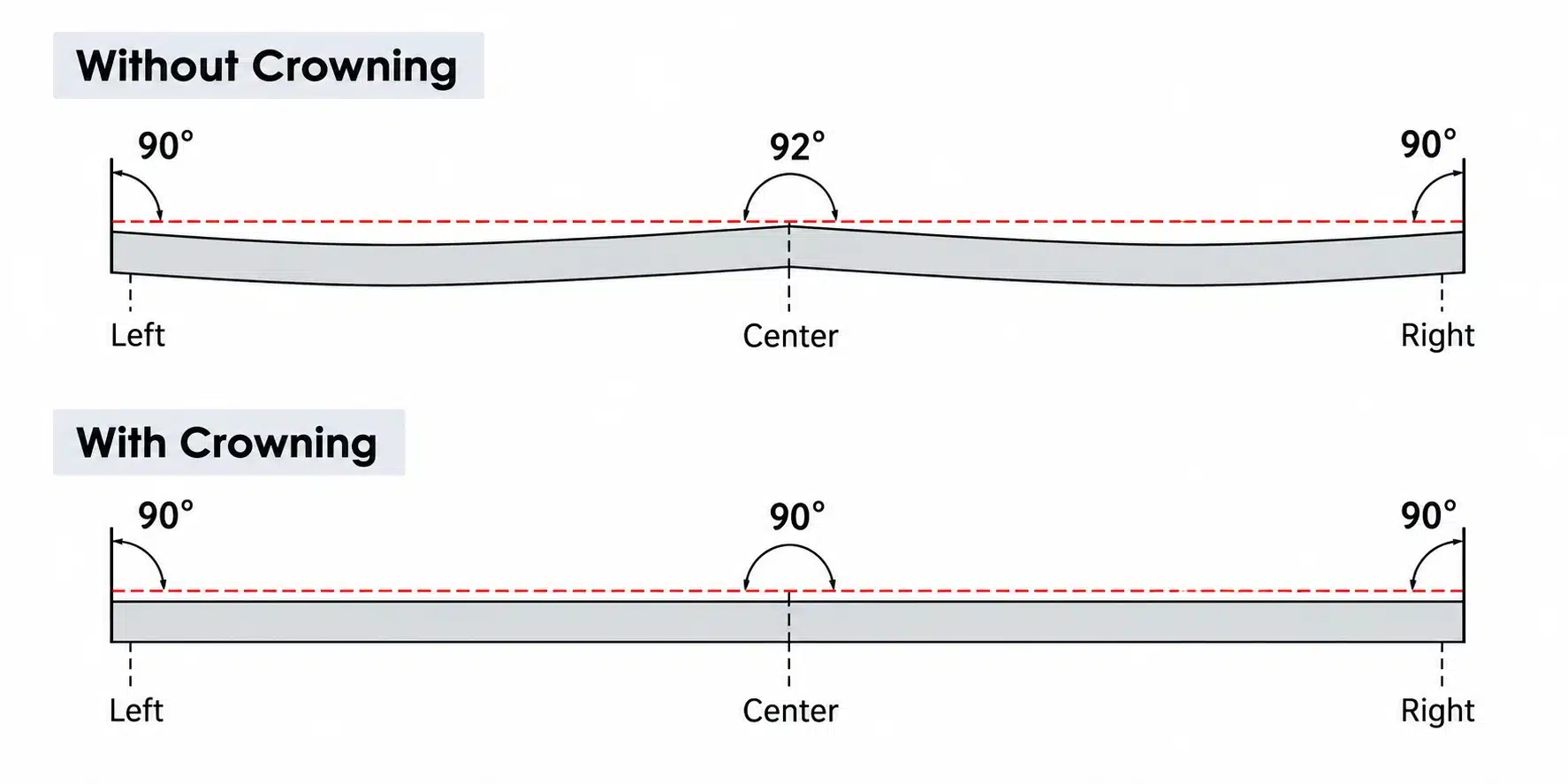
Why Does a Press Brake Deflect?
A press brake frame behaves elastically under bending load.
The amount of deformation depends on several factors:
Bending Force
Higher tonnage generally produces greater structural deformation.
A thick plate requiring high bending force will normally expose deflection more clearly than a thin sheet bent on the same machine.
Bending Length
The longer the loaded section of tooling, the more important lengthwise consistency becomes.
A short part positioned near the center of the machine may show little visible crowning error, while a nearly full-length bend can make the same machine deformation obvious.
Material Strength
High-strength steel and stainless steel usually require more bending force than mild steel of similar dimensions.
Greater required force means machine deflection becomes more important.
V-Die Opening
A narrower V-opening normally requires more tonnage.
Changing the lower die can therefore change the crowning requirement even if material and thickness remain the same.
Bending Method
Air bending usually requires substantially less force than bottoming or coining.
A crowning value that works for one process should not automatically be assumed correct for another.
Before Adjusting Crowning: Confirm That Deflection Is Really the Problem
This is one of the most important steps in press brake troubleshooting.
Not every angle difference should be corrected with crowning.
Use the pattern of the error to decide what to investigate first.
| Bending Result | Possible Cause | Check First |
|---|---|---|
| Center is more open than both ends | Insufficient crowning or structural deflection | Crowning setting and full-length load |
| Center is tighter than both ends | Excessive crowning | Reduce compensation |
| Left and right angles differ | Y1/Y2 synchronization, tooling alignment, asymmetric loading | Ram parallelism and setup |
| One short area differs from the rest | Local tooling wear, dirt or seating error | Punch/die condition |
| Entire bend is uniformly too open | Bend depth or springback | Y-depth / angle correction |
| Results vary from sheet to sheet | Material thickness or tensile-strength variation | Material consistency |
| Error changes after changing V-die | Different bending force | Tonnage and crowning value |
This distinction prevents an operator from using crowning to compensate for a problem that originates somewhere else.
Crowning vs Springback: Do Not Correct the Wrong Problem
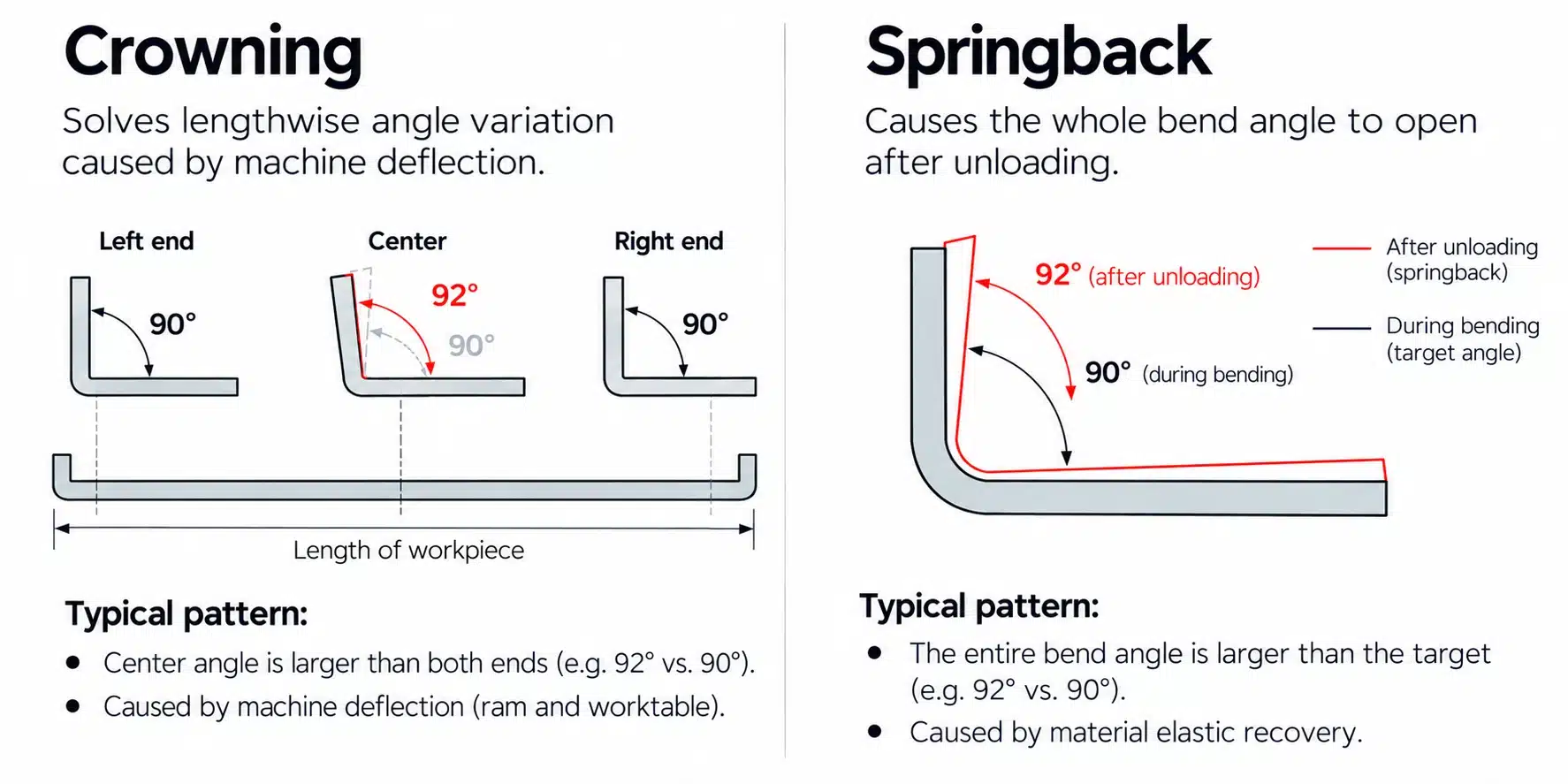
Crowning and springback are related to bending accuracy, but they solve different problems.
Springback
Springback occurs when the material elastically recovers after the bending load is removed.
A typical springback problem affects the overall bend angle.
For example:
Target:
90°
Measured:
92° across most of the entire part.
The usual correction is related to bend depth, angle correction, material parameters or an angle-measurement system.
Deflection
Machine deflection usually creates a lengthwise angle difference.
For example:
Left:
90°
Center:
92°
Right:
90°
This pattern is much more characteristic of a crowning issue.
A useful rule is:
If the whole part is wrong, investigate bend depth and springback first. If the center differs systematically from the ends, investigate deflection and crowning.
Main Types of Press Brake Crowning Systems
Modern press brakes generally use mechanical or hydraulic compensation systems.
The exact design varies by manufacturer, so the control strategy should always be confirmed for the actual machine.
1. Manual Mechanical Crowning
A mechanical crowning system commonly uses opposing wedges distributed along the lower table.
Moving the wedges changes the vertical support profile and creates a controlled counter-curve.
In a manual system, the operator adjusts the mechanism with a handwheel or another mechanical adjustment device.
Advantages
- Simple construction
- No hydraulic compensation circuit
- Stable once correctly adjusted
- Low maintenance requirement
- Suitable for repetitive production
Limitations
- Adjustment takes operator time
- More dependent on operator experience
- Less convenient when material, thickness and bend length change frequently
Best suited for
Production where similar jobs are repeated regularly and the required load profile does not change frequently.
2. CNC Mechanical Crowning
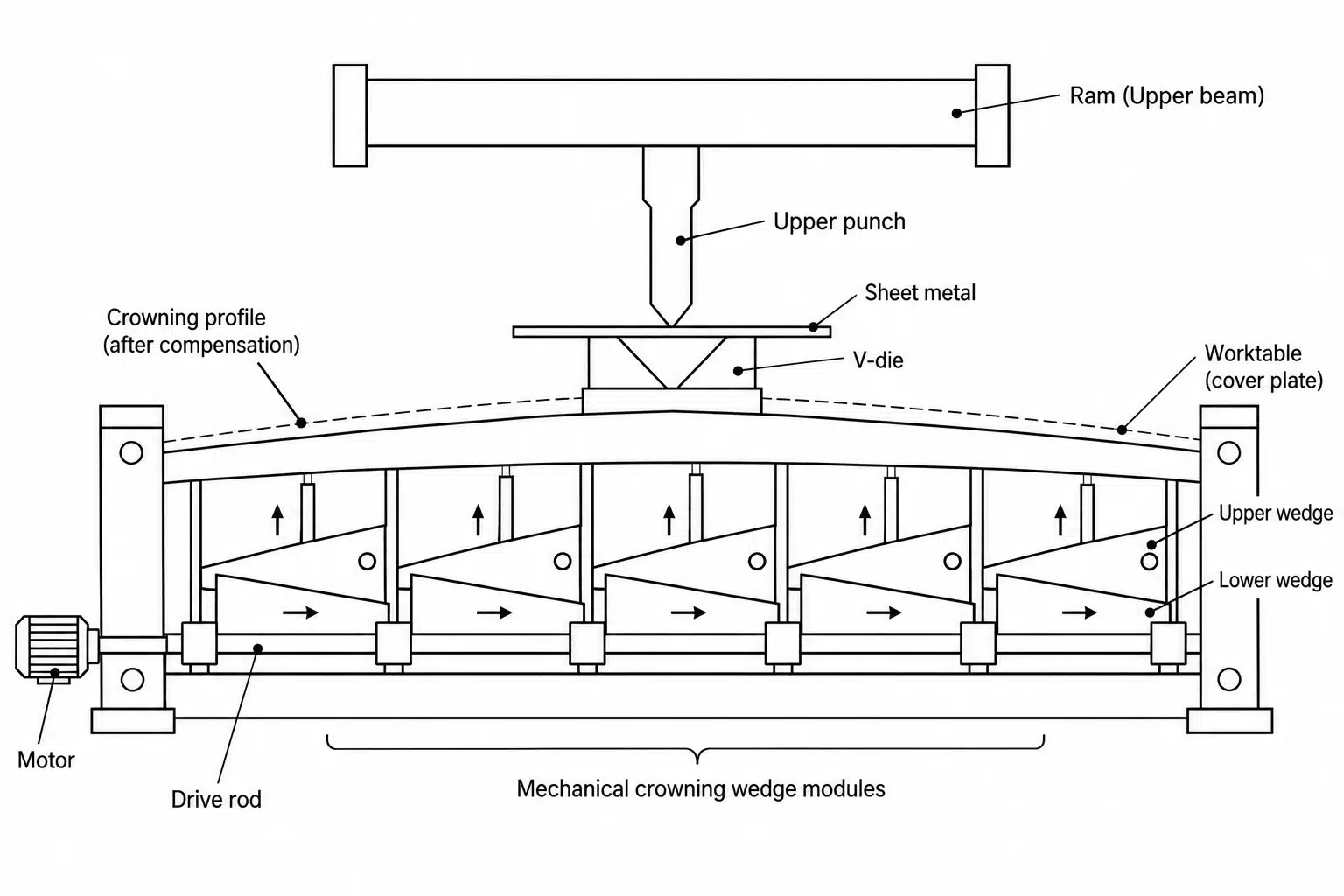
CNC mechanical crowning uses the same basic wedge principle, but the position is controlled by a motor and CNC system.
The controller determines or recalls a compensation position according to programmed machine and bending parameters.
The wedges then generate the required compensation profile.
Advantages
- Faster setup than manual adjustment
- Good repeatability
- Easy integration into CNC programs
- No hydraulic oil in the crowning mechanism
- Well suited to high-mix production
Limitations
- Requires accurate machine calibration
- The calculated value still depends on correct material, tooling and bending parameters
- It does not automatically mean the machine measures the final bend angle
CNC mechanical crowning should therefore be understood as controlled deflection compensation, not as an automatic closed-loop angle measurement system.
3. Hydraulic Crowning
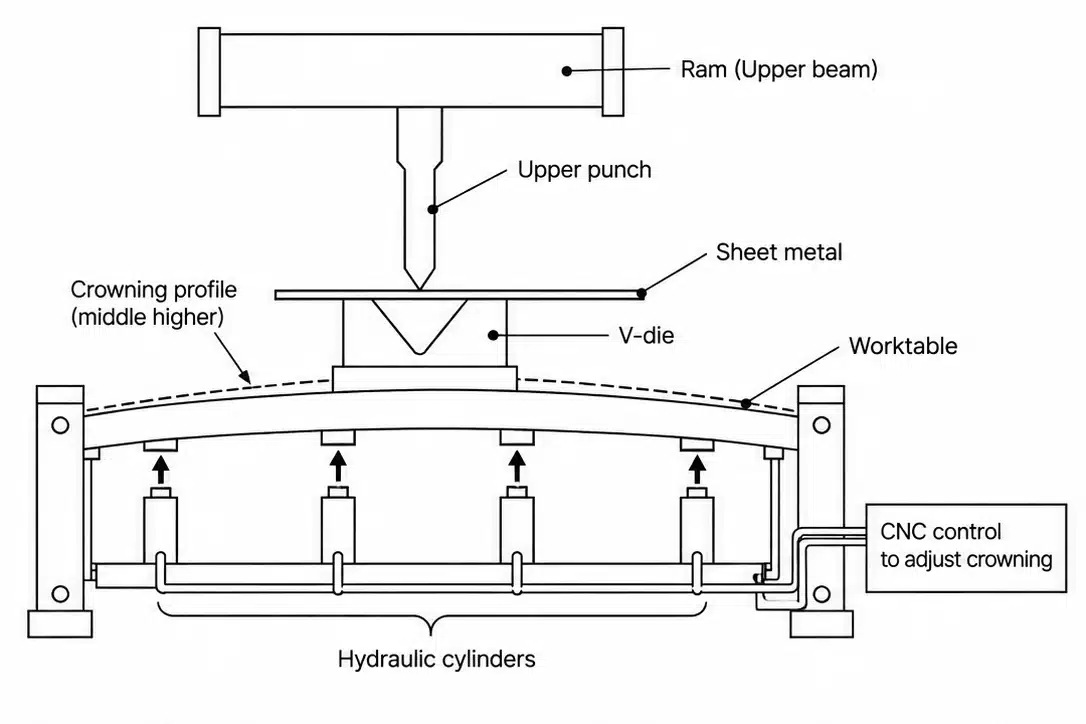
Hydraulic crowning normally uses cylinders integrated into the lower bed to generate the required compensation.
Hydraulic pressure changes the support profile of the table and counteracts the deformation produced by the bending load.
Depending on the machine design, the CNC may calculate or control the compensation according to programmed bending parameters.
Advantages
- Compensation can be adjusted through the machine control
- Suitable for different tonnage requirements
- Common on medium- and heavy-duty hydraulic press brakes
- No manual wedge adjustment during normal operation
Limitations
- More hydraulic components
- Calibration and hydraulic-system condition matter
- Maintenance is more involved than a purely mechanical system
- Retrofit options are normally more limited because the system is integrated into the machine structure
One important technical distinction:
Hydraulic crowning does not automatically mean real-time closed-loop compensation.
Some advanced press brakes use additional sensors and more sophisticated control strategies, but many systems calculate or command compensation according to programmed parameters rather than directly measuring the resulting bend angle.
Hydraulic vs Mechanical Crowning
| Factor | Manual Mechanical | CNC Mechanical | Hydraulic |
|---|---|---|---|
| Adjustment | Manual | CNC-controlled motor | CNC / hydraulic control |
| Setup speed | Slow–Medium | Fast | Fast |
| Repeatability | Operator-dependent | High when calibrated | High when calibrated |
| Hydraulic components | No | No | Yes |
| Operator dependency | Higher | Low | Low |
| Maintenance | Low | Low–Medium | Medium |
| Frequent job changes | Less convenient | Very suitable | Very suitable |
| Retrofit potential | Often possible depending on system | Possible on selected machines | Usually limited |
| Typical application | Repetitive jobs | Precision / high-mix production | Medium–heavy production |
There is no universal winner.
The right system depends on the machine structure, production mix, required accuracy and maintenance strategy.
When Does a Press Brake Need Crowning?
There is no single bending length at which every machine suddenly requires crowning.
Its importance increases when several conditions occur together.
Crowning becomes more valuable when:
- bending length increases,
- required tonnage increases,
- thicker or higher-strength material is processed,
- full-length bends are common,
- tighter angle consistency is required,
- production changes frequently between different jobs.
For many production press brakes in the 2500–3200 mm range and above, crowning becomes increasingly useful when customers require consistent full-length bending.
However, machine stiffness and application matter just as much as nominal working length.
How Much Crowning Should Be Applied?
There is no universal crowning value that works for every press brake.
The required compensation depends on:
- machine frame stiffness,
- ram and table design,
- bending force,
- material,
- thickness,
- bending length,
- V-opening,
- tooling,
- bend position.
This is why CNC machines normally use machine-specific compensation data rather than one generic number.
A good setup procedure is:
- Use the correct material and tooling parameters.
- Perform a controlled test bend.
- Measure the angle at the left, center and right—or at additional positions for long precision parts.
- Confirm that the error pattern is consistent.
- Adjust only the crowning parameter.
- Repeat the bend using the same material and setup.
- Compare the full angle profile again.
Changing Y-depth, crowning and material correction at the same time makes it much harder to identify which adjustment actually improved the result.
Practical Example: Identifying a Crowning Problem
Consider a 3000 mm bend.
Target angle:
90°
First trial:
| Measurement Position | Angle |
|---|---|
| 300 mm from left | 90.2° |
| Center | 91.4° |
| 300 mm from right | 90.1° |
The ends are close to target, but the center is consistently more open.
Before increasing crowning, verify:
- the tooling is properly seated,
- the center tool section is not worn,
- material thickness is consistent,
- Y1/Y2 are synchronized,
- the workpiece is loaded symmetrically.
If these checks are satisfactory and repeated bends show the same center-to-end pattern, insufficient crowning becomes a reasonable diagnosis.
Increase the compensation according to the machine manufacturer’s procedure and repeat the bend.
Do not assume that a specific angle difference always corresponds to a fixed crowning movement—the relationship depends on tooling geometry and machine design.
Common Crowning Mistakes
Increasing Crowning When the Entire Bend Is Wrong
If the whole part measures 92°, increasing crowning may only distort the lengthwise angle profile.
Correct bend depth or springback first.
Using Crowning to Compensate for Worn Tooling
A worn die section can create a local angle difference that looks similar to structural deflection.
Inspect and clean the tooling before changing the machine compensation profile.
Applying the Previous Job’s Setting to a New Job
Changing thickness, material, V-opening or bending length changes the required force.
The previous crowning value may no longer be correct.
Assuming CNC Crowning Requires No Verification
The controller can calculate a highly repeatable setting, but the calculation still relies on correct input data and a properly calibrated machine.
First-piece inspection remains important.
Confusing Crowning With Angle Measurement
Crowning changes machine geometry to compensate for structural deflection.
An angle-measurement system measures the actual workpiece angle and may correct bending depth.
The two technologies solve related—but different—problems.
Which Crowning System Should You Choose?
Choose Manual Mechanical Crowning When:
- production is repetitive,
- jobs change infrequently,
- operators are experienced,
- simple construction is preferred,
- budget is more important than automatic setup.
Choose CNC Mechanical Crowning When:
- material and part types change frequently,
- setup speed matters,
- repeatability is important,
- you want CNC-controlled compensation without a hydraulic crowning circuit.
Choose Hydraulic Crowning When:
- the press brake is designed around an integrated hydraulic compensation table,
- bending loads vary significantly,
- medium- or heavy-duty production is common,
- CNC-controlled adjustment is required.
The machine architecture should be evaluated as a complete system rather than selecting the crowning mechanism in isolation.
Crowning Is Only One Part of Bending Accuracy
A good crowning system cannot compensate for every source of error.
Consistent bending also depends on:
- accurate Y1/Y2 positioning,
- stable tooling,
- correct V-opening,
- material consistency,
- correct tonnage,
- proper machine calibration,
- appropriate springback correction.
The best results come from treating crowning as one part of the complete bending process.
Frequently Asked Questions
What is crowning on a press brake?
Crowning is a compensation method used to counteract elastic deformation of the ram, bed and tooling support during bending. Its purpose is to improve angle consistency along the bend length.
Why is my bend correct at the ends but open in the middle?
If the pattern is repeatable, structural deflection and insufficient crowning are possible causes. Tooling wear, setup and material consistency should be checked before adjusting the crowning system.
Is mechanical or hydraulic crowning more accurate?
Neither type is automatically more accurate in every application. Accuracy depends on machine design, calibration, control method and application. CNC mechanical and hydraulic systems can both provide high repeatability when properly engineered.
Does crowning compensate for springback?
Not directly. Crowning primarily addresses lengthwise variation caused by machine deflection. Springback is a material behavior normally corrected through bend depth, angle correction or angle-measurement systems.
Do short bends need crowning?
Often much less compensation is required because the loaded section is shorter. The actual requirement still depends on bending force, machine stiffness and required tolerance.
Can crowning be added to an existing press brake?
Some mechanical crowning systems can be retrofitted to suitable machines. Integrated hydraulic systems are generally more difficult to retrofit and depend heavily on the original machine design.
Conclusion
Press brake crowning is not simply an optional accuracy feature for long bends. It is a controlled method of compensating for the elastic deformation that naturally occurs when a press brake carries load.
The most important step is not choosing hydraulic or mechanical crowning first.
It is correctly identifying the source of the angle variation.
If the center consistently differs from the ends while tooling, material and ram synchronization are verified, crowning is likely part of the solution.
For repetitive production, manual mechanical systems can remain practical. For frequently changing jobs, CNC mechanical or hydraulic compensation can reduce setup time and improve repeatability.
The right solution should always be selected around the actual press brake structure, bending load and production requirements.