How to Calculate Press Brake Tonnage
Table of Content
1. What Determines Press Brake Tonnage?
- Material strength
- Sheet thickness
- Bending length
- V-die opening
- Bending method
Material strength
Material strength directly affects the required press brake tonnage. Under the same bending conditions, materials with higher tensile strength resist plastic deformation more strongly and therefore require greater bending force. Since most standard tonnage charts are based on mild steel, the result should be adjusted when bending stainless steel, aluminum or high-strength alloys according to their actual tensile strength.
Sheet thickness
Sheet thickness is one of the most important factors affecting press brake tonnage calculations. In general, under the same bending conditions, the thicker the sheet, the greater the force required to deform it, and therefore the higher the required press brake tonnage.
Bending length
Sheet length is another key factor in press brake tonnage calculations. The longer the bending length, the greater the bending force required. When a workpiece has several edges, the tonnage should be calculated based on the longest edge to be bent.
Recommended V-Die Opening
| Sheet thickness | General V-opening reference |
|---|---|
| 0.5–2.6 mm | V ≈ 6 × S |
| 3–8 mm | V ≈ 8 × S |
| 9–10 mm | V ≈ 10 × S |
| Above 12 mm | V ≈ 12 × S |
The final V-opening should also consider the required inside radius, flange length, material properties and available tooling.
Bending method
The bending method refers to how the punch forms the sheet against the lower die. Different bending methods require different levels of force, so they directly affect press brake tonnage calculations.
Air bending is the most common method. The sheet contacts the punch tip and the two shoulders of the V-die without being fully pressed into the bottom of the die. It requires the least bending force and is the basis for most standard press brake tonnage charts and formulas.
Bottom bending presses the sheet more closely against the die angle and therefore requires more force than air bending.
Coining forces the material deeply into the die and causes localized plastic deformation. It requires substantially more tonnage than air bending and is less common in modern general sheet-metal production.
This article mainly focuses on calculating the tonnage required for air bending. If bottom bending or coining is used, the actual force requirement will be higher and should be evaluated separately.
There are two common ways to determine the required bending force: using a press brake tonnage chart or applying the tonnage formula. For a faster estimate, you can also use our Press Brake Tonnage Calculator to calculate the required force based on material, thickness, bending length and V-die opening.
2.How to Calculate Press Brake Tonnage Using a Press Brake Tonnage Chart
The Press Brake Tonnage Chart provides tonnage values based on the tensile strength and a standard sheet length of L = 1 meter. When bending different sheet materials and lengths, you can use the chart and adjust the values according to the material’s properties. To calculate the required tonnage for other materials, simply multiply the value from the chart by the following coefficients:
Tonnage refers to the bending pressure required during the bending process. Available models typically range from 30T to 2200T. So, how do you choose the appropriate press brake based on your daily bending workpiece requirements? The selection of the correct press brake tonnage is influenced by factors such as the length, thickness of the sheet, and the width of the lower die opening.
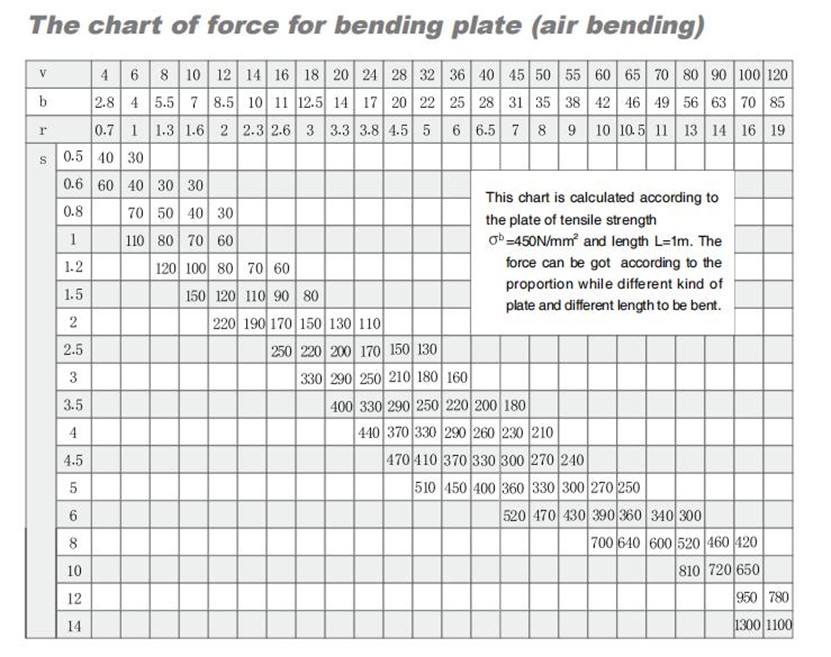
How Material Type Affects Press Brake Tonnage
When bending different sheet materials and lengths, you can use the chart and adjust the values according to the material’s properties. To calculate the required tonnage for other materials, simply multiply the value from the chart by the following coefficients:
| Material | Typical Relative Factor | Important Note |
|---|---|---|
| Mild steel | 1.0 | Reference material |
| Stainless steel | Approx. 1.5 | Depends on grade and tensile strength |
| Soft aluminum | Approx. 0.5 | Alloy and temper matter |
| Chrome-moly steel | Approx. 2.0 | Verify actual tensile strength |
Application:How much tonnage do you need to bending a workpiece with 3mm thickness and 3m length?
If the sheet thickness is S = 3 mm , According to the formula provided earlier in this article, the V-die opening should be V ≈ 8 × S=24mm
Check the Press Brake Tonnage Chart. For S = 3 mm and V = 24 mm, the chart indicates P = 250 kN.
This is the tonnage required for 1 meter length workpiece, know our workpiece is 3 meters,
So, the total tonnage required is:
250 kN×3m=750 kN = 75 Tons
3. How to Calculate Press Brake Tonnage Using a Chart and Formula
In addition to the Press Brake Tonnage Chart, you can calculate tonnage using a more precise formula based on the V-bending method. The force required to bend metal sheets is determined by the sheet thickness, die opening, bending length, and the material’s ultimate tensile strength. The press brake tonnage formula can be used to estimate the required bending force with the following standard die ratios:
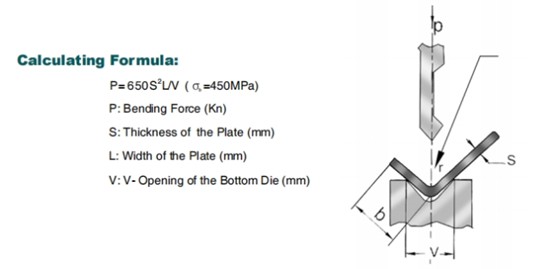
P= 650S2×L/V
Application How much tonnage do you need to bending a stainless steel workpiece with 3mm thickness and 3m length?
When S=3mm,L=3m
P=650×32 ×3/24≈730 KN=73Ton
The result is similar to the value we obtained from the chart.
If the sheet is made of stainless steel, you also need to multiply the result by the material coefficient for stainless steel, which is 1.5:
The total tonnage would be: 75Ton × 1.5 = 112Ton.
Assuming the thickest material is 1/4 inch, a 10-foot free bending requires 165 tons, while bending with a bottom die (corrective bending) requires at least 600 tons. If most parts are 5 feet or shorter, the tonnage is almost halved, greatly reducing procurement costs. The length of the parts is very important for determining the specifications of the new press brake.
4. Practical Press Brake Selection Example
When a press brake is required to handle several different workpieces, the requirements must be evaluated together.
For example, suppose the user needs to bend:
- Workpiece 1: 1 mm thick stainless steel with a bending length of 2,000 mm
- Workpiece 2: 8 mm thick mild steel with a bending length of 1,000 mm
If the user wants to bend both workpieces with the same press brake, what tonnage should the machine have?
Workpiece 1
- Material: Stainless steel
- Sheet thickness: S=1 mm
- Bending length: L=2 m
- V-die opening: V=S×6=6 mm
Using the formula:
First calculate the force based on mild steel:
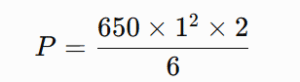
P=216.7 kN
Convert the force into metric tons:
216.7/9.81=22.1 tons
Because the workpiece is stainless steel, apply a material factor of 1.5:
22.1×1.5=33.2 tons
Therefore:
P1≈33 tons
Workpiece 2
- Material: Mild steel
- Sheet thickness: S=8 mm
- Bending length: L=1 mL
- V-die opening: V=S×8=64 mm
Substitute the values into the formula:
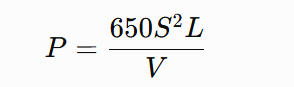
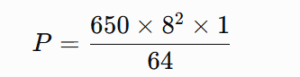
P=650 kN
Convert the force into metric tons:
Therefore:
Compare the Two Requirements
The tonnage values should not be added together. The press brake must meet the highest individual tonnage requirement:
It must also meet the longest bending-length requirement:
After allowing for an appropriate capacity reserve, the recommended machine is: