Why Hydraulic Systems Power Modern Metal Bending
Table of Content
This post is also available in:
Español (Spanish) العربية (Arabic) Русский (Russian)
In the fast-evolving world of metal fabrication, the hydraulic press brake continues to stand as the backbone of precision bending. While electric drive technologies have emerged as a modern alternative, the majority of industrial workshops still rely on hydraulic power for their most demanding tasks.
Here is a technical analysis of why the hydraulic press brake remains the premier choice for modern manufacturers.
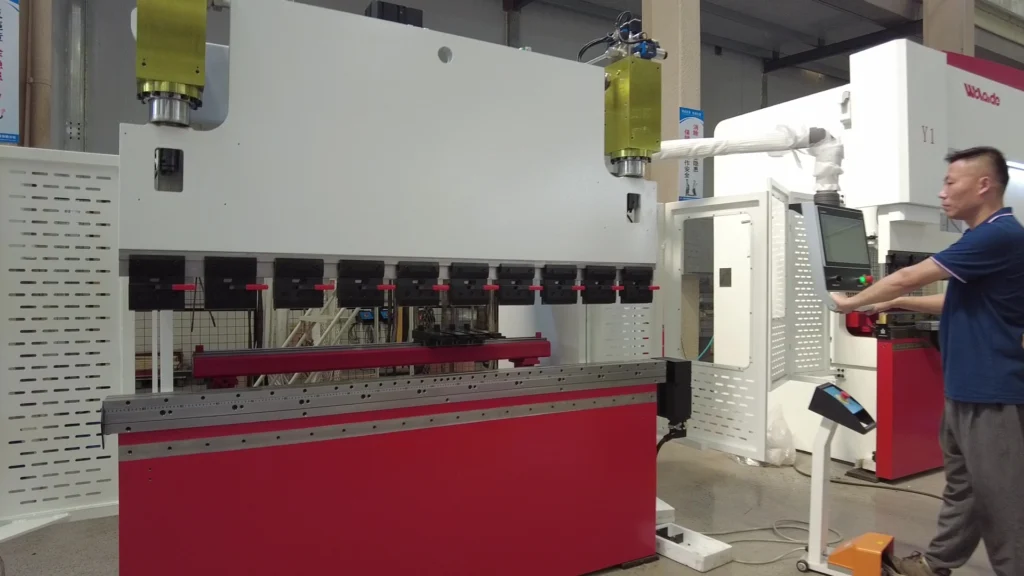
1. Superior Power Density and Constant Pressure
The fundamental requirement of bending is overcoming the yield strength of metal. The hydraulic press brake excels in this area due to its high power density.
-
High Tonnage Capacity: Hydraulic cylinders can generate massive force within a relatively compact footprint, allowing the machine to bend everything from thin gauge sheets to heavy armored plates.
-
Full Pressure Throughout Stroke: Unlike mechanical alternatives, a hydraulic system can deliver its maximum rated tonnage at any point during the stroke, offering unmatched flexibility for complex forming.
2. Micron-Level Precision with CNC Integration
Modern high-performance hydraulic press brake models utilize advanced electro-hydraulic synchronization to ensure absolute consistency.
-
Real-time Feedback: High-resolution linear scales mounted on the machine frames constantly monitor the position of the ram.
-
Proportional Valve Technology: The CNC controller manages servo-proportional valves to regulate oil flow in real-time. This ensures that even under off-center loading, the ram remains perfectly parallel with a repetition accuracy of typically $\pm 0.01\text{mm}$.
3. Adaptability to Diverse Materials
Different metals—such as aluminum, stainless steel, and high-tensile carbon steel—exhibit varying levels of springback.
-
Infinitely Variable Pressure: Operators can precisely calibrate the system pressure via the CNC interface. This versatility allows a single hydraulic press brake to handle a wide range of materials and thicknesses, making it an ideal tool for job shops with diverse project requirements.
4. Natural Overload Protection and Safety
In heavy-duty production, protecting the machine and the tooling is critical for minimizing downtime.
-
Built-in Safety Relief: Hydraulic systems feature inherent protection against overload. If the required force exceeds the machine’s capacity, the safety valves bypass the oil back to the tank. This prevents catastrophic damage to the frame or the expensive precision tooling.
5. The Evolution: Servo-Hydraulic Efficiency
To meet the global demand for sustainable manufacturing, the latest hydraulic press brake technology has integrated servo-pump systems:
-
Energy Savings: The servo motor only runs when the ram is in motion, reducing standby energy consumption by 60% to 80%.
-
Reduced Heat and Maintenance: By eliminating constant oil circulation, the system generates significantly less heat, which extends the life of seals and hydraulic components while ensuring stable performance during long production runs.
Conclusion
The hydraulic press brake maintains its market dominance by perfectly balancing raw power with sophisticated control. With the integration of intelligent crowning systems and servo-driven hydraulics, it remains the most reliable and cost-effective solution for high-precision metal forming.
CNC & Hydraulic Press Brake Machines | 30t – 600t Bending Solutions