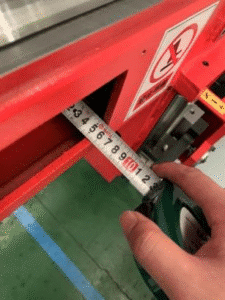
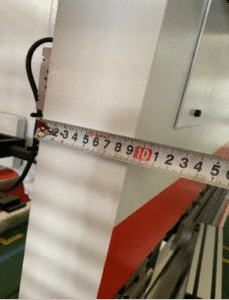
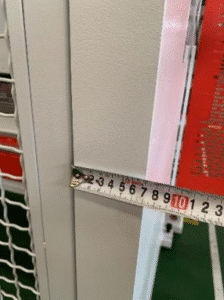
From the perspective of a professional press brake machine manufacturer, frame plate thickness refers to the steel thickness used in a press brake’s critical load-bearing components, including the side frames, uprights, ram (slider), and the vertical plates of the worktable. It defines the machine’s fundamental structural strength—much like bone density in the human body.
As the static support system of a press brake, the frame transfers and withstands the entire bending force, which can range from tens to thousands of tons. For this reason, frame thickness is the single most decisive factor governing long-term accuracy, stability, and service life—an assessment widely shared by experienced press brake machine manufacturers worldwide.
press brake machine frame
1. The Three Life-Critical Functions of Frame Plate Thickness
1.1 Structural Rigidity: the First Line of Defense Against Deformation
Under bending load, every press brake frame experiences elastic deflection. Even a seemingly negligible deformation—such as 0.06 mm—can result in an angular deviation of approximately 0.17°, creating the well-known “canoe effect,” where the bend angle is larger in the center and smaller at both ends.
The relationship between rigidity and plate thickness follows a clear physical principle:
Frame rigidity ∝ Thickness³ / Span²
A 10% increase in plate thickness improves rigidity by roughly 33%
Reducing thickness by half results in an almost 88% loss in rigidity
Frame thickness
Deflection control
Typical applications
Standard (50–60 mm)
< 0.15 mm/m
General fabrication
Reinforced (70–90 mm)
< 0.08 mm/m
High-precision, batch production
Ultra-heavy (100–150 mm)
< 0.05 mm/m
Aerospace, precision engineering
1.2 Accuracy Stability: the Foundation of Consistent Bending Results
Any deformation of the frame is directly transferred to the tooling and workpiece. This leads to angle variation within the same production batch, increased scrap rates, and frequent re-adjustments.
Practical data shows that:
Every additional 10 mm of frame thickness improves angular accuracy by approximately 15%
Long-term accuracy stability improves by about 25%
High-end European-standard machines illustrate this principle well. For example, a 110-ton / 3.2-meter press brake typically follows the “569 configuration” (50 mm side frames, 60 mm ram, 90 mm table plates), ensuring full-length angle deviation of less than 0.3°.
1.3 Fatigue Resistance: the Key to Long Service Life
A press brake operates under cyclic loading—often hundreds or thousands of cycles per day. If frame thickness is insufficient, fatigue cracks will gradually develop at weld seams and stress-concentration zones, ultimately leading to structural failure.
Fatigue life scales approximately with the square of plate thickness:
Fatigue life ∝ Thickness²
Increasing thickness by 20% extends fatigue life by about 44%
Reducing thickness by 15% can shorten machine life by up to 50%
Frame type
Annual maintenance cost
Major overhaul interval
10-year total cost
Economy (30–40 mm)
High (8–12% of machine value)
2–3 years
1.2–1.5×
Standard (50–70 mm)
Medium (4–6%)
5–7 years
0.6–0.8×
Heavy-duty (80–150 mm)
Low (2–3%)
10+ years
0.3–0.4×
2. The Broader Impact of Frame Thickness on Machine Performance
2.1 Protecting the Hydraulic System
Insufficient frame rigidity introduces additional lateral forces on hydraulic cylinders, accelerating seal wear, increasing oil temperature, and reducing overall system stability.
A rigid frame reduces pressure fluctuations by 15–20% and extends the service life of hydraulic components—seal life alone typically increases by 30–50%.
2.2 Extending Tooling Life
Frame deformation causes uneven load distribution on the tooling, leading to premature wear, edge chipping, and reduced accuracy. In precision applications, tooling life can be shortened by 40–60%.
A rigid, thick frame provides a stable platform, extending tooling life by 50–80%, especially for high-precision tooling.
2.3 Built-In Safety Margin Against Overload
During misoperation or unexpected overloads, a thick frame provides an additional 20–30% structural safety margin, preventing permanent deformation or catastrophic failure.
2.4 Defining the Machine’s True Bending Capacity
Frame thickness directly limits the maximum bending force the machine can safely withstand. As a result, it determines the maximum material thickness and strength that can be processed.
Each additional 10 mm of frame thickness increases the allowable material thickness by approximately 12–15% and enables processing of a higher material strength class.
2.5 Ensuring Long-Term Dimensional Stability
After proper stress-relief treatment, thick frames exhibit more uniform internal stress distribution. Over 5–10 years of operation, deformation remains below 0.05 mm/m, ensuring consistent accuracy throughout the machine’s life.
3. Structural Deformation Limits Defined by Press Brake Machine Manufacturers
3.1 Thickness Benchmarks by Machine Tonnage
Tonnage
Side frame (mm)
Ram (mm)
Table (mm)
Typical use
≤63 t
40–50
50–60
60–70
Thin sheet work
63–200 t
50–70
60–80
80–100
General fabrication
200–400 t
80–100
90–120
110–140
Thick plate, high accuracy
≥400 t
100–140
120–170
140–170
Heavy industry, aerospace
Note: Applicable to machines with a working length of 3–6 m. For every additional meter, increase thickness by 5–8 mm.
Never go below industry standards
National and European standards define the minimum safe thickness. Falling below them introduces structural risk.
Do not blindly pursue maximum thickness
Excessive thickness increases cost (each additional 10 mm raises machine cost by 5–8%) and may negatively affect dynamic response.
Do not neglect structural optimization
Intelligent rib design and load-path optimization can maintain the same rigidity with 15–20% less thickness—achieving a balance between strength and efficiency.
3.3 How to Verify Actual Frame Thickness
Review design drawings with clearly marked thicknesses at critical locations
Check material certificates: Q235 structural steel (ASTM A36 / JIS SS400 / EN S235JR / DIN St37-2) is commonly used
On-site measurement using an ultrasonic thickness gauge; deviation should be within ±5%
4. Frame Thickness: the Highest-Return Investment in a Press Brake
Increasing frame thickness by 20% typically raises the purchase price by 12–15%. However, the long-term benefits far outweigh the initial premium:
Maintenance frequency reduced by 50–70%
10-year maintenance costs reduced by 40–60%
Tooling replacement reduced by 30–50%
Production efficiency improved by 10–15%
Resale value increased by 20–30%
Total Cost of Ownership (TCO):
Within 3–5 years, the accumulated savings fully offset the initial price difference. Beyond that point, each additional year of operation delivers net gains equivalent to 5–8% of the machine’s original value.
5. Final Takeaway: Frame Thickness Is the Press Brake’s Lifeline
Frame plate thickness is the primary indicator because it is the only parameter that simultaneously determines rigidity, accuracy, service life, bending capacity, and operational safety—a conclusion consistently reached by experienced press brake machine manufacturers.
Buying advice:
Within budget limits, always prioritize machines whose frame thickness meets or exceeds industry standards—especially at critical load-bearing components such as the side frames, ram, and worktable.
As the industry rule of thumb goes: “Save on thickness today, pay for it over the next ten years.”
Request a Technical Proposal Now!
When evaluating press brake solutions for specific materials, thicknesses, or production requirements, early discussion of machine configuration during the requirement analysis stage is critical.
Contact us to discuss your application with an experienced press brake supplier.