Hydraulic Press Brake Oil Leakage: 6 Common Leak Points, Causes and Fixes
Table of Content
This post is also available in:
Hydraulic press brake oil leakage most often appears around valve connections, hydraulic fittings, cylinder seals, gland assemblies, or the piston rod. The correct repair depends on identifying the exact leak source before replacing parts.
Based on MECA’s hydraulic press brake assembly and troubleshooting experience, leakage is not always caused by a failed seal. Incorrect tightening, damaged sealing surfaces, machining defects, unsuitable seals, installation errors and hydraulic contamination can all produce similar symptoms.
This guide explains six common leak locations and the checks that should be performed before repair.
Safety note: Hydraulic systems may retain pressure after shutdown. Depressurize the machine before disassembly, and never use your hand to locate a pressurized oil leak.
Where Does a Hydraulic Press Brake Commonly Leak Oil?
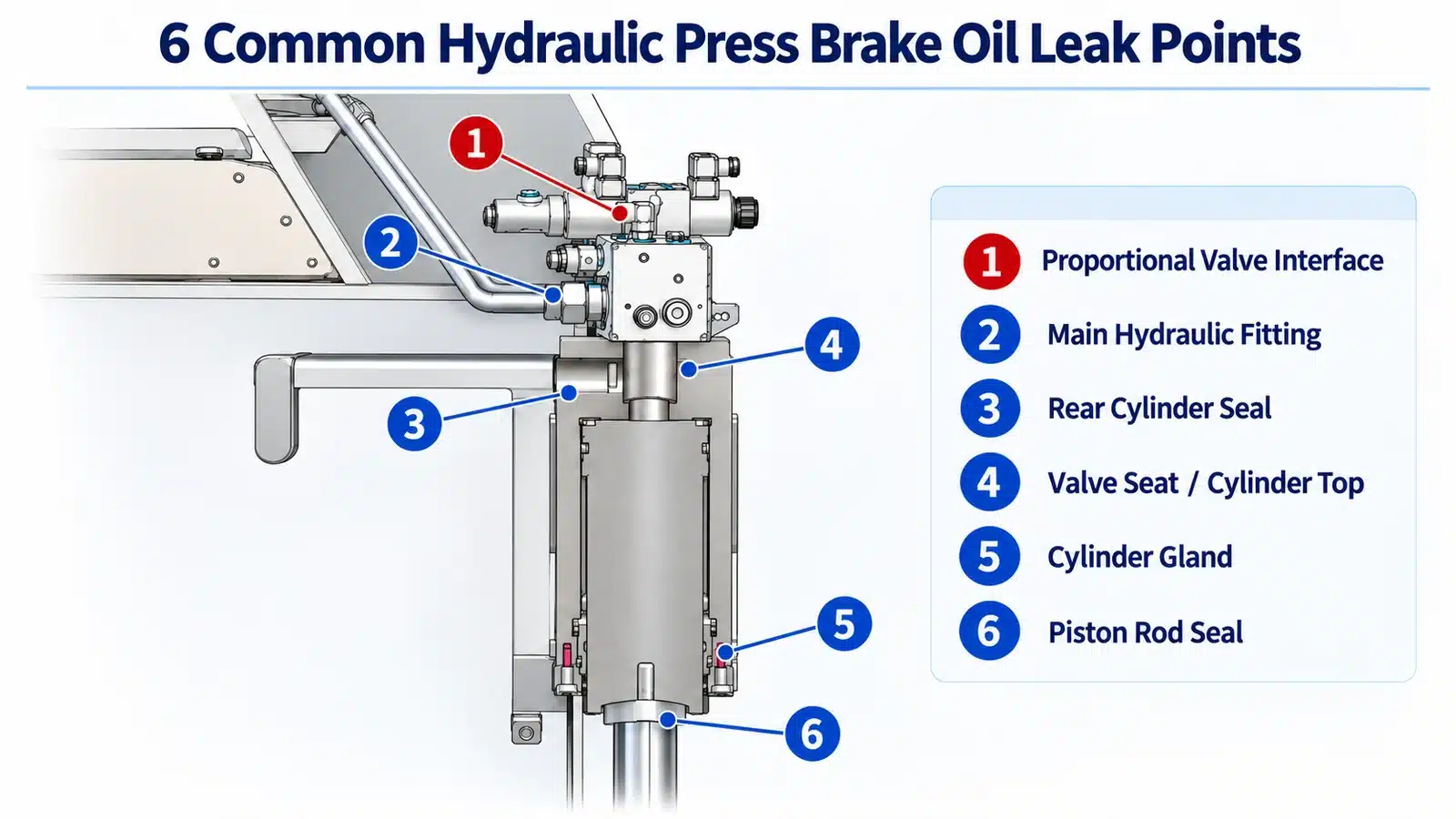
MECA’s technical team normally checks six areas first when tracing hydraulic oil leakage.
| Leak Location | Common Cause | First Check |
|---|---|---|
| Proportional valve / valve block | Damaged or displaced sealing ring | O-ring and sealing groove |
| Main hydraulic fitting | Incorrect tightening or damaged seal | Fitting and seal condition |
| Rear cylinder area | Damaged, missing or displaced seal | Seal installation |
| Valve seat / cylinder top | Seal failure or poor mating surface | Surface condition and O-rings |
| Cylinder gland / cylinder body | Seal, component or assembly issue | Gland fit and sealing surface |
| Piston rod / gland | Rod surface, seal specification or assembly | Rod finish and rod seal |
Image: 6 Common Hydraulic Press Brake Oil Leak Points
The leak location is only the starting point. The next step is to determine why that particular interface has lost its seal.
Why Does Oil Leak Between the Proportional Valve and Valve Block?
Leakage between the proportional valve and hydraulic valve block is usually related to the O-ring or the surfaces that compress it.
The sealing ring may be cut during assembly, flattened after long-term use, displaced from its groove, hardened with age or damaged by contamination. Oil can then escape through the valve interface under pressure.
Before replacing the seal, clean the area and confirm that fresh oil is actually appearing at the valve-to-block connection. After the hydraulic pressure has been safely released, inspect the O-ring, sealing groove and both mating surfaces.
If a new O-ring leaks again, the problem may be a damaged groove or sealing surface rather than the seal itself.
Why Does the Main Hydraulic Line Fitting Leak?
Main hydraulic fittings can leak because of incorrect tightening as well as seal damage.
If the connection is too loose, the sealing surfaces may not receive enough compression. If it is overtightened, the sealing ring or fitting surface may be damaged.
MECA recommends following the specified assembly requirements for the fitting and using a calibrated torque wrench whenever a torque value is provided.
If the fitting still leaks after correct installation, inspect the sealing ring, connection surface, pipe alignment and fitting condition. Applying additional force without identifying the cause can make the problem worse.
Why Does Oil Leak From the Rear Side of the Hydraulic Cylinder?
Oil at the rear of the cylinder usually indicates a problem with the sealing arrangement.
The seal may be damaged, incorrectly installed, missing or displaced by hydraulic pressure. Contamination or an installation edge can also damage the sealing element during assembly.
The timing of the leakage is useful for diagnosis. If leakage appears soon after commissioning, installation should be checked first. If the machine operated normally for a long period before leakage began, seal wear, contamination or damage to the sealing surface becomes more likely.
The cylinder itself does not necessarily need replacement. The seal position and surrounding components should be inspected first.
Why Does Oil Leak Between the Valve Seat and Cylinder Top Surface?
Leakage between the valve seat and cylinder top can be caused by the seal or by the metal surface underneath it.
This is an important distinction because a new O-ring cannot compensate for a poor mating surface.
The inspection should include the cylinder top surface, oil-port sealing ring, filling-valve seal and valve-seat contact surface. Scratches, insufficient flatness or inadequate surface finishing can create a leakage path even when the seal itself is new.
If leakage repeatedly returns at this position, the surface condition should be checked instead of replacing the same seal again.
This is one of the areas where machining quality directly affects long-term hydraulic reliability.
Why Does Oil Seep Between the Cylinder Gland and Cylinder Body?
Leakage between the cylinder gland and cylinder body can originate from the seal, the component itself or the assembly process.
A damaged or incorrectly installed seal is one possibility, but dimensional errors, damaged sealing grooves, poor mating surfaces and incorrect gland installation can produce the same result.
When leakage persists after seal replacement, inspect the gland and cylinder as a complete sealing system. The fit between the parts, the groove condition and the assembly position are just as important as the sealing ring.
This prevents unnecessary replacement of seals when the root cause is actually a component or assembly defect.
Why Does Oil Leak Around the Piston Rod?
Oil around the piston rod does not always mean that the rod seal alone has failed.
The piston rod surface is in continuous contact with the sealing lip. Scratches, machining defects or an unsuitable surface finish can damage the seal or prevent it from maintaining consistent contact.
The seal specification must also match the cylinder design and rod dimensions. A mismatched seal may provide insufficient sealing pressure or wear prematurely.
The timing and appearance of the leak can help narrow the cause. Leakage immediately after assembly often points to installation problems. Repeated leakage after installing a new seal may indicate an incorrect seal specification or a damaged piston rod surface.
Before replacing the seal again, inspect both the rod and the sealing system.
Can Hydraulic Oil Cleanliness Cause Repeated Leakage?
Hydraulic contamination can shorten seal life and create recurring leakage.
Foreign particles may scratch the piston rod, damage O-rings, enter sealing grooves or prevent valve surfaces from closing correctly. In these cases, the visible leak appears at the seal even though contamination is the underlying cause.
Cleanliness should therefore be controlled during system assembly, oil filling, filter replacement, cylinder maintenance and seal replacement.
Installing a new seal into a contaminated hydraulic system may only result in another premature failure.
How Should You Diagnose a Press Brake Oil Leak?
A reliable diagnosis starts by locating the actual source rather than the place where oil eventually collects.
Step 1: Clean the suspected area
Remove old oil from the surrounding components. Hydraulic oil can flow along the machine frame and make the apparent leak location misleading.
Step 2: Find where fresh oil first appears
During a controlled inspection by qualified personnel, identify the highest point where new oil becomes visible.
Step 3: Identify the leaking interface
Determine whether the leak originates from a fitting, valve interface, cylinder seal, gland, piston rod or machined sealing surface.
Step 4: Inspect the seal
Look for cuts, flattening, deformation, twisting, hardening, wear or incorrect installation.
Step 5: Inspect the mating components
If the seal does not explain the problem, check the sealing groove, surface finish, piston rod, valve seat, fittings and cylinder components.
Step 6: Investigate recurring leakage
If leakage returns after repair, check seal specification, machining quality, assembly method and hydraulic cleanliness before replacing the same part again.
This sequence is more effective than replacing components based only on where the oil is visible.
When Should You Stop the Press Brake Immediately?
A hydraulic press brake should be stopped when leakage affects safety or hydraulic stability.
Pressurized oil spraying from a hose or connection, rapid oil loss, sudden pressure loss, abnormal ram movement, damaged hoses or rapidly increasing leakage all require immediate inspection.
Minor seepage should also be investigated rather than ignored, because the visible amount of oil does not always indicate the severity of the underlying problem.
How Can Hydraulic Oil Leakage Be Prevented?
Oil leakage prevention begins during manufacturing and continues through maintenance.
Correct seal selection, clean assembly, properly machined sealing surfaces, controlled fitting installation and suitable hydraulic cleanliness all contribute to long-term reliability.
During maintenance, piston rods and sealing surfaces should be protected from scratches and contamination. If the same location leaks repeatedly, the underlying component or assembly condition should be investigated rather than repeatedly replacing the seal.
Frequently Asked Questions
What is the most common cause of press brake oil leakage?
Damaged or incorrectly installed seals are common, but fittings, sealing surfaces, piston rods and assembly quality should also be checked.
Why does a new press brake leak hydraulic oil?
Early leakage may result from seal installation, fitting assembly, contamination, machining defects or component alignment.
Why does a new hydraulic seal still leak?
The seal may be incorrect, or the sealing groove, mating surface or piston rod may be damaged.
Can overtightening a hydraulic fitting cause leakage?
Yes. Excessive tightening may damage the seal or sealing surface and create leakage.
Can a scratched piston rod cause hydraulic oil leakage?
Yes. Scratches can damage the sealing lip and prevent the rod seal from maintaining reliable contact.
Can dirty hydraulic oil damage seals?
Yes. Contamination can scratch sealing surfaces and accelerate seal wear.
Should I continue operating a press brake with a small oil leak?
The leak should be inspected before continued operation because a small leak can indicate a developing hydraulic problem.
Does every cylinder oil leak require cylinder replacement?
No. Many leaks are caused by seals, fittings, surfaces or assembly problems and can be repaired without replacing the complete cylinder.
Conclusion
Hydraulic press brake oil leakage should be diagnosed from the exact leak location before components are replaced.
If leakage returns after seal replacement, inspect the mating surface, machining quality, seal specification, assembly condition and hydraulic cleanliness. Finding the root cause is more effective than repeatedly replacing the nearest seal.
Technical source: MECA Hydraulic Press Brake Technical Team
This guide was developed from MECA’s hydraulic press brake assembly, inspection and troubleshooting experience. Hydraulic structures vary by machine model, so component specifications and repair procedures should always be confirmed before disassembly.